Most new players can rally happily until a ball clips a white mark, lands near the glass, or drops onto the service box edge. That is when padel court lines start to feel more confusing than they really are. The simple rule is that a ball touching a relevant line is usually in, but which line matters depends on whether you are serving or already in a rally.
Once you separate serve rules from rally rules, close calls become much easier. Padel does not work exactly like tennis, because the glass and mesh are part of the game after the ball has bounced. The markings help organise the serve, while the walls help decide what happens next.
At a glance
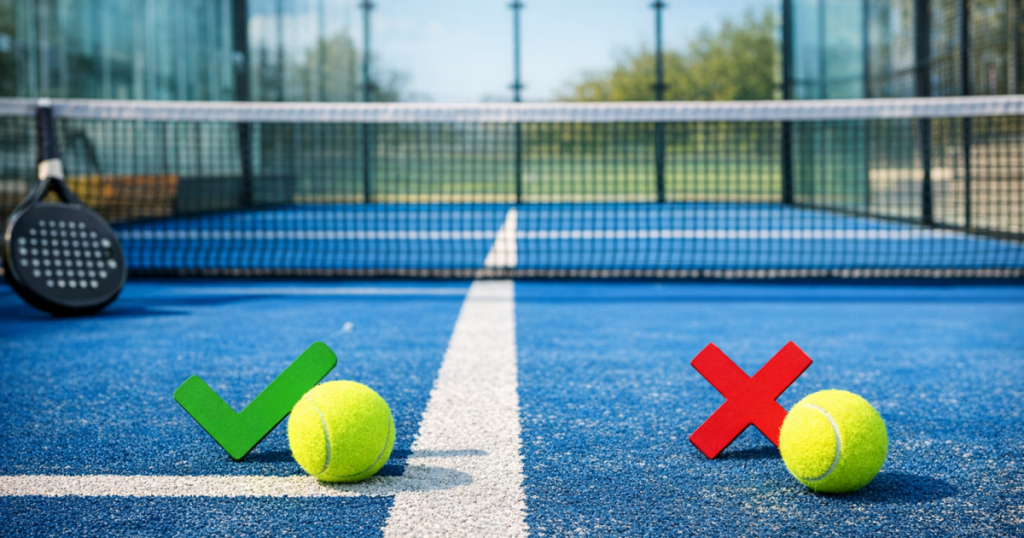
- If the ball touches a line that belongs to the correct area, it counts as in.
- On serve, the ball must land in the diagonal service box, including the lines of that box.
- The server’s feet must stay behind the service line when the ball is struck; standing on the line is not allowed.
- During a rally, the service-box lines no longer matter in the same way. A ball can land anywhere on the opponent’s floor area and remain playable.
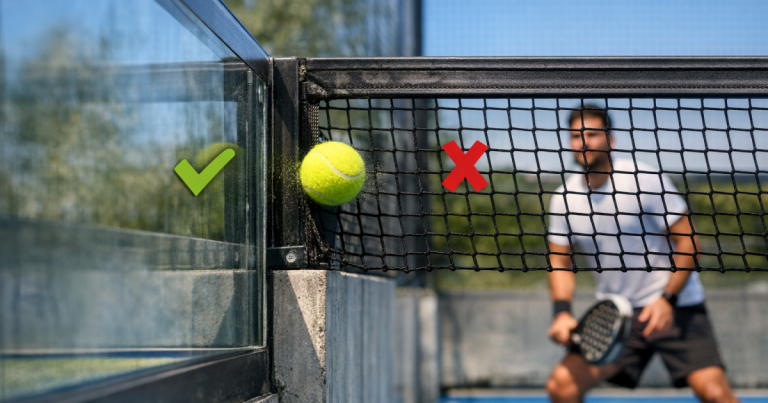
- A ball that hits glass or mesh before bouncing on the opponent’s floor is out.
- A ball that bounces first in court, then hits the glass, can still be in play.
What the markings on a padel court are for
A standard padel court is split by the net, with service boxes marked on each side. The most important markings for beginners are the service line, the centre service line and the edges of the service boxes. These are the lines you will use most often when deciding whether a serve is good.
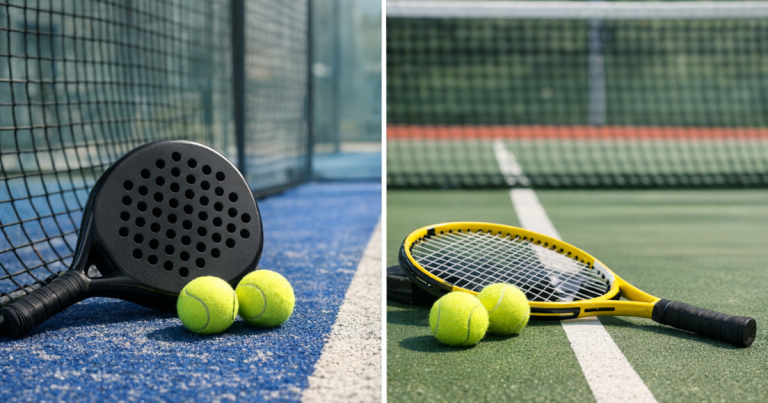
Unlike tennis, there are no tramlines for singles and doubles, and you are not constantly judging a sideline or baseline in the same way. Padel is normally played as doubles, and the enclosed court changes how “in” and “out” works. The glass and fence are not just barriers; they affect the rally once the ball has bounced correctly.
The key idea is simple: lines define areas, and the line belongs to the area it marks. If a serve lands on the correct service-box line, it is in. If it misses the box completely, it is out. If it hits the wrong part of the court, it is a fault even if it lands inside the overall court space.
For the wider match structure, including who serves, when sides change and how points work, the full beginner explanation of padel rules and scoring is a useful companion to this line-by-line guide.
The golden rule: a ball on the line is in
If the ball touches any part of the correct line, it is in. It does not need to land fully inside the line. A tiny clip is enough, even if most of the ball appears to be outside the box from your angle.
This is where many beginner disagreements come from. From across the net, a ball can look wide because you see the bounce from the side. The player nearest the bounce usually has the best view, although even then the glass, spin and court lighting can make it hard to tell. At club level, the fairest approach is to call what you genuinely see and replay only when both pairs agree there is real uncertainty.
That “line is in” rule applies clearly to the service box. If your serve lands on the centre service line in the correct diagonal box, it is in. If it lands on the service line at the back of the correct box, it is also in. If it touches the wrong side of the centre line, it is out because it has landed in the wrong service box.
Serve lines: what counts as a good serve
The serve is where court markings matter most. A legal serve must be hit underarm after bouncing the ball behind the service line, and it must land in the diagonal service box on the receiver’s side.
For example, if you serve from the right-hand side of your court, the ball must land in the receiver’s right-hand service box from their perspective, diagonally opposite you. If it lands in the left-hand box, even by a small margin, it is a fault.
The receiving service box includes its boundary lines. That means these serves are in if everything else about the serve is legal:
- The ball lands on the centre service line of the correct box.
- The ball lands on the service line at the back of the correct box.
- The ball clips the inner edge of the correct service box and then moves towards the glass.
These serves are faults:
- The ball lands in the wrong service box.
- The ball lands short of the net or hits the net and does not cross.
- The ball lands outside the correct service box before reaching the receiver.
- The ball bounces in the correct box but then hits the side mesh or fence before the second bounce.
A serve that hits the net and then lands in the correct box is usually a let if it remains otherwise legal, so the server repeats that serve. If it clips the net, lands in the box, and then hits the side mesh before the second bounce, that is treated as a fault under standard rules.
Where your feet can be when serving
There are two different line questions on serve: where the ball lands and where the server stands. Beginners often focus on the landing point but forget the foot position.
When serving, you stand behind the service line on your own side. Your feet should not touch or cross the service line before you strike the ball. You also serve from the correct side of the centre line, depending on the score and rotation. In ordinary club play, people are rarely overly strict about tiny foot faults, but it is worth building the habit early because it keeps your serve legal and avoids awkward calls later.
A simple way to check yourself is to start with both feet clearly behind the line, drop the ball comfortably, and keep your motion calm. If you are lunging forward or rushing, you are more likely to step onto the line and lose control of the serve.
During rallies, the service lines stop being the main issue
After a legal serve and return, the rally becomes much more open. The ball does not have to land in a service box. It can bounce anywhere on the opponent’s court floor, as long as it lands before touching the glass, fence or any outside area.
This is one of the biggest adjustments for players coming from tennis or squash. The service lines are still painted on the floor, but they do not restrict where your rally shot can land. A drive down the middle, a lob near the back glass, or a slow ball landing around the service line can all be good shots.
The important rally question is not usually “which box did it land in?” but “did it bounce on the court before anything else?” If the answer is yes, the ball is normally in play. If the answer is no because it hit the back glass, side glass or mesh first, the shot is out.
How the glass changes in and out calls
The glass is what makes padel feel different. A ball can bounce on the court, hit the glass, and still be playable. That is not out. In fact, learning to use the glass is one of the main steps towards feeling comfortable in regular club games.
Here are common examples:
- Your opponent hits a lob that lands near your back glass, then rebounds off the glass. That is in, and you can play it after the rebound if you reach it in time.
- Your opponent hits a shot that smashes directly into your back glass without bouncing on your court first. That is out.
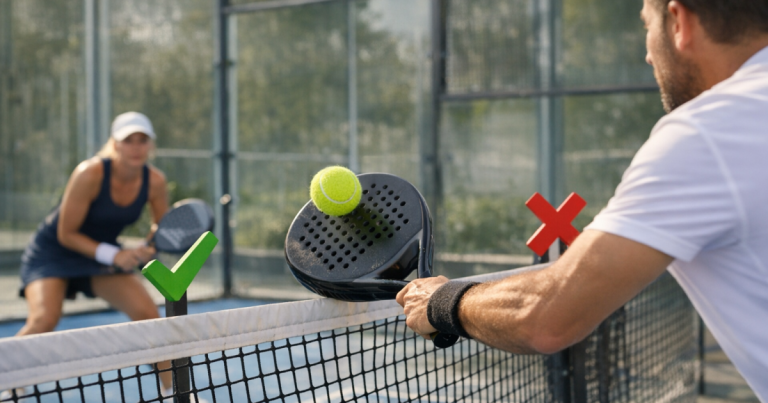
- You hit the ball into your own back glass and it then crosses the net. That can be legal, as long as it goes over and then lands properly on the opponent’s side.
- A ball lands inside the court, then touches the side glass. It remains in play unless it has already bounced twice or another rule stops the point.
For a first session, this can feel strange because the ball may still be live even after it has gone past you. If you want the broader beginner experience before stepping on court, what to expect at your first padel session covers the pace, format and common first-game moments.
What happens near the side mesh or fence
The side mesh creates some of the hardest calls because the ball can change direction sharply. The rule to remember is the same: floor first, then wall or mesh is normally fine during a rally. Wall or mesh first, before the bounce, is out.
On serve, the mesh is stricter. A served ball that bounces in the correct service box and then hits the side mesh before its second bounce is a fault. This surprises many beginners because the same-looking contact during a rally may be allowed after the ball has bounced in court.
At some clubs, players use the word “fence” for the mesh and “wall” for the glass. That language is not always precise, so when there is a close serve call it helps to be specific: did it hit the glass after the bounce, or did it hit the mesh? That distinction can decide whether the serve is good or a fault.
Close-call examples beginners actually face
The serve lands on the centre line
If it is the centre line of the correct diagonal service box, the serve is in. If the ball is on the wrong side of that centre line, it is a fault. The line itself belongs to both adjacent service boxes for the purpose of judging the boundary, so a touch on the correct line is enough.
The serve lands on the back service line
In. The back service line is part of the service box. A serve landing on that line is legal, provided the server’s action is legal and the ball does not go on to hit the side mesh before the second bounce.
The rally ball lands on a painted service line
In, assuming it lands on the opponent’s court floor before touching anything else. In a rally, those painted lines do not create a forbidden zone. They are just markings left from the serve layout.
The ball hits the glass first
Out. If your shot goes straight into the opponent’s glass without bouncing on their court, you lose the point. The same applies if it hits the mesh first.
The ball bounces, then hits the glass and comes back over the net
This can still be your opponent’s ball to play, depending on the sequence and whether it has bounced twice. Padel points often continue in ways that feel unusual at first, so do not stop just because the ball has touched glass.
Who should make the call?
In friendly club play, the pair closest to the bounce usually makes the call. If the ball lands on your side, you call it. If it lands on your opponent’s side, they call it. That keeps the game moving and avoids turning every close point into a debate.
If you are genuinely unsure, say so quickly. Many groups replay the point when nobody has a clear view, although match formats and organised sessions may expect a firmer call. The most important thing is consistency. Do not call tight balls out when they are against you and generous when they help you.
A good club habit is to give the benefit of the doubt to the shot that landed. If you cannot clearly see space between the ball mark and the line, call it in. This is not just polite; it makes games calmer and helps newer players feel more confident joining in.
Why padel line calls feel harder than they look
Padel balls are moving with spin, the court is enclosed, and many shots are played close to the glass. From the far side, a ball landing near the back service line can look longer than it is. From the net, a low ball near the centre line can be difficult to judge because you see it at a shallow angle.
Lighting can also make a difference indoors, especially on courts with strong reflections from the glass. Outdoor courts add shadows and occasional damp patches. None of that changes the rule, but it explains why two honest players can see the same bounce differently.
The practical answer is to keep your calls simple and immediate. Avoid long explanations mid-rally. A clear “in”, “out”, “fault” or “let” is enough. If you are playing socially and a call matters, pause briefly, agree what everyone saw, and move on.
How line calls affect the score
A line call matters because it decides the point or the serve count. If a first serve is out, the server gets a second serve. If the second serve is out, the receiver’s pair wins the point. If a rally ball is out, the other pair wins the point immediately.
The scoring itself follows the familiar tennis-style sequence of 15, 30, 40 and game, with deuce situations depending on the format used at your club. If the numbers are what trip you up rather than the line calls, the beginner-friendly guide to keeping score in padel explains the flow without overcomplicating it.
Things readers ask
Do padel court lines count as in?
Yes. If the ball touches a relevant line, it counts as in. On serve, that means the correct service-box lines. During rallies, a ball landing on a painted line on the opponent’s floor is in as long as it bounced before hitting glass or mesh.
Is a serve in if it hits the line and then the glass?
Yes, if it lands in the correct service box, including the line, and then hits the glass. If it hits the side mesh before the second bounce, the serve is a fault under standard rules.
Can the server stand on the service line?
No. The server should stand behind the service line and must not touch or cross it before striking the serve. Leave a small gap behind the line to avoid foot faults.
Does the centre line matter after the serve?
Not in the same way. The centre line divides the service boxes for serving. Once the rally is underway, shots can land on either side of it as long as they bounce in the opponent’s court first.
What if both pairs disagree about a close line call?
In social play, the pair closest to the bounce usually makes the call. If nobody is sure, replaying the point is often the fairest option, provided everyone agrees before the next serve.
Final thoughts
Most line decisions in padel come back to two questions: did the ball touch the correct area, and did it bounce on the floor before hitting the glass or mesh? If the answer is yes, the ball is usually in. If the answer is no, it is usually out or a fault.
For beginners, the biggest shortcut is to treat service lines as serve guides, not rally boundaries. Once the point is live, watch for the first bounce. That one detail clears up most confusion and makes club games feel much less stop-start.