Doubles is where padel starts to feel like a proper team game: four players, two service boxes, glass in play, and plenty of quick decisions. Understanding padel doubles rules early makes social matches smoother because everyone knows who serves, who receives, and when the order changes.
The good news is that the structure is simple once you separate three ideas: the serving order, the receiving positions, and the way teams change ends or rotate between games. Most confusion at beginner level comes from mixing these up.
What to know first
- Padel is normally played as doubles, with two players on each side of the net.
- Each team chooses its first server at the start of a set.
- After that, partners alternate service games within that set.
- The receiving pair chooses who returns from each side at the start of the set.
- Receiver positions stay the same during the set, but can usually be changed at the start of a new set.
- Players can move anywhere on their own side once the rally begins.
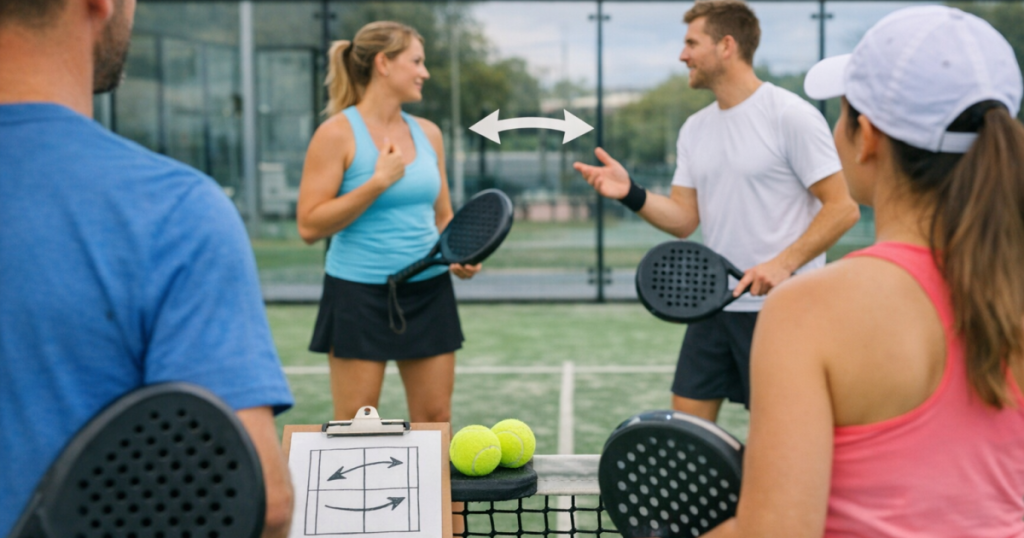
If you are new to social club games, agree the basics before the first point. A quick “who is serving first?” and “which side are you receiving?” avoids most awkward pauses later. It is also worth arriving warm and ready so the first few points are not spent finding your feet; this simple warm-up before a social padel match is a useful routine for beginners.
How serving order works in doubles
At the start of each set, the pair that is due to serve chooses which partner will serve the first service game. That player serves the whole game, changing service side after every point: first from the right-hand side, then from the left-hand side, and so on.
When that team’s next service game comes around, the other partner must serve. The pair then continues alternating service games for the rest of the set. You do not choose a new server every time your team serves during the same set.
Here is a simple example:
- Team A is Alex and Beth.
- Team B is Chris and Dana.
- Game 1: Team A chooses Alex to serve.
- Game 2: Team B chooses Chris to serve.
- Game 3: Team A’s other player, Beth, serves.
- Game 4: Team B’s other player, Dana, serves.
- Game 5: Team A goes back to Alex.
That pattern continues until the set ends. At the start of a new set, each pair can choose again, so Alex and Beth are not locked into the same first server for the whole match.
Serving position and diagonal service box
The server stands behind the service line and serves diagonally into the opposite service box. The first point of a game is served from the right-hand side of the court. The next point is served from the left-hand side, then right again, alternating until the game is finished.
The serve must bounce before it is hit, and it must be struck below waist height. It must land in the diagonal service box. If it clips the net but still lands correctly, it may be replayed depending on what happens next. For the detailed version, including when a net serve is replayed and when it is a fault, read the separate explanation of padel let rules for serves and replay points.
The server’s partner can stand wherever is tactically sensible on their side of the court. At beginner level, that usually means starting near the net but not so close that they cannot react to a return.
Who receives serve in doubles?
The receiving pair decides who will receive from the right side and who will receive from the left side. In many clubs, players call these the deuce side and advantage side, borrowed from tennis language, but “right” and “left” are clearer for beginners.
Only the player on the correct diagonal side should return the serve. For example, if the server serves from their right-hand side, the ball travels diagonally to the receiver’s right-hand service box. The player covering that receiving side returns the serve. Their partner should not step across and take it just because the ball looks comfortable.
Once the receiving order is set for the set, keep it consistent. You can change at the start of the next set, but not casually halfway through a game because one player fancies a different return.
Choosing the right receiving side
There is no one perfect receiving setup for every beginner pair. A right-handed player with a reliable forehand may feel happier on one side; a left-handed player may create a useful combination with a right-handed partner. More important than theory is clarity. Decide before the set starts, then stick with it long enough to build rhythm.
If one player is very new, it can help to put them on the side where they feel calmer returning serve. That might mean avoiding their weaker backhand return or giving the more experienced partner responsibility for trickier points. In a friendly match, it is fine to make practical choices rather than copying advanced pair formations.
What “rotation” means in padel
Rotation can mean two different things, which is why beginners often get confused. In official doubles scoring, rotation mainly refers to the order of servers and the way teams change ends. It does not mean that all four players rotate around the court after every point.
During a rally, both partners may move anywhere on their own side of the net. You can switch from left to right while defending, move forward together, or recover to your preferred side after a lob. The fixed part is the serve and receive structure at the start of each point.
Teams usually change ends after the first game and then after every two games, so the total number of games played is odd. In a tie-break, players normally change ends after every six points. This matters more outdoors, where sun, wind, or court conditions can make one end feel different.
Club rotations are not the same as match rotation
Many UK padel clubs run social formats where players rotate partners or move courts after short timed games. That is an organiser’s format, not a change to the underlying doubles rules. In those sessions, follow the host’s instructions for who moves, who stays, and how scores are recorded.
If you are moving from social mix-ins to proper sets, expect more fixed structure. Your partner stays the same for the set, the service order is maintained, and receiving sides are not shuffled every few points.
What happens in a tie-break?
If the set reaches a tie-break, the serving order continues from the set. The next player due to serve starts the tie-break. After the first point, service passes to the other team, and then players serve in turns, usually for two points at a time, keeping the same overall order.
The receiving positions also continue from the set. Do not use the tie-break as an excuse to swap receiving sides unless the competition format specifically allows it. In friendly play, if nobody is sure, agree a simple approach before the first tie-break point and apply it consistently.
At the start of the next set, the teams can reset their choices. That means a pair can choose a different first server and, if receiving, can also rethink who takes which side.
Common mistakes and how to fix them calmly
Beginner matches are friendly, but rule confusion can still interrupt the flow. The aim is not to win an argument; it is to restore the correct order and keep the match fair.
The wrong player serves
If you notice the wrong player has started serving, pause as soon as it is spotted. In most social settings, completed points are left as they are, and the correct server takes over from the current score. If you are in a league or tournament, follow the organiser’s rules.
The wrong receiver returns
If the wrong receiver takes a serve, stop and correct the receiving positions once the mistake is noticed. If the point has already been played and everyone accepted it at the time, most casual groups leave the point standing and fix the order for the next point.
Players swap sides mid-set
This is common when a pair is trying to solve a tactical problem. In a proper set, receiver sides should remain fixed. You can still move freely during rallies, but the player who receives from each side should not change until the next set.
No one remembers the score
Go back to the last score everyone agrees on. It is better to replay one point than to spend five minutes debating. Calling the score clearly before each serve prevents most of this.
A simple pre-match check for beginners
Before starting a doubles set, take 30 seconds to confirm the setup:
- Which team serves first?
- Which player on that team serves the first game?
- Which player on the receiving team takes the right side?
- Which player takes the left side?
- Are you playing a full set, a short set, or timed social games?
- What tie-break format will you use if the score gets close?
This small habit makes you look more confident even if you are still new to the game. It also helps when playing with people you have not met before, which is common at beginner mix-ins and open club nights.
Why these rules matter in real matches
Good structure makes doubles more enjoyable. When the serving order is clear, players can focus on tactics rather than administration. When receiver choice is settled, both partners know their responsibilities. When rotation is understood, nobody panics when teams change ends or a tie-break starts.
These details also make lessons and coached sessions more useful. A coach can spend more time on serve placement, return quality, positioning, and communication if the pair already understands the match framework. If you are thinking about structured help, this Game4Padel coaching review explains how lessons and venues can fit different beginner needs.
The most useful habit is to separate rules from tactics. The rule tells you who serves or receives. The tactic tells you where to stand, what return to aim for, and how quickly to move forward. Beginners improve faster when both partners know the difference.
FAQ
Can doubles partners change serving order during a set?
No. Once a pair has chosen its first server for the set, the partners alternate service games in that order. They can choose a different order at the start of a new set.
Can the receiving pair swap sides halfway through a set?
Not in a standard set. The receiving pair chooses right and left receiving sides at the start of the set and should keep them until the set is over.
Does the server’s partner have to stand in a fixed place?
No. The server’s partner can stand anywhere on their side of the court, provided they do not interfere with the serve or opponents. Most beginners start near the net.
What should we do if we realise the wrong person has been serving?
Stop when the mistake is noticed, agree the current score, and put the correct server in place. In organised matches, follow the event or league rules.
Are padel doubles rules different in social club sessions?
The core rules are the same, but social formats may rotate partners, courts, or opponents between short games. Follow the organiser’s format while keeping normal serve and receive rules within each game.
Practical takeaway
For a beginner doubles match, remember the simple pattern: choose the first server, alternate partners when your team serves, choose receiving sides at the start of the set, and keep those roles clear until the set ends. Once that structure feels automatic, doubles becomes much less stop-start and much more fun.