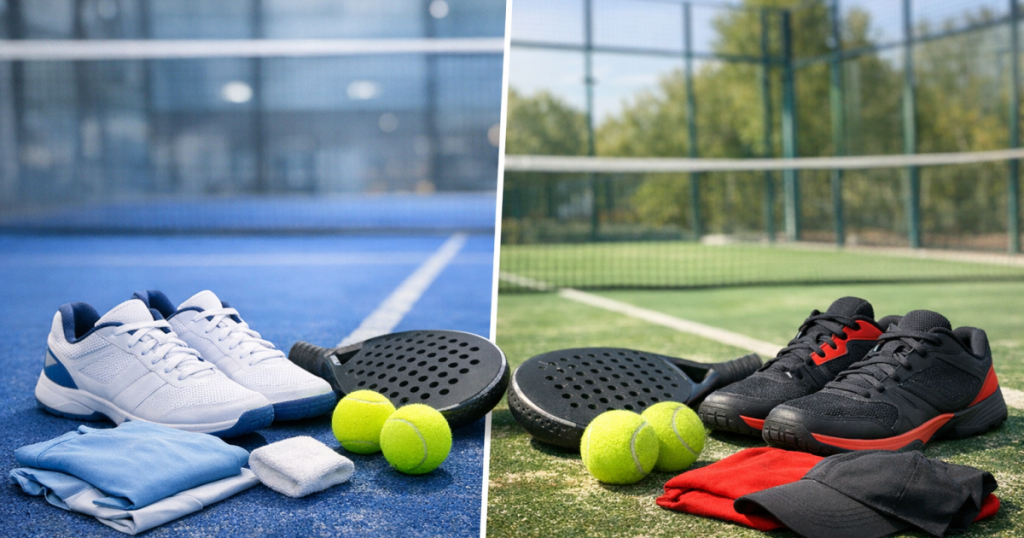
Moving between a covered club court and an exposed outdoor court can make your usual kit feel different very quickly. The real difference in indoor vs outdoor padel gear is not that you need two complete bags; it is that the ball, grip, footwear and clothing have to cope with different conditions.
For most beginners, the sensible approach is to keep your core kit simple and make small adjustments: fresher balls when conditions slow the game down, better grip management when your hand gets damp, suitable shoes for the court surface, and layers that help you warm up without overheating.
What to know first
- Indoor padel usually feels more controlled because wind, rain and strong sun are removed from the equation.
- Outdoor padel can make the same ball, racket and clothing feel different because temperature, moisture and wind affect play.
- You do not need separate rackets for indoor and outdoor play as a beginner, but you should look after your racket more carefully outdoors.
- Balls often feel livelier in warm, dry conditions and heavier or less responsive in colder, damp conditions.
- Shoes matter on both courts, but grip consistency becomes more noticeable when outdoor courts are damp, sandy or exposed.
Why the same kit feels different
Padel gear reacts to the court environment. Indoors, the court is usually more predictable: no wind, no drizzle, less temperature swing during a session, and fewer sudden changes underfoot. That makes it easier to judge lobs, volleys and rebounds off the glass.
Outdoors, small changes can stack up. A damp morning court can make balls feel slower. A breezy evening can turn a comfortable lob into a short ball your opponent attacks. Direct sun can affect visibility and make a black grip feel warmer in your hand. None of this means outdoor padel is worse; it simply asks more from your preparation.
A useful way to think about indoor vs outdoor padel gear is this: indoors rewards consistency, while outdoors rewards adaptability. Beginners often improve fastest when they notice these changes rather than blaming every mishit on technique.
Padel balls: pressure, bounce and weather
Balls are usually the first thing you notice when switching courts. Indoors, a decent set of balls tends to behave more consistently across the session. Outdoors, temperature and moisture can make the game feel slower or quicker without you changing anything about your swing.
On a cold or damp outdoor court, balls can feel less lively and may not come off the glass as cleanly. In warmer, dry conditions, they may feel quicker and more reactive. Wind also affects higher balls, so beginners who rely on lobs indoors may need to aim with more margin outdoors.
You do not need a special beginner-only ball for each setting, but you should pay attention to condition. A fresh tube such as Head Padel Pro or Dunlop Padel Pro can feel very different from a set that has been sitting in a bag for several sessions. If rallies suddenly feel flat and your shots are dying before reaching the back glass, it may be the ball rather than your racket.
For a simple check, bounce one ball from shoulder height onto the court and compare it with a newer one if available. You are not trying to run a laboratory test; you are checking whether the ball still has enough life for a fair, enjoyable game. For more detail, use this guide on how to tell when padel balls are worn out.
Footwear: grip matters more than the label
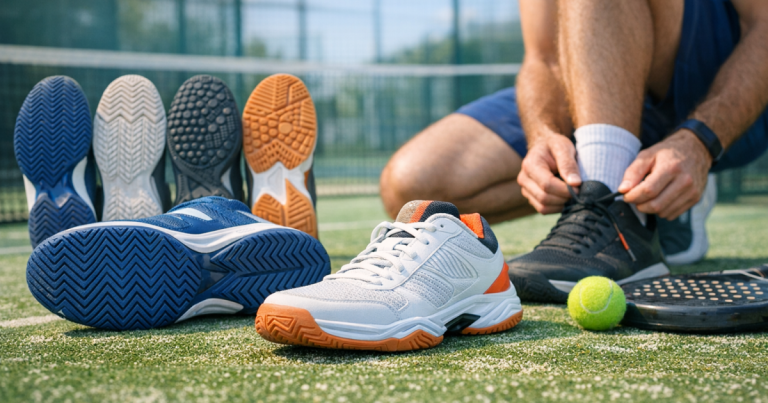
Padel shoes need to help you start, stop, turn and recover without feeling stuck to the court. Indoors, grip can feel more even across the whole playing area. Outdoors, the same sole can feel different depending on the amount of sand on the surface, how recently the court has been brushed, and whether there is moisture on the turf.
Beginners sometimes assume slipping means they need the most aggressive shoe available. Not always. Too much bite can make turning feel awkward, while too little grip can make you hesitant when moving into the corners. The goal is predictable traction: enough hold to push off, enough give to rotate, and enough support that your foot does not slide around inside the shoe.
If you play both indoors and outdoors, check three things before blaming your shoes. First, look at the sole: is the tread clogged with sand or worn smooth in key areas? Second, notice whether slipping happens everywhere or only near the glass, net or entry points. Third, check fit: if your heel lifts or your toes slide forward, the problem may be lockdown rather than sole pattern.
Padel-specific shoes are designed around lateral movement, which is why they are usually a better long-term choice than running trainers. If you want an example of how padel footwear is judged for support and movement, the Wilson Hurakn Pro Padel Shoes review breaks down the kind of checks worth making before committing to a pair. Another real-world example in this category is Asics Gel-Padel Pro 3, but the right choice still depends on your foot shape, court surface and how often you play.
Racket care: one racket is enough, but protect it properly
Most beginners do not need one racket for indoor play and another for outdoor play. A comfortable racket that suits your level matters far more than having a court-specific collection. What does change is how exposed the racket is before, during and after the session.
Indoors, your racket is mostly protected from rain, direct sun and sharp temperature shifts. Outdoors, it may sit beside the court in damp air, bright sun or cold conditions while you warm up, chat or rotate players. That does not mean you need to panic about normal use, but it does mean you should avoid leaving it uncovered for long periods.
Keep the racket in a bag when you are not playing. If the grip gets damp, dry it before packing it away. If the racket has picked up sand or moisture, wipe it down with a clean cloth. Avoid putting a wet towel directly against the racket face or handle. These are small habits, but they help your gear last and feel more consistent.
Shared bags are common for beginners travelling to club nights or casual games. They are convenient, but rackets can get knocked by shoes, bottles and ball tubes. If your kit often travels with other players’ gear, it is worth reading about protecting your racket inside a shared bag.
Grips and overgrips: indoor sweat, outdoor moisture
Grip comfort changes a lot between court types. Indoors, the issue is usually sweat and heat build-up, especially during busy sessions with limited airflow. Outdoors, you may also deal with drizzle in the air, a damp handle after picking up balls, or cold fingers at the start of a match.
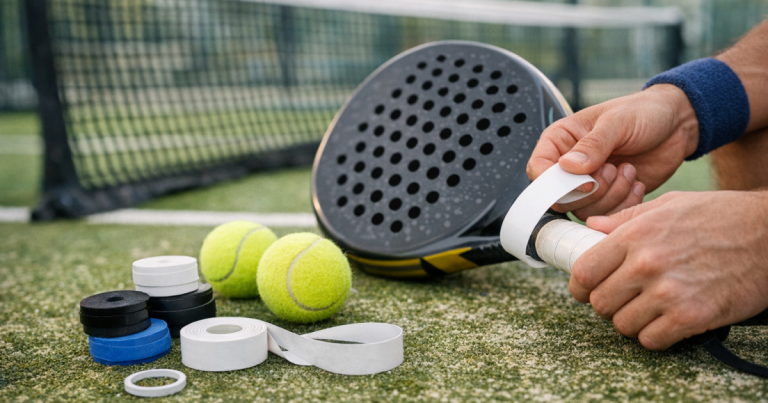
An overgrip is one of the cheapest and most useful adjustments a beginner can make. If your racket twists at contact, your shots can feel inconsistent even when your technique is improving. A fresh overgrip can make the handle feel more secure without changing the racket itself.
For indoor play, focus on a grip that stays comfortable when your hand warms up. For outdoor play, keep a spare overgrip in your bag and change it before it becomes slick. If you regularly play outdoors in changeable weather, a small towel is just as important as the overgrip itself. Dry the handle, dry your hand, then reset before the next game.
Clothing: layers beat bulky kit
Indoor padel clothing can be simple: a breathable top, shorts or leggings, socks that do not bunch, and a light layer for before and after play. Because conditions are more stable, you rarely need to think too hard beyond comfort and movement.
Outdoor clothing needs a bit more planning. In the UK, a session can start chilly and end warm, or begin dry and become damp around the edges. A lightweight hoodie, zip layer or gilet can help during warm-up, but you should be able to remove it quickly once rallies get longer.
Avoid heavy cotton layers for active play if they become uncomfortable when damp. You want clothing that lets you move freely through lunges, turns and overheads. Pockets can also matter more than beginners expect; if you like carrying a spare ball during serve games, make sure your shorts, skirt or leggings hold it securely without distracting you.
For bright outdoor sessions, a cap can help with sun and lobs, but check that it does not interfere with your overhead view. Sunglasses are a personal choice: some players like them outdoors, while others find they affect depth perception near the glass. Test them during a warm-up rather than for the first time in a match.
Bags and small accessories that help outdoors
Your bag setup does not need to be complicated. The main difference is that outdoor play rewards better organisation. Indoors, you can often get away with one main compartment and a bottle pocket. Outdoors, it helps to separate clean clothing, damp items, balls and racket protection.
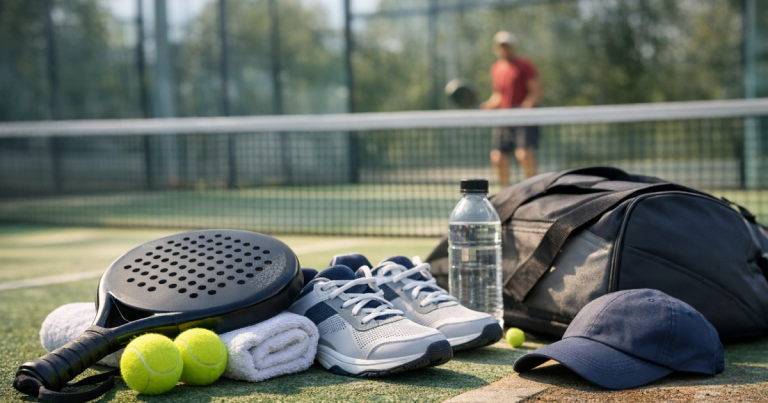
Useful extras include a small towel, spare overgrip, cap, water bottle and a simple plastic bag for damp clothing. None of these are glamorous, but they solve the problems beginners actually meet on court. A compact padel bag or backpack is usually enough if you are playing once or twice a week.
If you play straight after work, pack with the court conditions in mind. For indoor sessions, prioritise shoes, racket, balls and a breathable top. For outdoor sessions, add a light layer, spare grip and something to keep damp kit away from your racket. The goal is not to carry more; it is to avoid the one missing item that makes the session less enjoyable.
Beginner checks before each session
A quick pre-game check can save a lot of frustration. Before indoor play, ask: are my shoes clean, are my balls still lively, and is my grip comfortable? Before outdoor play, add: is the court damp, is it windy, do I need a layer, and do I have somewhere dry to store my racket between games?
During warm-up, use the first few minutes to read the court. Hit a few lobs, volleys and rebounds off the glass. If the ball is holding up in the wind, aim with more margin. If the court feels quick, shorten your backswing and focus on control. If the ball feels heavy, do not overhit; improve your preparation and contact point instead.
After the session, check what changed. Were you slipping at the same corner? Did the balls feel flat from the start? Did your grip become slick halfway through? These notes help you make better gear choices without buying unnecessary replacements.
Helpful questions
Do I need different padel balls for indoor and outdoor courts?
Not necessarily. Beginners can usually use the same type of padel ball, but outdoor conditions make ball condition more noticeable. Replace balls when bounce, sound and feel drop off.
Can I wear running shoes for outdoor padel?
Running shoes are not ideal because they are built mainly for forward movement. Padel shoes give better lateral support and more suitable court grip, especially when stopping and turning.
Should I use a different racket outdoors?
Most beginners do not need a separate outdoor racket. A comfortable racket with good control is enough; the bigger issue is protecting it from damp, knocks and extreme temperature changes.
What should I add to my bag for outdoor padel?
Pack a spare overgrip, small towel, light layer, cap if useful, and a way to separate damp clothing. These small items cover most outdoor problems without overloading your bag.
Why it matters
Indoor and outdoor padel are the same sport, but they do not always feel the same in your hand, under your feet or through the ball. Beginners progress faster when they learn to separate technique issues from condition changes.
You do not need to buy a new setup for every court. Start with sensible basics, keep your gear clean and dry, replace balls when they lose life, and use warm-up to judge the conditions. That approach keeps padel affordable, reduces frustration, and helps you enjoy both indoor club sessions and outdoor games with more confidence.