Padel becomes much easier when you know what the markings mean. The padel court lines are not there just to make the court look tidy; they decide where you stand to serve, where the serve must land, and whether a close ball is in or out. Once those basics click, rallies feel less confusing and you spend less time asking, “Was that good?”
The good news is that a padel court has fewer painted lines than a tennis court. The walls and fences do some of the boundary work, and most of the floor markings matter most during the serve. That makes the layout quite beginner-friendly once you know what each part is for.
At a glance
- A standard padel court is 20 metres long and 10 metres wide.
- The net splits the court into two equal halves.
- The main floor markings are the service lines and centre service lines.
- Lines are part of the court, so a ball that lands on a relevant line is normally in.
- During a rally, the ball must hit the opponent’s floor before it hits their glass or fence.
- The walls are playable after the ball has bounced on the court floor.
The basic court layout
A padel court is a rectangle enclosed by glass walls and metal fencing. The playing area is 20 metres from back wall to back wall and 10 metres from side to side. The net runs across the middle, creating two halves that are each 10 metres by 10 metres.
Unlike tennis, there is no full baseline painted across the back of the court and no traditional singles or doubles sidelines. The back and side boundaries are created by the walls and fences. This is one reason beginners sometimes feel unsure at first: the court looks partly like a tennis court, but the boundaries behave more like a mix of tennis and squash.
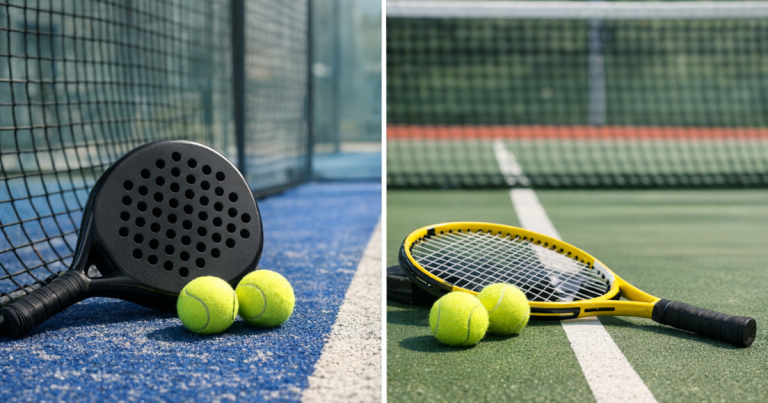
If that comparison helps you, it is worth reading this beginner breakdown of how padel differs from tennis and squash. The wall element is what changes the way lines and boundaries feel during a rally.
The service line: the marking beginners use most
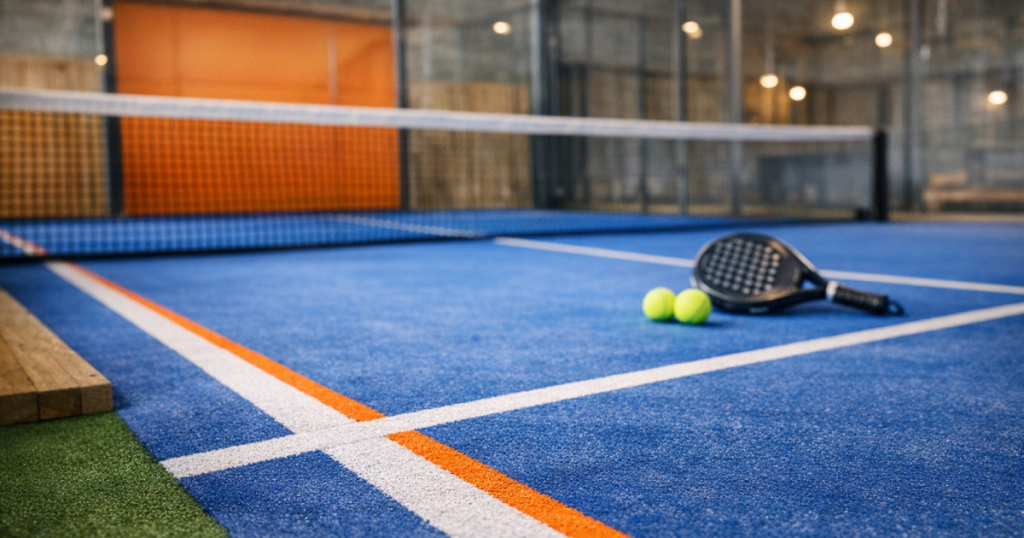
The service line is the horizontal line on each side of the net. It runs across the court, parallel to the net, and sits 6.95 metres from it. That leaves a smaller area between the service line and the back wall.
This line matters in two ways. First, the server stands behind it when serving. Second, the receiver’s service box is defined by it. A legal serve must land in the correct diagonal service box, which is the area beyond the opponent’s service line and inside the correct half of the court.
A common beginner mistake is to think the serve should land in the large area close to the net, as it does in tennis. In padel, it is the opposite: the serve has to travel diagonally and land in the receiver’s back service area.
What counts as behind the service line?
When serving, both feet must be behind the service line at the moment you hit the ball. You also serve from either the right or left side, depending on the score. You cannot step over or onto the service line before contact.
The ball is bounced before you hit it, and that bounce should also happen behind the service line. This is why the service line is one of the first markings you should identify when you walk onto a new court.
The centre service line
The centre service line runs from the back part of the court towards the service line and splits the left and right service boxes. It helps show which side you serve from and which diagonal box you are aiming for.
On your side, the centre service line separates the right service position from the left service position. On the receiver’s side, it separates the two target boxes. If you are serving from the right-hand side, you aim diagonally into the opponent’s right-hand service box from your perspective. If you are serving from the left-hand side, you aim into the opposite diagonal box.
It can feel strange at first because you are not simply serving “straight ahead”. The easiest habit is to pause before each serve and ask: which side am I standing on, and which box is diagonally opposite?
Are the lines in or out?
In general, the lines are in. If the ball touches the correct line on its first bounce, it is treated as landing in the court or service box.
For example, if your serve lands on the opponent’s service line in the correct diagonal box, that is normally a good serve. If it lands on the centre service line that forms part of the target box, that is also in. The same idea applies during open play: a ball that clips a valid court marking on the floor is good.
The practical challenge is not the rule itself, but judging close bounces at speed. In social padel, it is normal to give your opponents the benefit of the doubt on close calls, especially if they had the better view. Clear, calm calls keep beginner games much more enjoyable.
How boundaries work during a rally
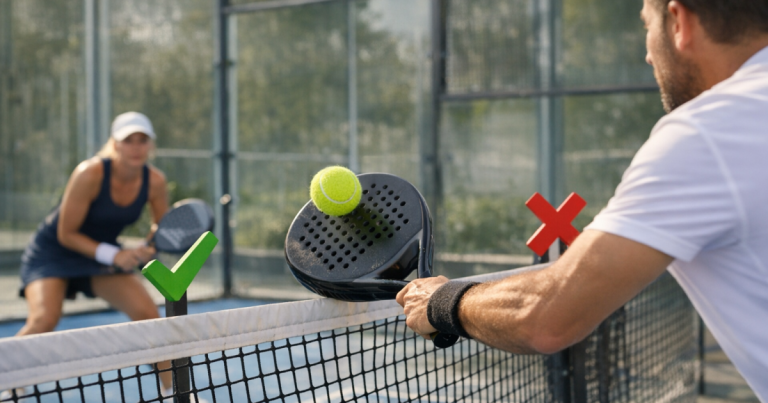
Once the serve is in and the rally has started, the key rule is simple: the ball must land on the opponent’s court floor before it hits their wall, fence or anything outside the playing area.
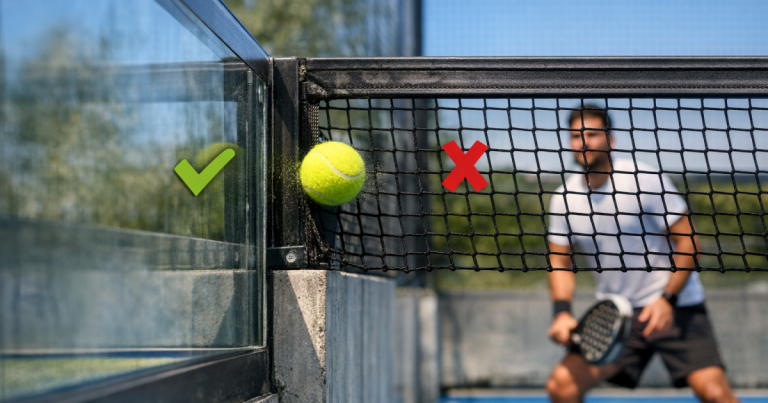
If your shot flies directly into the opponent’s back glass without bouncing first, it is out. If it lands on their floor and then rebounds off the back glass, it is in and the rally continues. The same principle applies to side glass and fence during normal play: floor first is playable; wall or fence first is not.
This is where beginners often hesitate. A ball can look “out” because it hits the glass hard, but if it bounced on the floor first, it is live. You and your partner can play the rebound after it comes off your own glass, as long as it has only bounced once on your side before you hit it.
Simple rally examples
- Your opponent hits the ball, it lands inside your court, then hits your back glass. The ball is in play.
- Your opponent hits the ball directly into your back glass without a floor bounce. The ball is out.
- The ball lands on the floor near the side wall, then touches the side glass. The rally continues.
- The ball lands on your side, rebounds off the glass, and you return it before it bounces again. That is a legal return.
- The ball bounces twice on your side before you hit it. You lose the point.
Serve boundaries are slightly stricter
The serve has its own boundary details, so it is worth separating it from rally play. A good serve must land in the correct diagonal service box. If it lands short of the opponent’s service line, in the wrong box, or outside the box, it is a fault.
If the serve lands on the service line or centre service line of the correct box, it is in. If it lands correctly and then hits the glass, that is usually fine. If it lands correctly but then hits the metal fence before the receiver plays it, it is generally treated as a fault on serve.
Club players sometimes describe this quickly as “glass is fine, fence is not” for serves. That shorthand is helpful, but the first bounce still matters most: it has to be in the correct service box.
For a fuller beginner explanation of the serve, wall rebounds and common faults, see the guide to serving, walls and faults in padel.
What beginners often misunderstand
The service line is not a baseline
Many new players call the service line the baseline because it sits towards the back of the court. That is understandable, but it can cause confusion. In padel, the back wall is the real rear boundary. The service line is mainly there to organise serving and receiving.
There are no tennis-style tramlines
Because padel is normally played as doubles, you do not have separate singles and doubles sidelines. The full width of the court is used. If the ball lands on the court floor inside the walls and fences, it is in, provided it has not broken another rule first.
The wall can save a point, not end it
Beginners often stop when the ball hits the glass because they assume the point is over. In padel, the glass is part of the game. If the ball bounced on your side first, you can often let it rebound and then play it. This is one of the biggest differences between rushed beginner rallies and more controlled club play.
Close line calls need the best angle
The person closest to the bounce does not always have the best view. A partner standing square to the line may see it more clearly. In friendly games, agree calls quickly and avoid replaying every doubtful point unless everyone is genuinely unsure.
How to read the court before you play
Before a beginner match or club session, take 30 seconds to orient yourself. Find the net, then find the service line on your side. Notice the centre service line and identify your right and left service areas. Then look across the net and picture the two diagonal target boxes.
This quick scan helps with three things. You will stand in the right place to serve, aim at the correct box, and recognise whether the opponent’s serve has landed legally. It also reduces the temptation to copy tennis habits, such as aiming a serve into the front half of the court.
If you are receiving, stand in or near your service box with enough room to react after the bounce. New players often stand too close to the service line and get cramped by serves that rebound off the glass. Giving yourself a little space behind the bounce can make returns much easier.
Why line knowledge changes your tactics
Understanding the markings is not just about avoiding faults. It also helps you make better choices. On serve, aiming safely into the middle of the diagonal box is usually smarter than chasing the side wall straight away. Once you are consistent, you can start using the glass and angles more deliberately.
During rallies, knowing that floor-before-glass is live encourages you to slow down and watch the bounce. Instead of swinging at everything early, you can let some balls come off the back glass and play them at a more comfortable height. That is one of the first big steps from beginner survival mode towards controlled padel.
Line awareness also helps with communication. If your partner calls “leave” because a ball is heading directly into the back glass without bouncing, you need to trust that boundary judgement. If they call “play” after a floor bounce, you know the wall rebound is still alive.
Main lessons
Once padel court lines make sense, the game feels far less random. The service line and centre service line control most of the marked-court decisions, while the walls and fences define how rallies continue after the first bounce.
Remember these beginner rules: lines are in, serves go diagonally into the back service box, and rally shots must hit the floor before the opponent’s wall or fence. If you keep those three ideas in mind, you will understand most close calls you meet in early club games.
Scoring can be the next source of confusion once the court layout is clear. If you want the points, games and tie-breaks to feel just as straightforward, read this simple guide to how padel scoring works.