Padel scores can sound strange at first, mainly because the game borrows its point language from tennis while adding a few club-specific formats of its own. Once you know the main padel scoring terms, it becomes much easier to follow a game, call the score confidently, and avoid awkward pauses during your first social matches.
What to know first
The simplest way to understand padel scoring is to separate it into three layers: points, games and sets. Points build a game. Games build a set. Sets decide the match. In most club matches, the serving pair calls the score before each point, and the server’s score is always said first.
-
A point is one rally. Win the rally and your side moves up in the game score.
-
A game is won by the first side to reach the required point score, usually with a margin of two points unless golden point is being used.
-
A set is usually won by the first side to win six games, with at least a two-game lead.
-
A match is commonly played as best of three sets, though beginner sessions often use shorter formats.
If you are still building the wider foundations, it helps to combine scoring knowledge with court positioning, serve basics and simple rally tactics. The guide to first padel skills, rules and gear is a useful next step for that.
The core point scores
Love
Love means zero. If the serving pair has not won a point and the receiving pair has won one, the score is love-15. It can feel like odd language, but you will hear it constantly in club play.
15, 30 and 40
Padel does not count points as one, two, three. The first point is 15, the second is 30, and the third is 40. If the serving pair wins the first two points and the receivers win the third, the server calls 30-15 before the next serve.
Game
A game is normally won when a pair reaches four points and leads by at least two. So 40-15 followed by another point to the same pair wins the game. If both pairs reach 40, the score is deuce.
Deuce
Deuce means both pairs have reached 40. Under standard advantage scoring, one pair must then win two points in a row to take the game: one point to earn advantage, then another to win the game.
Advantage
Advantage, often shortened to “ad”, means a pair has won the point after deuce. If the serving pair wins that point, it is advantage server. If the receiving pair wins it, it is advantage receiver. If the pair with advantage wins the next point, they win the game. If they lose it, the score goes back to deuce.
Golden point
Golden point is a one-point decider used in some competitions, leagues and social sessions. Instead of playing advantage at deuce, the next point wins the game. The receiving pair usually chooses which side will receive, but players should stay in their normal receiving positions unless the event rules say otherwise. Always confirm before the match starts, because not every club session uses golden point.
Game, set and match language
Hold
A hold means the serving pair wins its own service game. If you serve and your side wins the game, you have held serve. This is a common phrase in match chat, even at beginner level.
Break
A break means the receiving pair wins the game against the serve. Because serving is generally an advantage, breaking serve can be a big shift in a set. If the receivers are one point away from winning the server’s game, they have a break point.
Game point
Game point means one side needs one more point to win the game. At 40-30, the serving pair has game point. At 30-40, the receiving pair has game point, and because they would win against serve, it is also break point.
Set point
Set point means one side needs one more point to win the set. For example, if a pair leads 5-4 in games and 40-30 in the current game, they have set point.
Match point
Match point means one side needs one more point to win the whole match. In a friendly game, it is still worth calling clearly so everyone knows the situation before the serve.
Tiebreaks and shorter formats
Tiebreak
A tiebreak is commonly played when a set reaches 6-6. Instead of continuing until one pair leads by two games, the set is decided by a separate points race, usually to seven points with a two-point margin. Tiebreak points are counted normally as 1, 2, 3 and so on, not 15, 30 and 40.
Serve rotation changes during a tiebreak. The first server serves one point, then the serve usually alternates every two points between pairs and players in the correct order. If you are unsure who should serve next, stop before the point and agree the order. For a fuller explanation, see the guide to serve order and rotation in doubles.
Championship tiebreak or match tiebreak
Some social leagues and coaching sessions use a longer tiebreak instead of a final set. This is often played to ten points with a two-point margin. You might hear it called a match tiebreak, championship tiebreak or super tiebreak. The name matters less than agreeing the target score before you start.
Timed match
Beginner club nights often use timed matches so more players can rotate through the courts. You may play for a fixed number of minutes, then record games won or total points won. In these formats, the organiser’s scoring system takes priority over a normal best-of-three-set match.
Serve and rally terms that affect the score
Fault
A fault is an illegal serve. In padel, you get a first serve and a second serve. If the first serve is a fault, you try again. If the second serve is also a fault, it is a double fault and the receiving pair wins the point.
Let
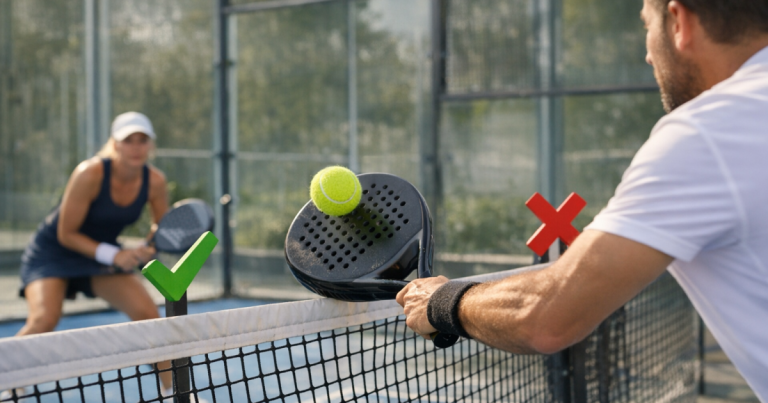
A let is a replayed serve. The common example is a serve that clips the net, lands in the correct service box and is otherwise legal. In that case, the serve is usually taken again rather than counted as a fault or a point won.
Receiver
The receiver is the player diagonally opposite the server who returns the serve. In doubles, the receiving pair decides at the start of each set which player receives on the right and which receives on the left. They then keep that receiving order for the set.
Point lost
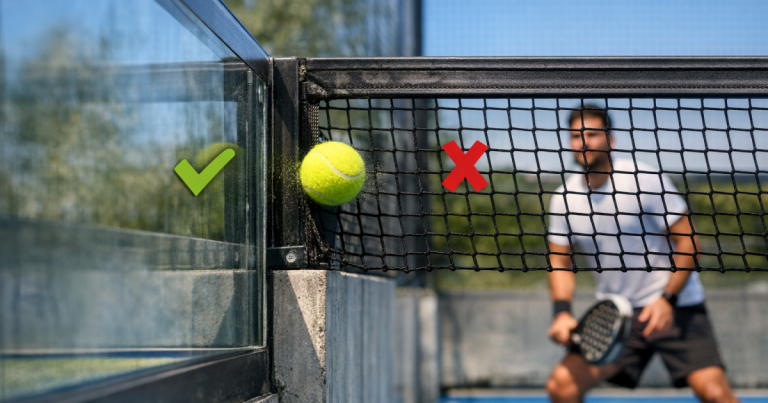
You lose the point if the ball bounces twice on your side, you hit into the net, you hit out after the legal court contact, or you commit another rule breach. For beginners, the most common confusion is whether the ball has hit glass, fence, floor or a line in the right order. When in doubt, pause calmly and talk it through.
Examples of common score calls
Score calling becomes easier when you practise with real match situations. Remember: the server calls their own side’s score first.
-
If the serving pair has won no points and the receivers have won two, the call is love-30.
-
If the serving pair has won two points and the receivers have won one, the call is 30-15.
-
If both pairs have won three points, the call is deuce.
-
If the server wins the point after deuce under advantage scoring, the call is advantage server.
-
If the game score in the set is 5-5, the next game makes it 6-5, not a set win unless the format says otherwise.
-
If the set reaches 6-6, many matches move into a tiebreak, but you should confirm the format before the match.
Here is a simple match example. Pair A serves at 3-2 in games. They win the first point, lose the second, win the third and win the fourth. The point score moves 15-love, 15-all, 30-15, then 40-15. If they win the next point, Pair A wins the game and the set score becomes 4-2.
Small checks before you start a match
Most scoring disagreements are easy to avoid if the four players agree the format before the first serve. This is especially useful in UK club sessions where one court might be playing a normal set while another is playing timed rotations.
-
Are you playing advantage scoring or golden point at deuce?
-
Is the set first to six games, or a shorter first-to-four format?
-
What happens at 6-6: tiebreak, sudden death game or something else?
-
Are you playing best of three sets, one set only, or a timed match?
-
Who is serving first, and what is the serving order?
-
Are you recording games, sets or total points for the session?
If a disagreement still comes up, keep it calm and reset from the last score everyone agrees on. The guide to common padel rule disputes explains sensible ways to handle those moments without spoiling the game.
Common questions
Whose score is called first in padel?
The server’s score is called first. If your side is serving and you have won one point while the receivers have won two, the call is 15-30.
Is golden point used in every padel match?
No. Some matches use golden point at deuce, while others use advantage scoring. Check before starting, because both formats are common in club padel.
What score wins a padel set?
A standard set is usually first to six games with a two-game lead. At 6-6, many matches use a tiebreak, but social formats can vary.
What is the difference between game point and break point?
Game point means one side can win the game with the next point. Break point is a game point for the receiving pair against the server.
Do beginners need to know every scoring term before playing?
No. Start with love, 15, 30, 40, deuce, advantage and game. The rest becomes easier once you have played a few matches.
Main lessons
The most useful padel scoring terms are the ones you will hear before almost every serve: love, 15, 30, 40, deuce, advantage and game. Add set, match, tiebreak and golden point, and you can follow almost any beginner club match with confidence.
The key habit is to agree the scoring format early, call the server’s score first, and pause before the next serve if nobody is sure of the score. Clear communication keeps the match friendly, fair and much more enjoyable.