Walking into a mixed-level padel match can feel awkward at first: one player is smashing confidently, another is still learning where to stand, and you are trying not to slow everyone down. The good news is that uneven levels can still make for a really enjoyable game when everyone keeps things simple and communicates early.
Your aim is not to prove you belong on court. It is to play steady padel, help the rally flow, and make sure both the newer and stronger players get a proper game.
What to know first
- Agree the tone before you start: social hit, competitive set, coaching-style game, or club box league.
- Play into space, not at the weakest player: testing someone is fine; repeatedly exposing them is not.
- Use percentage padel: deeper serves, simple volleys, patient lobs and fewer miracle winners.
- Talk to your partner: call balls early, reset after mistakes, and agree who covers the middle.
- Keep the stronger player involved: good rallies need balance, not avoidance.
Step 1: set expectations before the first serve
A quick chat at the net can prevent most of the awkwardness. You do not need a formal team talk; just ask what everyone wants from the match. Is it a friendly hit after work, a proper set, or a chance for a newer player to get used to club play?
If you are new to scoring, serving order or wall rules, it is worth brushing up before you arrive. The main differences are easy to miss if you come from tennis, so this clear explainer on padel rules compared with tennis rules is a useful refresher.
Simple expectation-setting also helps stronger players relax. They will usually enjoy the match more if they know whether to play normally, take a little pace off, or use the session to practise placement and patience.
Step 2: start with safe, repeatable shots
In your first few games, avoid trying to match the best player shot for shot. Mixed standards magnify errors because one rushed smash or wild return can end a rally before the newer player has touched the ball.
Use a simple first plan: return cross-court, serve with margin, aim your volleys deep, and lob when you are under pressure. These choices keep you in the point without needing advanced technique.
If you are the stronger player, the same idea applies. You can still play properly, but choose controlled targets. Aim for corners, feet and gaps rather than hitting everything as hard as possible. That keeps the game realistic without turning it into a lesson nobody asked for.
Step 3: avoid the two common extremes
Beginners often worry about being targeted, while stronger players worry about being frozen out. Both can happen in a mixed-level padel match, and both make the game less enjoyable.
Do not pick on the newest player every point
It is normal to send some balls towards the less experienced player. They need touches, and the opposing pair needs to compete. The problem is when every serve, lob and volley goes to the same person regardless of the rally. That feels less like padel and more like pressure practice.
Do not avoid the strongest player completely
At the other end, refusing to play a single ball to the strongest player makes rallies predictable. It can also stop them contributing to the match. A better balance is to play smart: use lobs over them, test their backhand side, or make them volley from awkward positions rather than feeding easy winners.
Step 4: communicate in short, useful phrases
Mixed-level games improve quickly when the pair talks well. Keep calls short and calm: “mine”, “yours”, “leave”, “switch”, “lob” and “stay” are enough for most rallies.
After a mistake, avoid long explanations while the ball is being collected. Try one quick reset phrase instead: “Good idea, next one deeper” or “No problem, we were in the right place.” This keeps the energy positive and stops the newer player feeling analysed after every point.
Positioning chats are useful between games. For example, if the middle ball keeps causing confusion, agree that the forehand player takes it unless clearly called otherwise. Small agreements like that make the pair feel organised without overcomplicating the match.
Step 5: adjust your tactics to your role
Your role changes depending on whether you are the least experienced player, the strongest player, or somewhere in the middle.
If you are the newer player
- Prioritise getting the return back in play, even if it is not perfect.
- Use lobs when you feel rushed at the back glass.
- Stay connected to your partner rather than drifting too far forwards or backwards.
- Ask one clear question at changeovers instead of trying to fix everything at once.
If you are the stronger player
- Set the tempo with reliable serves and returns rather than constant winners.
- Give your partner simple information before the point, not a lecture after it.
- Defend patiently so the rally has time to develop.
- Use placement, angles and height changes to challenge opponents fairly.
If you are the middle-level player
- Be the organiser: call more, cover sensible gaps, and keep the score clear.
- Help the newer player feel included without taking every ball from them.
- Make the stronger player move, but do not feed their favourite shot repeatedly.
Step 6: manage the score without making it tense
Scoring can change the atmosphere quickly. A friendly game can suddenly feel uncomfortable if one pair races ahead or if people start apologising after every point.
For a first social match, consider playing shorter sets, sudden-death deuce, or rotating partners after each set. Many UK clubs and social sessions use formats like this because they keep people moving and reduce the pressure on one pairing.
If you are still getting used to club play, booking the right type of session matters. A relaxed taster or beginner-friendly group can be a better stepping stone than jumping straight into a competitive box league; this guide to padel taster sessions versus full lessons explains the difference clearly.
Step 7: finish well, whatever the result
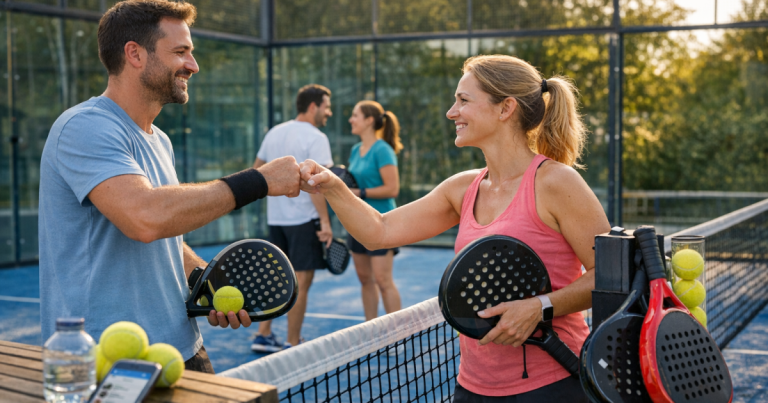
The end of the match is part of the experience. Thank everyone, mention one thing you enjoyed, and avoid turning the handshake into a coaching review. If someone asks for feedback, keep it specific and kind: “Your lobs improved as the match went on” is far more helpful than a list of technical faults.
If the level gap was too wide, say so in a constructive way next time you book. You might suggest rotating partners, adding another player of similar standard, or choosing a session labelled for beginners or improvers. That is normal club life, not a failure.
Small things that make a big difference
- Arrive warmed up: five calm minutes before the first game helps you avoid rushed early errors.
- Bring enough balls: tired balls make rallies harder to control, especially for newer players.
- Use clear body language: encouragement matters more than people think in uneven games.
- Do not apologise for every miss: say it once if needed, then focus on the next point.
- Book at the right level: if a session description says intermediate or advanced, check whether it suits your current stage before joining.
For your next game, it also helps to understand how court booking works at local clubs, leisure centres and padel venues. If you are not sure where to start, read how to book your first padel court in the UK before arranging a match.
FAQ
Should the stronger player go easy in a mixed-level game?
They should play with control, not pretend to be worse. Placement, patience and rally-building keep the game fair while still giving everyone proper padel.
Is it rude to hit most balls to the weaker player?
It depends on the pattern. Some pressure is normal, but repeatedly targeting one player point after point makes the match feel unbalanced and less enjoyable.
What should I say if I feel out of my depth?
Keep it simple: “I’m still fairly new, so I’ll focus on keeping rallies going.” Most club players appreciate the honesty and will adjust the tone.
How can beginners contribute when stronger players dominate?
Focus on returns, lobs, communication and court position. You do not need winners to be useful; steady balls often set up your partner’s next shot.
Should mixed-level pairs rotate partners?
Yes, if the gap is making the match one-sided. Rotating after a set often creates fairer rallies and gives everyone a better experience.
Why it matters
Your first uneven game can teach you a lot about real club padel. You learn how to stay calm, communicate, choose sensible shots and read different playing styles.
The best mixed matches are not perfectly balanced on paper. They work because players respect the level difference, keep rallies alive, and leave the court wanting to play again.