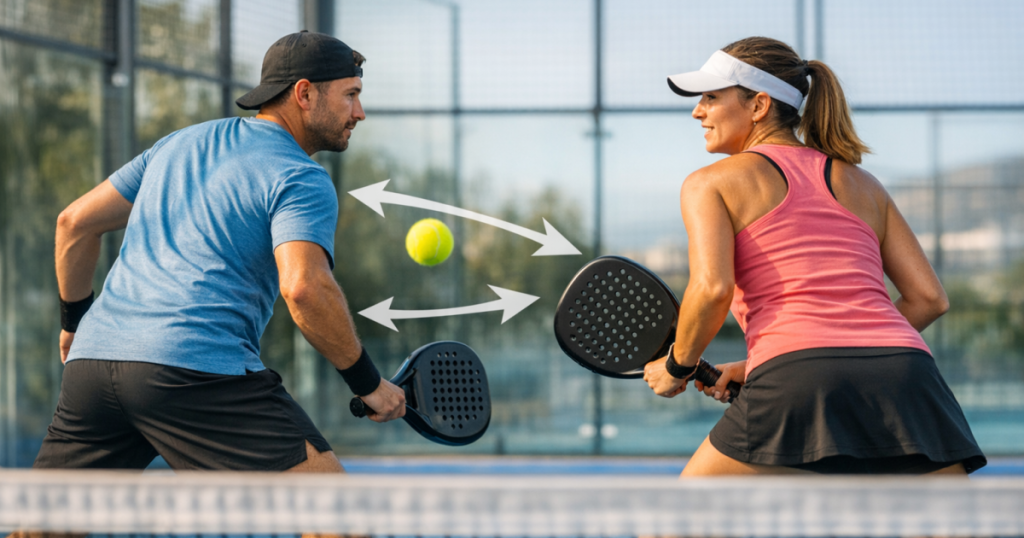
Good padel doubles movement is less about sprinting everywhere and more about staying connected with your partner. When one player moves, the other should usually move too, so the pair protects the most dangerous spaces instead of leaving easy gaps.
For beginners, the biggest improvement often comes from learning a few simple patterns: move as a unit, avoid standing in a straight line with your partner, and recover together after every shot.
What to know first
- Think in pairs, not as two singles players. Your job is not only to reach your own ball, but to help your partner cover the next one.
- Keep the distance manageable. If you are too far apart, balls through the middle become easy. If you are too close, the opponents can use the sides.
- Move forwards and backwards together. One player at the net and one stuck deep usually creates confusion unless it is a deliberate defensive moment.
- The middle ball needs a plan. Decide early who takes balls through the centre, rather than both players hesitating or both swinging.
- Reset after every shot. Beginners often watch their own shot for too long. Hit, recover, check your partner, then prepare for the reply.
Step 1: Start with a simple side-by-side shape
At beginner level, the easiest default is to stay roughly side by side with your partner. If you are both near the back glass, defend together. If you both move towards the net, attack together. This does not mean standing on the same line perfectly, but you should feel connected.
Imagine an invisible rope between you and your partner. If they move a metre to the left, you shift left as well. If they drop deeper to defend, you should usually drop too. This rope idea stops one player from charging forward while the other is left alone at the back.
A good starting distance is wide enough to cover your half, but close enough that the middle does not feel abandoned. On a standard padel court, the centre is attacked constantly because hesitation there causes mistakes. If you are unsure whether a ball is yours, call early: “mine”, “yours”, or “leave”.
Step 2: Move sideways as a pair
Most beginners understand moving forwards and backwards, but sideways movement is where doubles positioning starts to feel more natural. When the ball is played into your partner’s corner, you should slide across slightly to protect the middle. You are not trying to steal their ball; you are closing the easiest passing lane.
For example, if your partner is defending in the right back corner, they will often be stretched towards the side glass. You should move a little towards the centre line, ready for a ball pushed through the middle or a soft return. If you stay glued to your left side, the gap between you becomes too large.
The same applies the other way. If you are pulled into your left corner, your partner should shift inwards rather than stay too wide. This is why knowing the padel court lines helps: you start to understand which spaces are actually dangerous and which balls are likely to stay playable.
Step 3: Defend together before trying to attack
When both players are under pressure, the priority is not to hit a winner. It is to stay organised, use the glass where needed, and earn a chance to move forwards. Beginners often lose points because one player tries to escape pressure alone while the other remains in the wrong place.
In defence, aim to stand behind the service line, with each player covering their side and sharing the middle. If your partner is about to play off the back glass, give them room, but do not drift so far away that the next ball through the centre is open.
After a defensive lob, watch the opponents. If the lob pushes them back and gives you time, both players can move up together. If the lob is short, do not rush forwards into trouble. Stay back, prepare for the smash or volley, and defend as a pair again.
Step 4: Attack together at the net
The net is powerful in padel because volleys let you take time away from your opponents. But it only works if both players understand their shape. If one player takes the net and the other stays deep without a reason, the opponents can play into the gap or force the back player to defend alone.
When you and your partner move up, avoid standing too close to the net. Beginners often crowd it, then struggle with lobs. A more balanced position is a little behind the net, ready to volley but still able to turn and chase a lob if needed.
At the net, shift towards the side where the ball is being played. If your partner volleys from the right side, you should move slightly towards the centre to support. If the ball is on your side, your partner covers the middle behind you. The aim is to make the court look smaller to your opponents.
Step 5: Agree who takes the middle
The middle ball causes more beginner doubles arguments than almost anything else. The simple rule is this: the player with the easier shot should usually take it. That may be the player facing the ball, the player on their forehand, or the player who has already called for it.
Many pairs use a starting rule where the forehand in the middle takes priority. For example, if one player is right-handed on the left side, their forehand may cover many middle balls. But this is not automatic. Court position, balance and communication matter more than a rigid rule.
Use short calls. “Mine” means you are taking it. “Yours” means your partner should play. “Leave” means the ball is going out or reaching the back glass in a better way. Keep calls calm and early. A late shout often creates more confusion than silence.
Step 6: Practise the patterns during normal rallies
You do not need a complicated training session to improve. During your next club game, pick one movement habit for each set. For example, spend one set focusing only on moving sideways together. In the next, focus on recovering after every shot. Small, clear targets work better than trying to fix everything at once.
If you are new to organised sessions, it is worth reading about what to expect at your first padel session so the court layout, rotation and general rhythm feel less unfamiliar. When you are less worried about the basics, partner movement becomes much easier to notice.
Common beginner mistakes to avoid
- Both players chasing the same ball. This usually happens when no one calls. Decide early and trust the call.
- One player admiring their shot. After you hit, recover immediately. The point is still alive.
- Standing too wide in defence. Covering the side fence feels safe, but it can leave the middle open.
- Rushing the net alone. If your partner cannot move up with you, you may create more space for the opponents.
- Backing away from every lob. Some lobs can be attacked, some need to be chased, and some should simply reset the point. Read the height and depth before panicking.
A simple rally example
Picture this: you are on the left side and your partner is on the right. The opponents play a low ball into your partner’s back corner. Your partner moves right and back to defend. You slide slightly towards the middle, ready for the next ball.
Your partner plays a lob. It is deep enough to push the opponents away from the net. You both move forwards together, stopping in a balanced net position rather than running too close. The opponents return a slower ball towards your side. You volley, your partner covers the middle, and both of you prepare for the next reply.
Nothing spectacular has happened, but the pair has moved well: defend together, shift together, attack together, recover together. That is the pattern to build.
Quick partner checks between points
Between points, keep your chats short. Long tactical talks can make beginner games feel tense. Try quick checks such as:
- “Let’s both stay back until we get a good lob.”
- “I’ll call early on middle balls.”
- “When you are in the corner, I’ll cover centre.”
- “Let’s move up together after a deep lob.”
These tiny agreements are often more useful than advanced tactics. They give both players the same picture before the serve starts.
Helpful questions
Should both players always move at the same time?
Usually, yes, but not identically. Think of moving as a connected pair: if one player is pulled wide or deep, the other adjusts to protect the middle and the next likely shot.
Who should take balls down the middle?
The player with the clearer, easier shot should take it. Many pairs favour the forehand in the middle, but early communication is more important than a fixed rule.
Is it wrong for one player to stay back?
Not always. It can happen during defence or after a difficult lob, but as a beginner default, try to avoid one player attacking alone while the other is stranded deep.
How do we stop leaving gaps at the net?
Move sideways towards the ball as a pair. The player closest to the ball applies pressure, while the partner closes the centre rather than standing too wide.
Does scoring affect how we should move?
The movement principles stay the same, but pressure points can make players rush. If scoring still feels distracting, practise keeping score in padel until it becomes automatic.
Final thoughts
Strong doubles movement is built from simple habits repeated often. Stay connected, cover the middle, move up and back together, and talk early. You do not need perfect technique to become a better partner; you need to make the court easier for both of you to defend and harder for your opponents to attack.
Next time you play, focus on one rule: when your partner moves, check whether you should move too. That single habit can make beginner doubles feel calmer, clearer and much more enjoyable.