For most new players, UK padel rules feel less confusing once you separate official rules from what clubs actually enforce on a busy evening. The core game is consistent: serve diagonally, let the ball bounce when required, use the glass correctly, and score much like tennis. The differences usually come from club-night formats, time limits, and how relaxed the organiser is with beginner mistakes.
That distinction matters because beginners often worry about tiny technicalities when the real expectation is simpler: play safely, keep the game moving, be honest with calls, and learn the formal rules as you go.
The short version
- Most UK clubs broadly follow the international rules of padel, with local adjustments for social play, coaching sessions, leagues, and tournaments.
- The biggest strict areas are serving, double bounces, balls hitting the fence or glass, touching the net, and calling whether the ball was in or out.
- Club nights often use timed matches, golden point at deuce, mixed pairings, or shorter sets to help more people rotate through the courts.
- If you are unsure, ask the organiser before the game starts. At beginner sessions, that is completely normal.
- For official matches, always follow the competition rules published by the organiser, not just what your regular club night does.
Official rules versus club-night habits
Padel clubs in Britain generally use the recognised rules of the sport as the foundation. The court, scoring language, serve order, glass use, and most fault calls are the same whether you are playing a friendly match, a box league, or a more formal competition.
Where things change is the format. A club organiser might have twelve players and three courts for ninety minutes. In that setting, a full best-of-three-set match is not realistic. Instead, the club might run short games, timed rotations, or an American-style mix-in where partners change after each round. That does not mean the rules are being ignored; it means the structure has been adapted so everyone gets a fair amount of play.
A useful way to think about UK padel rules is this: the laws of play decide what wins or loses a point, while the club format decides how long you play, who you partner with, and how the session is scored overall.
The rules clubs are most likely to enforce
The serve must be under control
The serve is the rule beginners get corrected on most often. You serve diagonally into the opposite service box, after letting the ball bounce, and you strike it below waist height. Your feet should stay behind the service line area until you hit the ball, and you should not run or jump into the serve.
At friendly club nights, people are usually patient with new players, but repeated overarm-style serves, serving from the wrong side, or hitting the ball too high will normally be called. If this is the area you want to understand properly, the separate guide to padel serve rules breaks down position, bounce, height, lets, and faults in more detail.
The return of serve must bounce first
You can volley during a rally, but not when returning serve. The receiving player must let the serve bounce before playing it. This catches out beginners who come from squash, badminton, or tennis doubles, where an instinctive volley can feel natural. In padel, volleying the return of serve loses the point.
Glass is in, fence is different
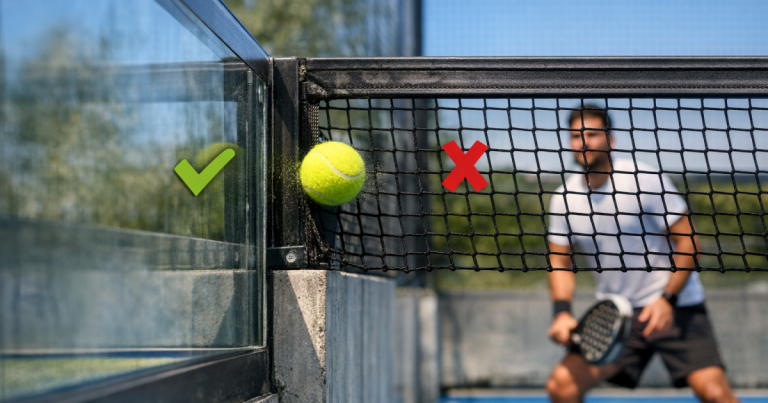
One of the most important padel habits is learning the difference between glass and mesh fencing. If the ball lands in the opponent’s court and then hits the back or side glass, it is usually still in play. If it hits the mesh after bouncing, the rally can also continue in normal play, depending on the situation. But on a serve, if the ball lands in the correct service box and then hits the side fence, it is a fault.
If the ball hits the glass or fence before it lands in the opponent’s court, it is out. A lot of beginner disputes come from this sequence, so listen for what happened first: court, then wall, or wall, then court.
Two bounces ends the point
The ball is allowed to bounce once on your side. If it bounces twice before you return it, the point is over. This includes awkward rebounds off the back glass where the ball drops sharply. Club players will normally call this honestly because it is often clearer to the player nearest the ball than to anyone watching from the other side.
You cannot touch the net
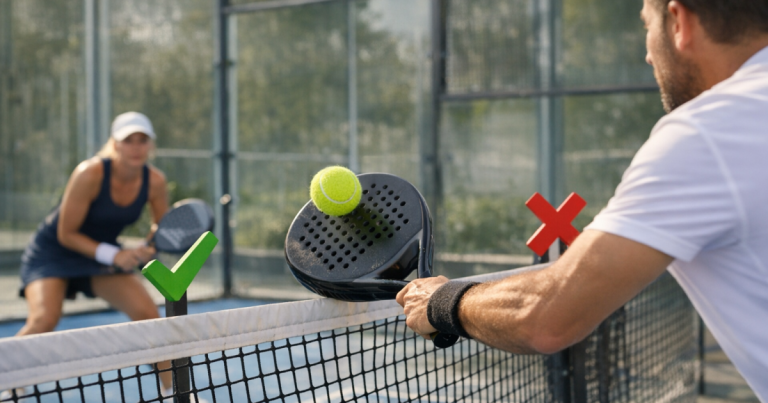
If you, your racket, or anything you are carrying touches the net during a live point, you lose the point. This is enforced even in social play because it is simple and affects safety as well as fairness. Reaching for a short ball is fine; leaning into the net is not.
Scoring formats you will actually meet
Traditional padel scoring is very similar to tennis: 15, 30, 40, game. Sets are commonly played to six games, usually with a tie-break at 6-6, and matches may be best of three sets. That is the structure you are most likely to see in leagues, ladders, and formal competitions.
Club nights often use shorter versions. The organiser’s aim is not to recreate a tournament; it is to give everyone good rallies, balanced matches, and enough court time. You might see:
- Timed rounds: for example, players rotate after a set period rather than finishing a full set.
- First to four games: a shorter set format that works well when courts are busy.
- Golden point at deuce: instead of playing advantage, one deciding point settles the game.
- Americano-style scoring: players rotate partners and keep individual points across several mini-matches.
- Level-based courts: beginners, improvers, and stronger players may be grouped separately to keep rallies enjoyable.
None of these formats changes what is legal during a point. They simply change how the session is organised. If you are building regular habits, combine these match formats with structured practice rather than only playing points. The guide on your first month of padel practice is a useful next step if you want a simple progression plan.
What happens with let serves?
A let serve happens when the ball clips the net, lands in the correct service box, and remains otherwise legal. In that case, the serve is usually replayed. If the ball clips the net and lands out, it is a fault. If it clips the net, lands in the box, and then hits the side fence on the serve, clubs will normally treat it as a fault rather than a let.
At beginner sessions, the organiser may quickly explain this before play starts because let serves cause plenty of hesitation. The easiest habit is to pause, agree the call calmly, and replay only when both sides accept it was a legal let.
Who calls the lines?
In most club play, players call their own side. If the ball lands near your back glass or side glass, you are often in the best position to know whether it landed in before hitting the wall. If you are not sure, the friendly convention is to give the benefit of the doubt to your opponents.
For competitive matches, an organiser may set clearer expectations, and some events may have supervisors or referees for later rounds. But at normal club level, good calling is more about honesty and consistency than authority. Avoid replaying points too often just because nobody wants to make a decision; if someone had the best view and makes a fair call, accept it and move on.
Beginner mistakes clubs usually forgive
Most clubs want new players to settle in, so not every mistake gets treated the same way. A first-time player standing on the wrong receiving side might get a quick reminder. Someone repeatedly serving too high after being told the rule will probably be corrected more firmly.
Common beginner mistakes that are usually handled gently include:
- forgetting whose serve it is after a long rally;
- standing too close to the net when receiving;
- trying to volley a serve return once or twice;
- not knowing whether a ball came off the back glass or side glass first;
- calling the score in the wrong order.
The social rule is simple: be open about being new, ask short questions between points rather than during rallies, and accept corrections without taking them personally. Most regular players remember how confusing the glass felt at first.
Etiquette matters almost as much as the written rules
Padel is a social sport, and UK club nights rely on good court behaviour. The rules tell you what is legal; etiquette helps the session run smoothly.
Before you start, introduce yourself, confirm the scoring format, and check who is serving first. During play, call the score clearly before each serve. If a ball from another court rolls on, stop the point and replay it. Do not walk behind an active court while a point is in progress unless the club layout makes it unavoidable and the players have paused.
Clothing and footwear are not usually part of the laws of padel, but they do affect comfort and confidence at your first session. If you are not sure what is normal at a UK club night, this guide on what to wear to your first padel club night keeps things simple and beginner-friendly.
Rules that vary by club or competition
Some areas are not about right or wrong so much as local format. These are worth checking before you play, especially if you are visiting a new venue:
- Golden point: some clubs use it all the time; others play advantage scoring.
- Tie-breaks: competitions may use standard tie-breaks, match tie-breaks, or short-set rules.
- Out-of-court play: many beginner sessions ignore this because the court setup, doors, and safety space may not suit it.
- Rotation rules: social nights may require winners to move up a court, split pairs, or change partners after each round.
- Ball rules: tournaments may specify when balls are changed, while social sessions are usually more relaxed.
- Coaching feeds: in drills, coaches may pause or replay points to teach a pattern rather than score strictly.
If you are entering a league or tournament, read the event notes before arriving. If you are attending a social, ask the organiser for the house format. That one-minute check prevents most awkward rule debates.
Common questions
Are padel rules different in the UK from Spain or other countries?
The core rules are the same. What differs is the club format, the level of enforcement, and how social sessions are organised. A friendly mix-in will feel looser than a formal competition.
Can you play the ball off your own glass?
Yes. You can use your own back or side glass to return the ball, as long as the ball then goes over the net and lands legally in the opponent’s court.
Is golden point an official rule or just a club shortcut?
Golden point is a recognised scoring option used in many formats, but it is not used everywhere. Always check whether your session uses golden point or advantage at deuce.
Do beginners need to know every rule before joining a club night?
No. Know the serve basics, one-bounce rule, glass basics, and how scoring works. You can learn the finer points through play, especially if the session is labelled beginner-friendly.
What should I do if another player gets a rule wrong?
Keep it calm and brief. Say what you saw, ask the organiser if needed, and avoid turning a social game into a debate. Most mistakes at beginner level are genuine.
Main lessons
Padel clubs in the UK are not usually inventing their own version of the sport. They follow the main rules, then adapt scoring and rotation so real people can share courts, play balanced games, and enjoy a social session after work or at the weekend.
If you are new, focus first on the rules that decide points: legal serves, one bounce, glass and fence sequences, net touches, and honest line calls. Once those feel natural, club formats such as timed rounds, short sets, and golden point become much easier to follow.
The best habit is to ask the format before the first serve, call the score clearly, and keep the game moving. That will make you a better partner long before you know every rare rule in the book.