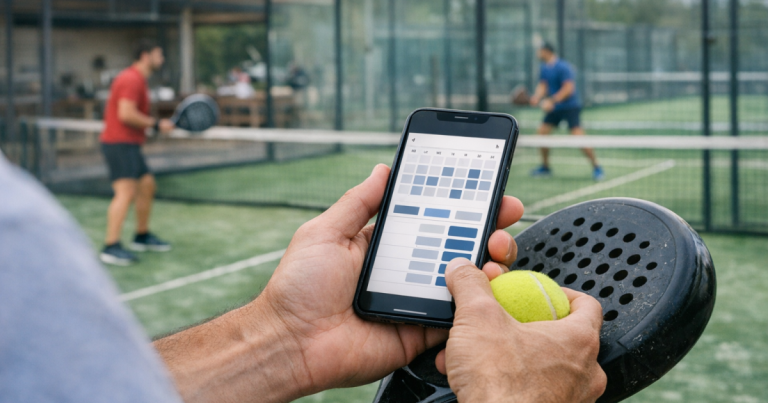
Walking into a busy padel session can feel more intimidating than the game itself: people already seem to know the rotation, the warm-up rhythm and who plays with whom. The easiest way to join a padel club night is to treat it like a friendly structured session rather than a trial where everyone is judging you.
Most club nights are built for mixing players, not showing off. If you arrive a little early, know the basic etiquette and keep your first matches simple, you will usually fit in far faster than you expect.
The short version
- Book the right level if the club separates sessions by ability.
- Arrive 10–15 minutes early so you can check in without rushing.
- Introduce yourself to the organiser before you step onto court.
- Say clearly that it is your first club night, but avoid apologising for every point.
- Keep warm-ups short, cooperative and controlled.
- Play steady padel: serve in, recover position and communicate with your partner.
- Thank partners and opponents, then ask how the rotation works for the next game.
Step 1: Pick a session that matches your level
The least awkward club night is the one where the level is roughly right. Many UK venues run separate beginner, improver, intermediate or open mix-in sessions. The names vary by club, so read the booking notes rather than guessing from the title alone.
If you are new to match play, look for words such as “social”, “beginner friendly”, “improver”, “mix-in” or “coached club night”. Be more careful with “competitive”, “team training” or “advanced” sessions, even if you are sporty in other racquet sports. Padel has its own rhythm, wall use and doubles positioning, so tennis or squash experience helps but does not automatically place you in a higher group.
If the booking page is unclear, message the venue with a simple note: “I can serve underarm, rally a little and know the basic scoring, but I am new to club nights. Which session should I book?” That gives the organiser enough information to point you in the right direction.
Step 2: Prepare just enough before you go
You do not need to arrive with a perfect bandeja or a brand-new racket. You do need enough basics to avoid feeling lost during the first ten minutes. Check that you understand the underarm serve, the scoring, when the ball can be played after the glass, and the basic idea that padel is played as doubles.
If you are unsure about what to take, the easiest fix is to sort your kit earlier in the day rather than packing in a panic. A small towel, water bottle, overgrip if you use one, and suitable court shoes will make the evening feel calmer. For a simple pre-session checklist, see our guide on how to pack a padel bag for club night.
Also give yourself a realistic target. For a first session, “make every shot look good” is too much pressure. Better targets are: get your serves in, call the ball early, keep rallies alive, and learn two or three names.
Step 3: Arrive early and find the organiser
Arriving early is the single easiest confidence boost. It gives you time to find the courts, put your bag somewhere sensible, change shoes if needed, and ask how the evening is run. Turning up right on start time often creates the awkward feeling you were trying to avoid.
When you arrive, look for the organiser, coach, reception team or the person holding the player list. Keep your introduction brief and useful: “Hi, I’m Sam. It’s my first club night here. I’ve played a few times and booked the beginner/improver session.”
That sentence does three helpful things. It tells them you are new to the format, gives a rough playing level, and makes it easy for them to place you with suitable partners. Most organisers would rather know this at the start than discover it halfway through the rotation.
Step 4: Understand the rotation before the first match
Club nights usually work in one of three ways. Some venues use timed games and rotate everyone every 12–20 minutes. Some play short sets or first-to-a-number formats. Others use a ladder, where winners move one way and non-winners move another. None of these systems is difficult, but they can feel confusing if everyone else already knows the routine.
Ask one direct question before play starts: “How does the rotation work tonight?” If there is a whiteboard, app booking screen or court list, take a quick look at where your name appears. If you are paired with someone you do not know, introduce yourself before stepping on court rather than waiting until the first point.
Do not worry if you miss a detail. After the first match, ask: “Do we stay on or rotate?” That is normal club-night behaviour, not a beginner giveaway.
Step 5: Make the first warm-up easy for everyone
A padel warm-up at club night is not a private lesson, a power test or a chance to win points early. It is a short, cooperative hit so four players can get their timing, check the court conditions and start safely.
Start with gentle cross-court or straight rallies, then a few volleys, lobs and overheads if there is time. Avoid smashing hard at someone who is standing close to the net, and do not chase every warm-up ball as if the point matters. If you mishit, smile, reset and feed the next ball neatly.
Good warm-up etiquette makes you look comfortable even if your shots are not yet polished. It tells the group you understand the social rhythm of the session.
Step 6: Use simple communication with your partner
Padel club nights feel much less awkward when you talk early and clearly. Before the first point, agree who will take lobs through the middle and whether either player has a preferred side. If you do not mind, say: “I’m happy either side, but I’m still learning.”
During rallies, use short calls: “yours”, “mine”, “leave”, “switch” and “good”. Avoid giving long technical advice unless your partner asks for it. Even well-meant coaching can feel uncomfortable in a social match, especially when players have only just met.
If you are unsure about positioning, focus on moving with your partner. When they go forward, you generally go forward too. When they are pushed back, recover with them. You do not need advanced tactics to be a good partner; you need awareness, effort and clear calls.
Step 7: Keep your first matches boring in the best way
At a new club night, steady padel is better than dramatic padel. Get the serve in, aim with margin, use the middle of the court, and avoid trying to finish the point from awkward positions. Most beginner errors come from rushing, overhitting or trying to copy highlight shots before the rally has been built.
Serve at a pace you can control. After serving, move up with your partner so you are not leaving a huge gap at the net. When returning, make the server play one more ball rather than going for a risky winner down the side glass.
If you need a rules refresher, especially on serve order and partner rotation, our explainer on padel doubles rules is worth reading before your next session.
Step 8: Handle mistakes without over-apologising
Everyone makes mistakes at club night. The awkwardness usually comes less from the error and more from the reaction. A quick “sorry” after an obvious miss is fine, but saying it after every point can make your partner feel they need to reassure you constantly.
Use a simple reset instead: “Next one”, “good idea, wrong execution”, or “I’ll give that more height next time.” This keeps the mood light and shows you are engaged without turning the match into a running apology.
The same applies when your partner misses. Say “unlucky”, “good idea” or “we’re fine”. Club players remember supportive partners more than they remember one missed volley.
Step 9: Know the small etiquette points that matter
Padel etiquette is mostly common sense, but a few habits make a big difference at a shared session:
- Bring spare balls back to the server promptly rather than leaving them near the glass.
- Do not walk behind a neighbouring court while a point is live.
- Call your own side’s double bounces and obvious faults honestly.
- Keep phone use away from the court unless you are checking the rotation.
- Celebrate good points without shouting across other matches.
- Thank each partner and opponent when the timed game or set ends.
If there is a disagreement over a line, serve or double bounce, keep it calm. At social level, replaying the point is often the quickest and friendliest solution unless the club has a clear organiser ruling.
Step 10: Stay for five minutes after play
The end of the session is where the next club night becomes easier. Do not disappear the second the final point is over unless you genuinely need to leave. Take five minutes to thank the organiser, return any borrowed kit, and say goodbye to the people you played with.
If you enjoyed a match, say so: “That was fun, thanks for the game.” If the club uses WhatsApp groups, booking ladders or regular mix-ins, this is the natural moment to ask how players normally hear about future sessions.
You do not need to become best friends with everyone on night one. Your goal is simply to become a familiar, friendly face who is easy to pair with.
What to say when you feel out of place
Having a few ready-made phrases helps when nerves kick in. Try these:
- “It’s my first club night here, so I might need a reminder on the rotation.”
- “I’m still getting used to the glass, but I’ll keep the ball in play.”
- “Do you prefer left or right side?”
- “Nice shot — I thought I had that one.”
- “Thanks for the game. Are you usually at this session?”
These phrases are relaxed, honest and useful. They give other players a way to help without making the whole evening about your nerves.
When lessons might help before trying again
If your first club night feels too fast, that does not mean you are not ready for padel. It may just mean you need one or two focused sessions on serving, positioning or using the back glass. A short block of coaching can make social play feel much more manageable.
For a clearer next step, read our guide to group and private padel lessons. Group coaching can be a gentle way to meet players at a similar level, while private coaching can target one awkward area quickly.
Questions people ask
Can I go to a padel club night on my own?
Yes. Most club nights are designed for solo players as well as pairs. The organiser will usually place you into a four and rotate partners during the evening.
How good do I need to be before going?
You should know the basic serve, scoring and idea of doubles positioning. You do not need to be consistent from the glass or confident with every shot if the session is beginner friendly.
What if everyone else already knows each other?
That is common, but regulars were new once too. Introduce yourself early, be easy to play with, and focus on learning names rather than breaking into every conversation immediately.
Should I tell people I am a beginner?
Yes, briefly. Saying you are new to club nights helps partners adjust expectations, but you do not need to explain your whole playing history before every match.
What if I am put on court with stronger players?
Play steady, communicate clearly and avoid low-percentage shots. After the game, ask the organiser whether there is a better-matched court or session for your level next time.
Why it matters
Joining club night is one of the best steps from casual padel into regular play. It gives you different partners, varied opponents and a feel for the rhythm of real doubles without needing to organise seven other people yourself.
The first visit may feel awkward for a few minutes, but that usually fades once the first game starts. Arrive prepared, ask simple questions, be a supportive partner and leave the court as someone people would happily play with again.