Turning up cold to a social match is an easy way to start slowly, snatch at the ball and feel stiff after the first few games. A padel warm up does not need to be long or serious, but it should prepare your feet, shoulders, hips and reactions before the first serve.
For most beginner and club-level social matches, 8–12 minutes is enough if you use the time well. The aim is not to tire yourself out; it is to arrive at point one already moving like a padel player.
Returning from injury, managing pain during movement, or changing a rehabilitation plan should be handled by a qualified physiotherapist or healthcare professional in line with UK clinical standards and safety requirements.
The short version
- Start with 2 minutes of light movement to raise your temperature.
- Use dynamic mobility, not long static stretching, before you play.
- Prepare padel-specific movements: side steps, split steps, short accelerations and recovery steps.
- Hit at controlled pace first, then build towards match speed.
- Rehearse serves, returns and the first volley so your opening game does not feel rushed.
- Keep it sociable and efficient: nobody wants a 25-minute fitness session before a friendly match.
Step 1: Get warm without wasting energy
Begin off court if the court is not free, or use the back third of the court if you have space. Move continuously for around 90 seconds to 2 minutes. A brisk walk, light jog, gentle side steps and a few relaxed backwards steps are enough.
The key check is simple: you should feel slightly warmer and more alert, but you should still be able to chat. If you are already breathing hard, you have gone too fast for a social match warm-up.
Try this sequence:
- 20 seconds brisk walking around the court or beside it.
- 20 seconds light jogging.
- 20 seconds side shuffles to the left and right.
- 20 seconds gentle backwards movement, watching your spacing.
- 20 seconds of small split steps, as if waiting for an opponent to hit.
Step 2: Loosen the joints you actually use in padel
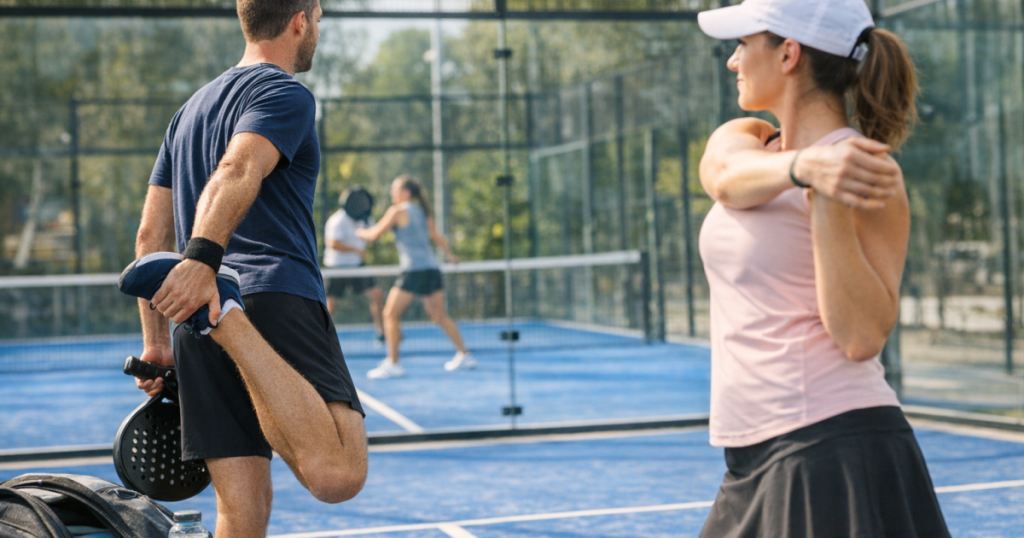
Padel asks a lot from your ankles, hips, upper back and shoulders. You do not need complicated stretches, but you do need movement through the ranges you will use during rallies: lunging low for the ball, turning for the glass, reaching for volleys and rotating on overheads.
Use dynamic movements rather than holding long stretches. Save deeper static stretching for after the match, when the goal is to relax rather than react quickly.
- Ankles: rise onto your toes 8–10 times, then gently rock from heel to toe.
- Calves and hamstrings: walk 5–10 metres with controlled high knees, then repeat with gentle heel flicks.
- Hips: do 6–8 bodyweight lunges, keeping them short and smooth rather than deep and forced.
- Upper back: rotate your torso left and right with relaxed arms, as if preparing for a bandeja or forehand turn.
- Shoulders: make small arm circles forwards and backwards, then a few easy shadow volleys.
Step 3: Add padel footwork before you hit
A good padel warm up should include the little movements that happen between shots. Beginners often warm up by hitting balls only, then feel late once the match starts because their feet have not switched on.
Stand around the service line and practise a split step, two short side steps, then a recovery step back towards the middle. Repeat both ways. Keep your knees soft and your steps quiet. You are trying to feel balanced, not prove how quick you are.
Then add three short forward movements, as if you are closing towards the net for a volley. Stop under control each time. In padel, arriving balanced is usually more useful than sprinting and overrunning the ball.
If you play mostly social games, this is a helpful habit because rallies can be unpredictable. One point might be a slow lob exchange; the next might be three quick volleys at the net. Your feet need to be ready for both.
Step 4: Start hitting at half speed
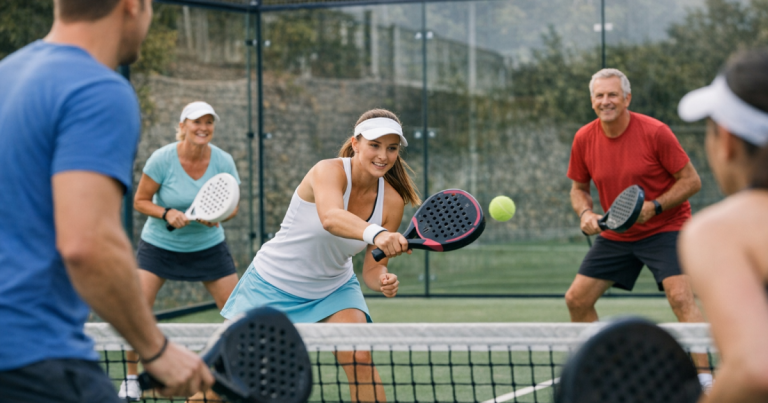
Once you pick up a racket, resist the temptation to blast the first ball. Start with controlled contact from close range. If there are four players, pair up across the net and hit gently from around the service line. Aim for clean contact, steady height and relaxed swings.
Spend the first minute trying to keep the ball in play rather than win the mini-rally. Then move back gradually and add more normal groundstrokes. If your club has limited knock-up time before social sessions, agree with your group that the first few balls are cooperative.
A simple hitting order works well:
- 1 minute of gentle forehands and backhands from the service line.
- 1 minute of volleys, aiming through the middle rather than at feet.
- 1 minute of lobs and overhead preparation, keeping the pace sensible.
- 30 seconds of playing one controlled rally point without keeping score.
If you are new to social play and still deciding how much structure you need, the comparison between padel lessons and social games can help you choose the right next step without overthinking it.
Step 5: Rehearse the serve and first shot
The serve is often where beginners feel most rushed. Before the match starts, hit a few legal practice serves from each side if time allows. Focus on a smooth drop, contact below waist height and a calm follow-through. You are not trying to ace anyone; you are trying to start the point without tension.
After each serve, take one step towards the net and prepare for the next ball. This matters because many beginners serve, admire the serve, then react late to the return. Make the serve and first movement feel like one action.
If you are unsure about the details, refresh the basics with this guide on how to serve legally in your first padel game. A confident legal serve makes social matches calmer for everyone.
A simple 10-minute routine
Use this when you have a little time before a normal club social match:
- Minute 1–2: brisk walk, light jog, side shuffles and small split steps.
- Minute 3–4: ankle rocks, lunges, torso rotations and shoulder circles.
- Minute 5: split step, side step and recover from the service line.
- Minute 6–7: gentle mini-rallies from close range.
- Minute 8: volleys and lobs at controlled pace.
- Minute 9: two or three serves from each side.
- Minute 10: one short practice point or a few serve-plus-first-volley patterns.
If you only have 5 minutes, keep the same order but shorten each part. Do not skip the movement completely and go straight to smashing balls. The shorter the warm-up, the more disciplined you need to be.
Quick checks before the first point
Before someone calls the score, take 30 seconds to check the things that can disrupt the opening game. These small details are especially useful in social matches, where players may not all know each other’s habits.
- Body check: are you moving freely, or is one area still stiff? Start the first game sensibly if you need a few more rallies to settle.
- Grip check: make sure your hand is dry enough and the racket is not twisting on contact.
- Ball check: agree which balls are being used and remove any dead or odd balls from the court area.
- Court check: notice the surface, lighting and any damp patches around entrances on outdoor or covered courts.
- Rules check: agree how strictly you are calling serves, lets and close calls before the match gets competitive.
Let calls can cause confusion in beginner games, particularly when the serve clips the net or players are unsure whether to replay the point. This clear explanation of padel let rules is worth reading before your next club session.
Common warm-up mistakes to avoid
Standing still while chatting
Social padel should be friendly, but chatting beside the court is not the same as warming up. Keep the conversation going while you move. Even gentle footwork is better than standing cold until the first serve.
Hitting too hard too early
Big shots feel fun, but they can make your timing worse if you start with them. Build from clean contact to normal pace. Your first few minutes should make you more controlled, not more tense.
Only warming up your favourite shot
If you spend the whole knock-up hitting forehands, the first backhand volley or lob defence may feel awkward. Touch each main shot lightly: groundstroke, volley, lob, overhead preparation and serve.
Turning the warm-up into a workout
A pre-match routine should leave you fresher, not fatigued. Long sprint sets, heavy resistance work or repeated maximal jumps are not needed before a relaxed social match. Save harder conditioning for a separate session.
Helpful questions
How long should I warm up before a social padel match?
Most beginners do well with 8–12 minutes. If you are short on time, do 2 minutes of movement, 2 minutes of mobility and 1 minute of controlled hitting rather than skipping the routine completely.
Should I stretch before playing padel?
Use dynamic mobility before playing: lunges, rotations, ankle rocks and easy shadow swings. Long static holds are usually better after the match or during a separate flexibility session.
Is it worth practising serves before a friendly match?
Yes. A few calm serves from each side help you settle your rhythm and avoid starting the match with a tight arm. Keep them controlled rather than powerful.
What if the court is busy and there is no space?
Do the first part beside the court: brisk walking, side steps, shoulder circles and gentle lunges. Once you get on court, use the first few shots cooperatively before playing points.
Should beginners practise smashes in the warm-up?
Only lightly. It is useful to rehearse the movement, but repeated hard smashes before a social match can be tiring and may annoy other players if the warm-up is meant to be cooperative.
What stands out
The best pre-match routine is short, repeatable and specific to the way padel is actually played. Raise your temperature, loosen the main joints, switch on your footwork, hit with control, then rehearse the serve and first movement. Do that consistently and you will start social matches sharper, calmer and more ready for the first rally.