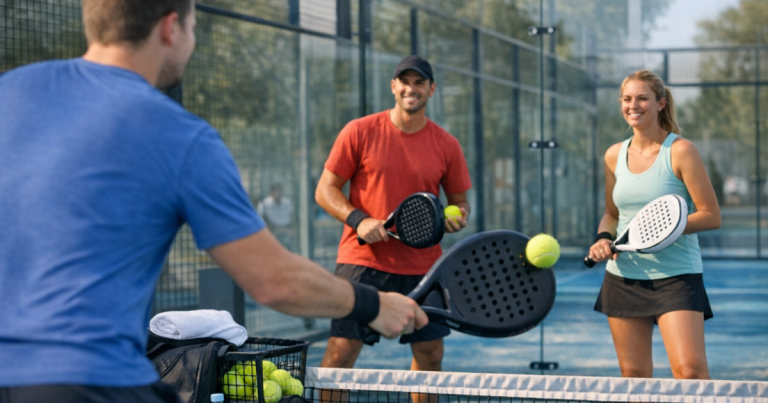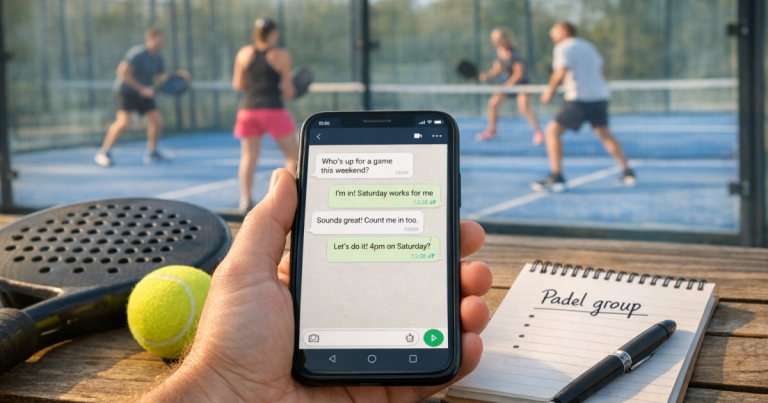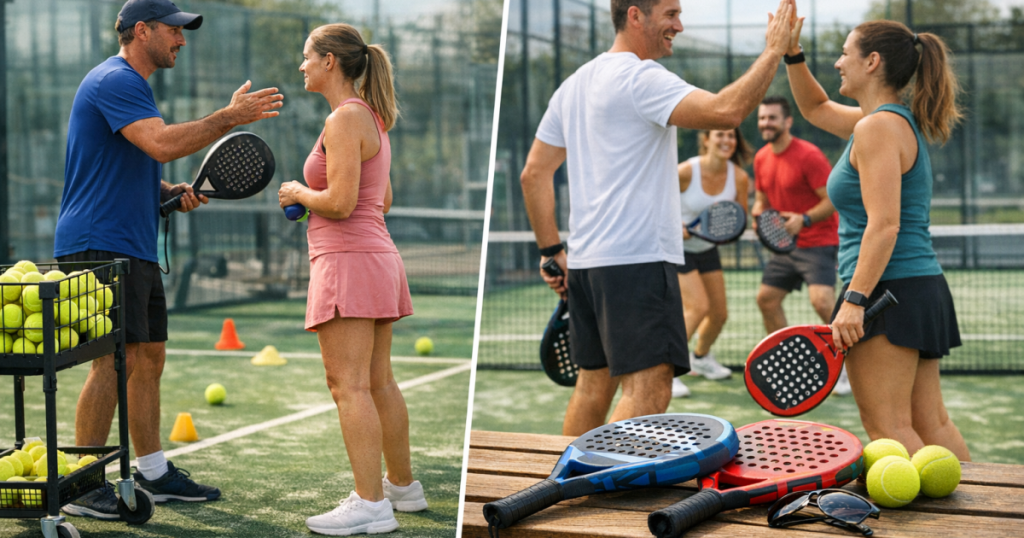
Your first few weeks in padel can feel oddly split: lessons promise structure, while social games promise fun and court time. For most new players, padel lessons vs social games is not an either-or decision. The best start is usually a small amount of coaching to learn the rules, contact point and positioning, then regular low-pressure games to make those ideas feel natural.
The short version
If you are completely new, start with at least one beginner lesson or clinic. It will save you from guessing the serve, standing in the wrong places, and developing habits that are annoying to undo later. Then play social games as soon as you can, because padel only starts to make sense when you deal with real rebounds, awkward lobs, changing partners and imperfect rallies.
A good beginner rhythm is one coached session for every two or three social games. That gives you enough guidance to improve, but enough play to stay relaxed and enjoy the sport. You do not need to become technically polished before joining a social session; you only need to know the basic rules, be honest about your level, and play with people who understand you are learning.
Why lessons help so much at the start
Padel looks simple because the court is smaller than a tennis court and the rallies can begin quickly. The confusing part is that the simple-looking shots are shaped by details: the underarm serve, the glass, court position, when to let the ball bounce, and how little swing you often need.
A beginner lesson gives you a clean starting point. A coach can show you the serve height, where to stand with your partner, how to defend after the glass, and why trying to win every point with one big shot usually causes more errors than winners. That matters because many new players arrive from tennis, squash, badminton, football or no racket-sport background at all. Everyone brings different instincts, and some of those instincts need softening for padel.
Lessons are also useful because feedback arrives immediately. If your racket face is too open, your feet are too square, or you keep drifting into your partner’s space, a coach can spot it in a minute. In a social game, you might simply lose the point without knowing why.
The biggest benefit is confidence. Once you understand the basic shape of the game, you can join beginner club sessions without feeling as though you are holding everyone back. If the rules still feel hazy, it is worth reading through the basic padel rules for beginners before your first organised game.
What social games teach that lessons cannot
Lessons are controlled. Social games are messy, and that mess is valuable. You will face balls that clip the side glass, serves that bounce lower than expected, partners who move differently, and rallies where nobody hits the perfect coaching-drill ball. This is where your learning becomes usable.
Social games teach timing, communication and judgement. You learn when to call “mine”, when to leave a ball for your partner, when to lob instead of drive, and how to recover after a poor shot. These are not small extras; they are central to enjoying padel.
They also teach emotional control. In a lesson, a mistake is just feedback. In a game, a mistake can feel like you have let your partner down. The sooner you play friendly, beginner-level matches, the sooner you learn that errors are normal and that the next point matters more than the last one.
For many UK beginners, social play is also the route into regular club life. You meet other players of a similar standard, find future partners, and discover which sessions suit your level. A one-off lesson can teach you the serve; a month of social games teaches you how to use it when someone is actually trying to return it.
A sensible first-month plan
You do not need a perfect training programme. You need enough structure to avoid confusion and enough play to keep the game enjoyable. A simple first month might look like this:
- Week 1: Book a beginner lesson, taster session or small-group clinic. Focus on the serve, court positions, forehand and backhand contact, and the basic idea of using the glass.
- Week 2: Join a beginner social game or club mixer. Tell the organiser you are new, and aim to keep rallies going rather than win points quickly.
- Week 3: Have another lesson or clinic. Ask about the specific problems you noticed in your social game, such as returning serve or getting trapped at the back.
- Week 4: Play two social sessions if your schedule allows. Try one clear focus, such as calling earlier, lobbing higher, or recovering to your side after each shot.
This approach keeps improvement practical. You are not collecting abstract tips; you are bringing real match problems back into coaching, then taking the answers back onto court.
When lessons are the better starting point
Choose a lesson first if you are nervous about the rules, have never played a racket sport, or dislike learning by trial and error in front of other people. A coach or beginner clinic can make the first social game feel far less intimidating.
Lessons are also the better start if you want to avoid common rule mistakes. Serving is the obvious example. Padel serves are underarm, must bounce before contact, and have specific placement rules. If you want a clear walk-through before you play, read how to serve legally in your first padel game and then practise it on court.
Coaching is particularly useful if you keep using a big tennis-style swing, stepping into your partner’s space, or trying to smash from poor positions. None of these habits make you a bad player; they are just common beginner patterns. Catching them early keeps your progress smoother.
When a social game is enough to begin
A social game can be a perfectly good first step if the session is clearly labelled as beginner-friendly and the organiser is used to new players. Many people learn best by doing, and padel is welcoming enough that you can enjoy your first hour without understanding every tactical layer.
The key is the level of the group. A relaxed beginner social is very different from a competitive match with regular players who expect quick reactions and consistent positioning. If you join the wrong level too early, you may spend the whole session apologising instead of learning.
Before you book, look for phrases such as “intro”, “beginner”, “improver”, “club social” or “all welcome”. If the listing uses rating levels, ask the organiser where a first-timer should start. It is much better to begin in a gentle session and move up quickly than to start too high and lose confidence.
The common trap: only doing one or the other
Only taking lessons can make you tidy but hesitant. You might hit nice feeds in drills, then freeze when a real opponent changes pace or the ball comes off the back glass at an ugly angle. Padel is a game of reading, reacting and solving problems with a partner, so match play matters.
Only playing social games can be fun but slow. You may improve through repetition, but you can also repeat the same mistake for weeks without knowing what to change. This is how beginners end up blaming their racket, the court, or the ball when the real issue is spacing, footwork or shot choice.
The blend works because each side fills the gap left by the other. Lessons give you a clearer map. Social games give you the roads, traffic and wrong turns that make the map useful.
How to make social games more useful
Beginner social games are not just about turning up and hoping to improve. A few small habits make them much more productive:
- Arrive early enough to warm up. A rushed start makes the first few games feel harder than they need to.
- Say your level honestly. Most players are happy to help if they know you are new.
- Pick one focus per session. For example, return more serves into court, call earlier, or lob when under pressure.
- Avoid coaching your partner mid-point. Keep communication short and positive during rallies.
- Ask one useful question afterwards. “Where should I stand when you serve?” is better than “What am I doing wrong?”
As you play more, you will start noticing whether your errors are technical, tactical or decision-based. That makes future lessons far more targeted.
What about online coaching and video?
Online coaching can help if you already play socially and want clearer explanations between court sessions. It is not a complete replacement for a coach seeing your movement live, but it can make tactics, positioning and shot selection easier to understand.
Video is useful for beginners because what you feel you are doing and what you are actually doing can be very different. A short clip of your serve, return position or bandeja attempt can reveal simple fixes. If you like the idea of structured learning away from court, our Hello Padel Academy review looks at whether online coaching is worthwhile for newer players.
Things readers ask
How many lessons should I take before playing a social game?
One beginner lesson is usually enough to start. You do not need to master every shot first. Learn the serve, scoring, basic positioning and how the glass works, then join a suitable beginner social.
Will better players be annoyed if I join a social session?
Not if the session is genuinely beginner-friendly and you are honest about your level. Problems usually happen when new players join a group that is too advanced for their current consistency.
Is group coaching better than one-to-one coaching for a first lesson?
Group coaching is often a good first step because it is social, affordable, and close to real game situations. One-to-one coaching is useful if you feel nervous, want faster feedback, or have a specific issue to fix.
Should I learn the rules before booking anything?
You only need the basics before your first session, but knowing the serve, walls, faults and lets will make the game feel much less chaotic. The rest becomes clearer once you are on court.
What if I am not fit or sporty?
Start with a beginner clinic or gentle social rather than a competitive match. Padel rewards positioning, patience and teamwork, not just speed or power, so you can build confidence gradually.
Why it matters
The best way to begin is the one that gets you learning and playing without feeling overwhelmed. For most beginners, that means using lessons for structure and social games for experience. Coaching helps you avoid confusion; social play helps you fall in love with the game.
If you are choosing your first step this week, book a beginner lesson or clinic, then put a social game in the diary soon after. That small combination gives you rules, rhythm and real rallies — exactly what you need to become a regular padel player.
Quick Buying Links
Padel Lessons
For most new players, padel lessons vs social games is not an either-or decision.
Social Games: The Best Way to Begin
Worth considering if its strengths better match your needs.