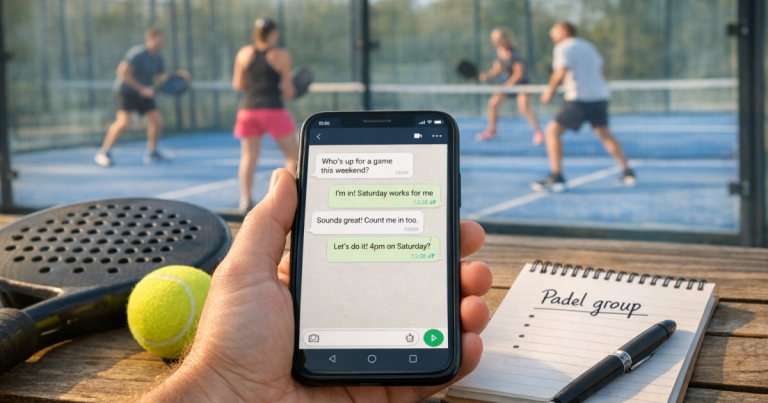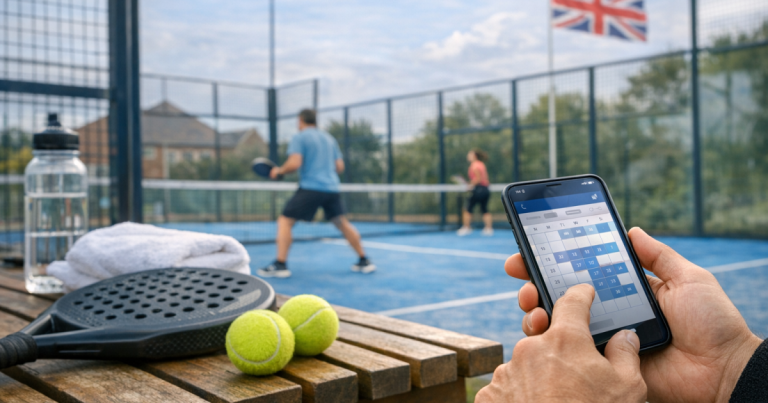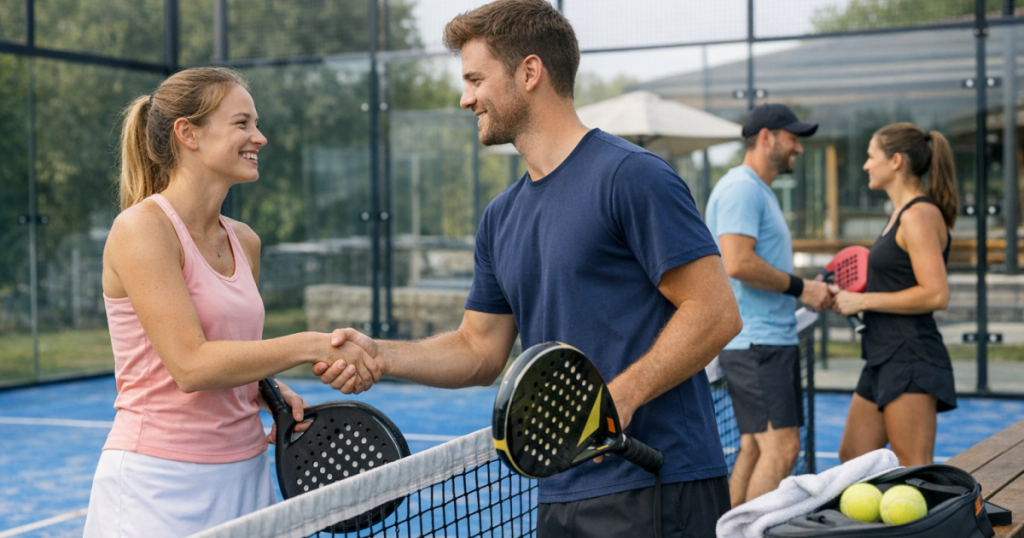
Walking onto a padel court for the first time can feel a bit awkward, even if everyone is friendly. Good padel etiquette for beginners is mostly about being easy to share a court with: turning up prepared, respecting the flow of play, communicating clearly, and leaving the court ready for the next group.
You do not need to know every unwritten club habit before your first game. If you understand the basics below, you will avoid the common mistakes that make new players feel self-conscious and you will be much easier to partner with in social games, coaching sessions, and club match nights.
The short version
- Arrive early enough to check in, change shoes if needed, and be ready when your court time starts.
- Warm up cooperatively rather than trying to win the warm-up.
- Call the score clearly before serving and be honest with line calls.
- Keep rallies safe by avoiding wild swings, walking behind active courts, or chasing balls onto another court without warning.
- Respect the booking slot: start promptly, finish promptly, and clear your belongings quickly.
- Be positive with partners. Padel is a doubles game, and good communication matters as much as shot-making.
Before you arrive at the club
Etiquette starts before the first ball is hit. Most UK padel venues run on timed bookings, so a late arrival can take minutes away from three other people. Aim to arrive 10 to 15 minutes before your slot, especially if it is your first visit to that club. That gives you time to find reception, locate the courts, use the toilet, fill a water bottle, and sort out anything you have hired or borrowed.
If you are joining a social mix-in, beginner session, or coaching group, read the booking notes carefully. Some sessions are aimed at complete beginners, while others assume you can serve, rally, and rotate in doubles. Turning up to the right level is not about ego; it keeps the session enjoyable for everyone.
Pack lightly but sensibly. A racket, water, suitable court shoes, a small towel, and a layer for after play are usually enough for a first session. If you are unsure what to bring, the checklist in how to pack for your first padel session is a useful next step.
Getting onto court without holding things up
When your booking starts, be ready to move onto court promptly. If another group is finishing, wait just outside the gate and let them collect their balls and belongings first. Avoid opening the gate mid-rally, even if your time has technically started. A few seconds of patience is better than interrupting a point or risking a collision.
Once you are on court, place bags, jackets, bottles, and phones where they will not become trip hazards. Many courts have benches or storage areas beside the glass. Do not leave loose items near the playing area or tucked by the net posts. Padel involves quick movement into corners and towards the doors, so clutter gets in the way quickly.
If you are playing with people you have not met before, a quick introduction helps: name, rough playing level, and whether you are very new. Most club players are happy to adjust when they know someone is learning. It is much better to say “I have only played a few times” than to pretend you know all the patterns and then feel lost.
Warm-up manners that make a good first impression
The warm-up is not a mini match. Its purpose is to let everyone find their timing, check the court conditions, and loosen up safely. Start with controlled forehands and backhands, then volleys, lobs, and a few serves if time allows. Hit to your partner or opposite player at a manageable pace rather than trying to blast winners.
Good warm-up etiquette also means sharing the ball. If one player is repeatedly retrieving or feeding while everyone else hits, reset the rhythm. After a minute or two, swap roles or switch sides so each player gets a similar feel for the court.
On outdoor courts, the warm-up is also a chance to notice wind, damp glass, low sun, or a livelier bounce after rain. On indoor courts, noise and lighting can feel different if you are not used to them. For a wider beginner-friendly comparison, see indoor vs outdoor padel.
Serving, scoring, and calling the game clearly
Clear scoring prevents confusion and small frustrations. Before each serve, the server should call the score loudly enough for all four players to hear. In casual games, people will forgive mistakes, but they will appreciate the effort to keep everyone aligned.
Padel uses underarm serving, and in doubles the serving order and receiver positions matter. New players often lose track after a few games, especially when rotating partners. If nobody is sure, pause briefly and agree the fairest reset rather than arguing. In friendly play, honesty and flow are more important than squeezing an advantage from a mix-up.
If you want the rules side explained separately, the guide to padel doubles serving order and rotation covers the structure without assuming tournament experience.
Line calls and honesty
Most beginner and club matches rely on players calling their own lines. The usual expectation is simple: if the ball is on your side and you clearly see it out, call it out. If you are not sure, give the benefit of the doubt to your opponents.
Call quickly and clearly. A late “out” after the rally has continued can feel unfair, even if it was genuine. If the ball clips the glass, fence, or side wall and you are unsure whether it bounced first, ask the nearest player what they saw. Do not turn every close call into a debate. Social padel works best when players trust each other.
It is also good etiquette not to pressure opponents over calls. Asking once is fine; repeatedly questioning every close ball makes the atmosphere tense. At beginner level, everyone is still learning the angles, so a generous attitude goes a long way.
Safety and spacing on a doubles court
Padel courts are compact, and four people move quickly around glass, mesh, doors, and the net. The main etiquette point is to stay aware of your partner’s position. Avoid taking huge backswings when your partner is nearby, and call “mine” or “yours” early when a ball comes through the middle.
If a ball rolls onto your court from another game, stop play straight away and remove it safely. Do not try to finish the rally around a loose ball. Likewise, if your ball goes onto another court, wait until their point has finished before asking for it back, unless it creates an immediate hazard.
When walking around a venue, never cross behind a court while a point is active if there is any chance of distracting players or entering the playing area. Use the marked paths and gates, and wait for a natural break before moving past tight court entrances.
How to communicate with your partner
Padel is social, but it is also a partnership. A calm partner makes the game more enjoyable, especially for new players who are already processing positioning, glass rebounds, and scoring. Use short, helpful calls: “leave”, “mine”, “switch”, “good lob”, or “take your time”. Avoid coaching your partner after every mistake unless they have asked for advice.
Encouragement matters. A simple “good idea” after a missed attacking shot can keep someone confident. If your partner makes the same error repeatedly, save detailed suggestions for a break between games rather than delivering a running commentary during points.
It is also polite to adapt to the level of the game. If you are stronger than the other players, do not dominate every rally, smash every loose ball, or target the weakest player relentlessly in a friendly session. You can still play properly while making the game enjoyable and useful for everyone.
Respecting the pace of club play
Most club sessions have a rhythm. Players change ends, take quick drinks, check the score, and get going again. Long pauses can eat into the booking and frustrate others, particularly during busy evening slots.
That does not mean rushing. Take water breaks, tie your laces properly, and ask rule questions when needed. Just avoid turning every point into a discussion or spending several minutes searching through your bag between games. If you know you like a towel or drink nearby, place it sensibly before the set starts.
At the end of the booking, finish the current point if the next group is not waiting, but do not start a new game when your time is up. Collect balls, clear the bench, check for personal items, and leave the court promptly. A smooth handover is one of the simplest ways to show respect at a busy padel venue.
What to do after the match
Post-match etiquette is straightforward: thank the other players, acknowledge your partner, and keep the tone friendly whether you won or lost. A quick handshake, racket tap, or verbal thanks is normal in casual UK club play.
If you borrowed balls, a racket, or club equipment, return it in the same condition and to the right place. If the court is damp, sandy, or littered with tape, bottle caps, or snack wrappers, leave it cleaner than you found it. Small habits like this help clubs stay welcoming for the next group of beginners.
If you enjoyed the session, say so. Club padel grows through friendly invites and repeat games. Asking “Do you play this time most weeks?” is a natural way to find future partners without making it awkward.
Common etiquette mistakes new players can avoid
- Arriving exactly at the start time: you are already late if you still need to park, check in, or change shoes.
- Overhitting in the warm-up: controlled rallies help everyone more than winners.
- Forgetting to call the score: say it before serving, even in relaxed games.
- Walking onto court mid-point: wait outside the gate until the rally has ended.
- Giving constant advice: encouragement is welcome; unsolicited coaching after every shot is not.
- Leaving belongings behind: check the bench, corners, and gate area before you leave.
- Arguing close calls: ask once if needed, then move on.
Different club settings, different expectations
A beginner coaching session, open social, box league match, and private court booking can all feel different. Coaching sessions are more structured, so listen to the coach’s instructions and keep balls moving efficiently during drills. In social sessions, the emphasis is usually on mixing in, being welcoming, and keeping games balanced. In league or ladder matches, players may be more focused on rules, scoring, and competitive fairness.
When you are unsure, watch for a few minutes and follow the local rhythm. Some clubs rotate after a set; others rotate after a fixed time. Some social groups use golden point; others play standard scoring. Asking “How do you normally run this?” is completely acceptable and shows that you want to fit in.
FAQ
Do I need to know all the rules before my first padel game?
No. You should know the basics of serving, scoring, and when the ball is in or out, but most beginner-friendly groups will help you as you go. Good manners and willingness to learn matter more than perfect rule knowledge at the start.
Is it rude to ask better players for tips?
It is fine to ask during a break or after the game. Avoid asking for detailed coaching during every point, as it can slow the session and put pressure on the other player.
What should I do if I hit someone with the ball?
Stop, apologise, and check they are okay. Accidental hits happen in padel, but acknowledging it quickly keeps the atmosphere friendly.
Can I join a club social if I am a complete beginner?
Check the session description first. Many clubs run beginner socials, but some open sessions expect players to rally and serve consistently. Choose the right level and message the organiser if the listing is unclear.
Should I bring my own balls?
For coaching or organised socials, balls are often provided, but private games may depend on the players. Check the booking details and bring a tube if you are organising the court.
What to remember
Good padel etiquette for beginners is not about being formal or nervous. It is about making the game easier for the four people on court: be on time, communicate clearly, stay safe, respect the booking, and treat partners and opponents generously.
New players who follow those basics quickly become the kind of people others are happy to invite back. That is the real value of court and club etiquette: it helps you relax, build confidence, and move from trying padel once to feeling part of regular club play.