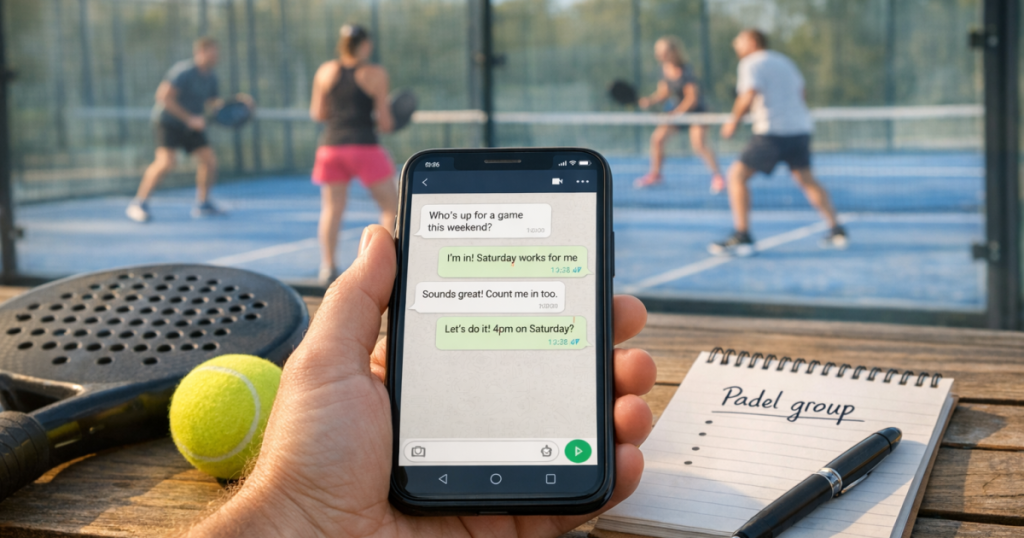
Walking onto a court is easier when you already know who is turning up, but many beginners start without a ready-made group. The simplest way to find padel partners is to combine club sessions, booking apps, WhatsApp groups and friendly follow-ups after matches. You do not need to be brilliant; you just need to be clear about your level, reliable with bookings and open to mixed games while you build a regular circle.
Padel is naturally social because most games are doubles. That can feel awkward at first, but it also means there are more routes into regular play than in many other racket sports.
At a glance
- Start with beginner-friendly club sessions rather than trying to organise a private four straight away.
- Ask venues which WhatsApp, app or noticeboard they use for player matching.
- Be honest about your level so games feel fair and enjoyable.
- After a good match, suggest another specific time rather than leaving it vague.
- Keep a small list of dependable players so you can fill courts more easily.
Begin with organised club sessions
The easiest route is usually a club social, taster session, improver group or beginners night. These sessions remove the hardest part: finding three other people before you book. A coach or organiser will often rotate players, balance levels and keep things moving, which gives you a relaxed way to meet people without feeling responsible for the whole evening.
When you enquire, ask simple, direct questions:
- Is the session suitable for complete beginners or early-stage players?
- Do players rotate partners during the session?
- Is there a WhatsApp group or mailing list for future games?
- Do I need to bring a partner, or can I attend alone?
- What happens if the session is full?
If you have not booked before, get comfortable with the process first. The guide to booking your first padel court in the UK explains what to expect when choosing a venue, slot and court type.
Use venue groups, not just public social media
Public Facebook groups and local community pages can help, but the most useful player groups are often run around a specific venue. These groups tend to be more practical because everyone is already willing to travel to the same courts.
Ask at reception, message the venue, or speak to the session organiser after play. Many clubs have informal groups for beginners, improvers, ladies sessions, mixed socials, daytime players or last-minute court fillers. Some are very active, while others are quiet but still useful when someone needs a fourth player.
When you join, introduce yourself briefly. You do not need a long playing history. A useful message might include your approximate level, preferred days, nearest venue and whether you are happy to play mixed-level games. For example: I am a beginner who has played a few socials, based near the club, usually free weekday evenings, and happy to join friendly games.
Be clear about your level without underselling yourself
Level-matching matters because padel is more enjoyable when rallies last. Beginners often worry about being too weak for a group, but most players are fine with mixed ability if expectations are clear.
Use plain descriptions instead of trying to guess a formal rating. Say whether you are brand new, have played a few times, can rally consistently, understand the walls, or are starting to serve and return with control. That is more helpful than saying you are intermediate when you are not sure what that means at your club.
If you are invited to a stronger game, be positive but honest. You can say you are happy to join if they need a fourth, but you are still learning and do not want to spoil a competitive match. That gives the organiser room to decide, and it shows you respect the group.
Turn one good game into another
The best padel contacts often come from the people you have already played with. If you enjoyed a match, say so before everyone leaves. A simple follow-up works better than waiting for someone else to organise the next one.
Try one of these low-pressure lines:
- That was a good level for me. Would you be up for another game next week?
- I usually play on Tuesday or Thursday evenings. Shall I message if I see a court?
- If you ever need a fourth for a friendly game, I would be happy to join.
- Do you mind if I add you to a small group for beginner games?
Specific plans build momentum. Instead of saying let us play again sometime, suggest two possible days or a rough time. You will quickly learn who is reliable, who books promptly and who prefers casual invites.
Make mixed-level matches work for you
Most beginners will play mixed-level games at some point, especially when courts are busy or groups are short of one player. These matches can be useful, but they work best when everyone understands the tone of the game.
If you are the newer player, focus on keeping the ball in play, communicating with your partner and learning positioning. You do not need to hit winners to be a good addition to the court. If you are joining a more experienced group, ask whether they want a relaxed hit, a coaching-style game or a proper match. That tiny question avoids a lot of awkwardness.
For more confidence before stepping into uneven groups, read the advice on handling your first mixed-level padel match.
Try apps and booking platforms sensibly
Some UK venues use booking platforms, club management tools or event apps to organise sessions and player lists. These can be useful, but they are not all used in the same way. At one club, the app might show open matches and social events. At another, it might only handle court bookings while the real player matching happens in WhatsApp.
Do not assume the technology is the whole answer. Use apps to spot sessions, then follow up with real people. If a club uses a group management tool, check how notifications work, who can create events and whether the group is actually active. The review of the Spond app for padel club sessions is useful if your local group uses it to organise players.
Build a small dependable player list
You do not need dozens of contacts. A reliable list of six to ten players at a similar level is enough to make padel feel much easier to organise. With that size group, someone is usually available, and you can still rotate partners so games stay fresh.
Keep your messages simple. Include the venue, date, time, expected level and whether the court is already booked. People are more likely to reply when the decision is clear. For example: Court available at 7 pm on Wednesday at our usual venue, beginner to early improver level, need two more.
Good group habits matter. Confirm promptly, pay your share on time if costs are being split, and give as much notice as possible if you need to cancel. Reliability is one of the quickest ways to be invited back, even if your padel level is still developing.
Where beginners often go wrong
The most common mistake is waiting until you have the perfect four. Start with sessions where the organiser handles rotation, then gradually create your own group. Another mistake is joining games that are far too competitive too soon. You may learn a lot, but if every rally feels like survival, it can knock your confidence.
It is also easy to be too vague. Messages like anyone fancy a game sometime rarely work. Give people enough detail to say yes or no quickly. Venue, day, time, level and number of players needed are the basics.
Finally, avoid treating every game like a trial. Most players remember whether you were friendly, fair and dependable more than whether you won. Say hello properly, call the score clearly, apologise for accidental body shots and thank people afterwards. Small court habits make you easier to play with.
Simple ways to widen your circle
- Attend the same weekly session for a month so familiar faces become contacts.
- Arrive ten minutes early and chat rather than rushing straight onto court.
- Ask coaches which sessions suit your current level.
- Volunteer to be a reserve when a group needs a last-minute fourth.
- Try daytime, weekend and evening sessions if your schedule allows.
- Play with different partners instead of always sticking with one friend.
- Keep notes on which groups are friendly, competitive, beginner-focused or mixed level.
As your confidence grows, you can be more selective. Early on, the goal is to get court time, meet decent people and learn what sort of padel environment suits you.
Questions people ask
Can I turn up alone to a padel session?
Often, yes, if it is listed as a social, taster or organised club session. Always check with the venue first, because some court bookings require you to bring your own four players.
What should I say when asking strangers for a game?
Keep it short and useful: mention your level, availability, preferred venue and whether you are looking for friendly or competitive play. Clear details make it easier for others to include you.
Is it awkward to join a group as the weakest player?
It can feel awkward, but honesty helps. Tell the group you are still learning and ask whether the match is relaxed enough for your level. Many players are happy to include beginners in the right setting.
How many padel contacts do I need?
A small group of six to ten reliable players is usually enough for regular games. You can then add people gradually through socials, club sessions and follow-up matches.
What is the fastest way to find padel partners as a beginner?
Book into beginner socials and ask the organiser which group chat or app the venue uses. That combines structured play with access to players who are already looking for games.
Why it matters
Finding people to play with is not just admin; it is one of the biggest steps from trying padel once to becoming a regular player. The more dependable your playing circle becomes, the easier it is to book courts, practise under match conditions and enjoy the social side of the sport.
Start with organised sessions, be honest about your level, follow up after good games and keep your plans specific. Do that consistently and you will not just fill courts more easily; you will feel much more at home in your local padel scene.