The best way to practise between padel lessons is to keep your solo or social practice narrow, slow enough to control, and tied to the last correction your coach gave you. New players usually pick up bad habits when they chase winners, copy advanced players too early, or repeat a shot without noticing what their body is doing.
Think of practice as a way to make your next lesson easier. You are not trying to rebuild your whole game alone; you are giving your coach better raw material to work with next time.
In brief
- Choose one theme from your last lesson, not five different things.
- Practise at a pace where you can repeat the movement cleanly.
- Use simple targets and constraints instead of trying to hit spectacular shots.
- Stop a drill when the technique gets messy, even if you still have court time left.
- Write down what felt better, what broke down, and what you want to ask your coach.
Step 1: Turn your last lesson into one clear practice goal
The biggest mistake beginners make is leaving a lesson with too many ideas. You might have worked on grip, ready position, bandeja shape, serve placement, wall timing and communication. Trying to practise all of that in one session usually means none of it improves properly.
Before your next hit, pick one main goal. It should be specific enough that you can notice whether you are doing it. For example, “keep the racket head up before volleys” is useful. “Improve net play” is too broad. “Let the ball come off the back glass before swinging” is useful. “Get better at walls” is too broad.
If you are still in your first few weeks, link your practice to a sensible progression rather than random court time. The first month plan for new padel players is a helpful way to keep lessons, games and basic skills moving in the right order.
Step 2: Use the “clean reps before clever reps” rule
A clean repetition is one where your body position, contact point and shot choice match what you are trying to practise. It does not have to be powerful. It does not even have to win the point. It simply has to reinforce the movement you want.
For beginners, clean reps usually come from slowing down. That might mean a softer feed, a bigger target, fewer moving parts or a shorter drill. If the ball is flying around the court and you are lunging, flicking or guessing, the drill is probably too hard for the habit you are trying to build.
A useful rule is to aim for sets of 8 to 12 controlled repetitions. If you can do those with reasonable shape, increase the challenge slightly. If you cannot, reduce the difficulty. That could mean standing closer, feeding by hand, using a softer rally speed or removing the pressure to finish the point.
Step 3: Practise with constraints, not pressure
Pressure is when you try to win, impress or hit harder before the technique is ready. Constraints are simple rules that guide your decisions. Good constraints help you avoid bad habits because they stop you from escaping into the shots you already overuse.
Here are beginner-friendly examples:
- For volleys, only aim cross-court and below chest height for a few minutes.
- For lobs, count a shot as successful only if it gives you time to recover, not just if it lands in.
- For serves, aim to start the point calmly rather than looking for an instant winner.
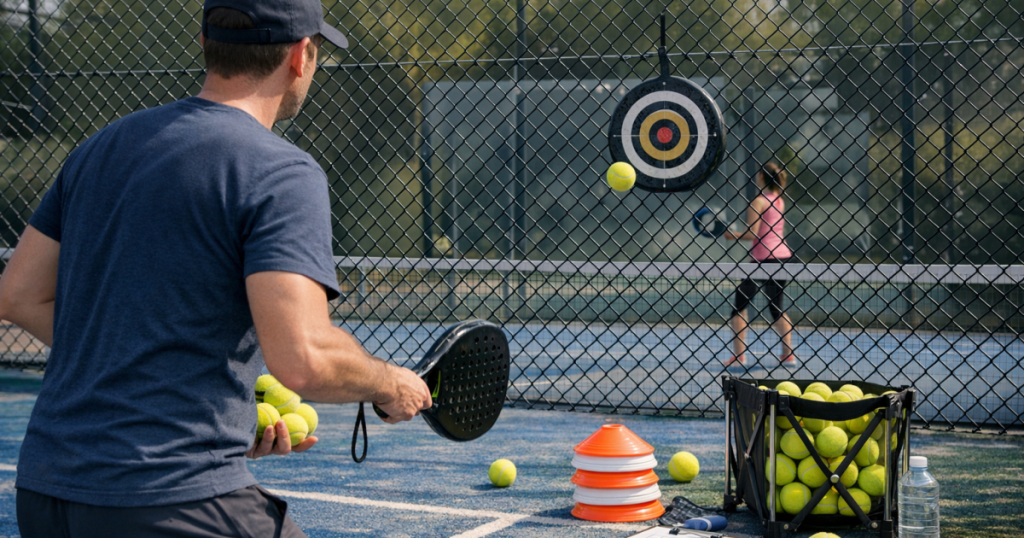
- For wall practice, wait for the ball to drop into a comfortable contact zone before swinging.
- For defence, play three steady balls before trying to change direction.
These restrictions can feel less exciting than match play, but they are exactly what helps a new player build reliable choices. Padel rewards control, positioning and patience much more than a collection of one-off highlight shots.
Step 4: Build a simple 45-minute practice session
A good practice session does not need to be complicated. In fact, if you are new to padel, a simple structure makes it easier to stay honest about your technique.
Minutes 0 to 8: warm up with purpose
Start with gentle rallies, short volleys and easy movement. Do not judge your level during the warm-up. Use it to check your ready position, footwork and timing. If you are practising a lesson point, bring it in early at low speed.
Minutes 8 to 20: repeat the main skill
This is the most important block. Work on one skill from your lesson: perhaps forehand volley shape, back glass timing, serve rhythm or a simple lob. Keep the feeds predictable at first. You want enough repetition to feel the movement, not chaos.
Minutes 20 to 32: add movement or decision-making
Once the basic movement is stable, add one realistic challenge. You might recover to the centre after each shot, alternate forehand and backhand, or choose between playing low and lobbing. Add only one layer at a time.
Minutes 32 to 42: play points with one rule
Finish with controlled points, but keep the theme alive. For example, if your lesson was about defending from the back, start each point from a defensive feed. If you were working on volleys, you only “score” a good point if you hold your net position sensibly.
Minutes 42 to 45: note what happened
Write down three short notes: what improved, what failed under pressure, and what question you want to ask in your next lesson. This is one of the easiest ways to make your coaching more valuable.
Step 5: Know which habits to avoid early
Not every mistake is equally harmful. Some are just part of learning. Others become sticky because they feel useful in the short term. Watch out for these common beginner habits:
- Standing too upright between shots, which makes late reactions more likely.
- Taking huge swings on slow balls instead of preparing early and contacting cleanly.
- Running straight to the net without noticing whether your shot gave you time to move.
- Trying to smash every lob instead of using a controlled overhead or resetting the point.
- Turning your shoulders too late on balls off the glass.
- Playing every ball down the line because it feels decisive, even when cross-court is safer.
When you practise between padel lessons, your job is not to remove every mistake. It is to stop the same avoidable mistake from becoming your default. If you spot a repeated problem, slow the drill down and return to the simplest version of the shot.
Step 6: Use video without over-analysing yourself
Short video clips can be useful, but only if you know what you are checking. Do not film a whole session and then judge every detail. That usually leads to confusion or frustration.
Instead, record 20 to 30 seconds of one movement. Watch for one cue from your coach. For example, are you preparing before the bounce? Is your racket starting in the right place? Are you balanced after contact? Are you recovering after the shot?
If something looks different from what you expected, save the clip and show it to your coach. Avoid rebuilding your technique from online clips between lessons, because small details such as grip, stance and ball height can change the right correction.
Step 7: Make social games part of practice
Club games and friendly matches are where you test whether a skill survives under pressure. The key is to enter those games with one private focus rather than trying to control the whole match.
For example, you might decide: “Today I will recover after every lob,” or “I will not rush balls off the back glass.” You can still play normally, but your success measure is linked to the habit you are building.
Choosing the right people to practise with also matters. A steady partner who feeds you playable balls and understands the goal is more useful than a chaotic game where every point turns into survival. If you are trying to build regular practice around lessons, use this guide on finding a padel partner for regular games so you get enough repetition without turning every hit into a mini tournament.
Step 8: Ask your coach better questions
Your coach can help more if you bring clear feedback. Instead of saying “my volleys were bad,” try something more specific: “When the ball came fast at my body, I dropped the racket and jabbed at it.” That gives your coach something useful to diagnose.
Good questions include:
- “Which part of this movement should I practise first?”
- “What is the easiest drill I can use between lessons?”
- “How will I know if I am doing this wrong?”
- “Should I use this shot in matches yet, or keep it to practice?”
- “What should I ignore for now so I do not overload myself?”
That last question is underrated. Beginners often improve faster when they know what not to worry about yet.
Step 9: Keep net practice realistic
Net play is where many beginners develop rushed habits. They stand too close, swing too much, or try to finish from awkward positions. A cleaner approach is to practise compact volleys, soft hands and good recovery before looking for winners.
Use targets that reward control. Aim deep into safe areas, keep the ball low when possible, and recover to a balanced position after each shot. If you are unsure when you can legally take the ball early or what counts as a valid volley, read the explanation of volley rules in padel before drilling too many net situations.
Step 10: Stop before tired practice turns sloppy
More repetitions are not always better. Once you are tired, late or annoyed, you may start practising the exact movement you are trying to avoid. Beginners often call this “getting more practice in”, but it can be habit-building in the wrong direction.
End a drill when your form drops for several reps in a row. Move to an easier version, take a short break, or finish with a calm rally. Leaving the court with a few clean repetitions in your body is better than grinding through messy shots just because time remains.
Questions people ask
How many times should I practise between padel lessons?
One or two focused sessions between lessons is plenty for most beginners. Quality matters more than volume, especially while your technique is still settling.
Is match play enough practice?
Match play helps decision-making, but it rarely gives enough repeated practice of one skill. Use games to test habits, and drills to build them.
Should I practise alone if I cannot book a court partner?
You can still rehearse footwork patterns, shadow swings and recovery positions off court. Keep it slow and accurate, and avoid inventing complex movements without coaching feedback.
What should I do if my practice feels worse than my lesson?
Reduce the speed and difficulty. Lessons often create new awareness, so a temporary dip is normal while your body learns a cleaner pattern.
Can I copy advanced players at my club?
Use them for ideas, not direct imitation. Advanced players may use shots and positions that rely on timing, strength and experience you are still building.
Key takeaways
Good practice between lessons is not about doing everything. It is about repeating the right things often enough that they start to feel normal. Pick one lesson theme, make the drill simple, add pressure gradually, and stop when the quality drops.
If you keep notes and bring specific questions back to your coach, each lesson becomes part of a longer learning loop. That is how beginners turn occasional coaching into steady progress without collecting bad habits along the way.