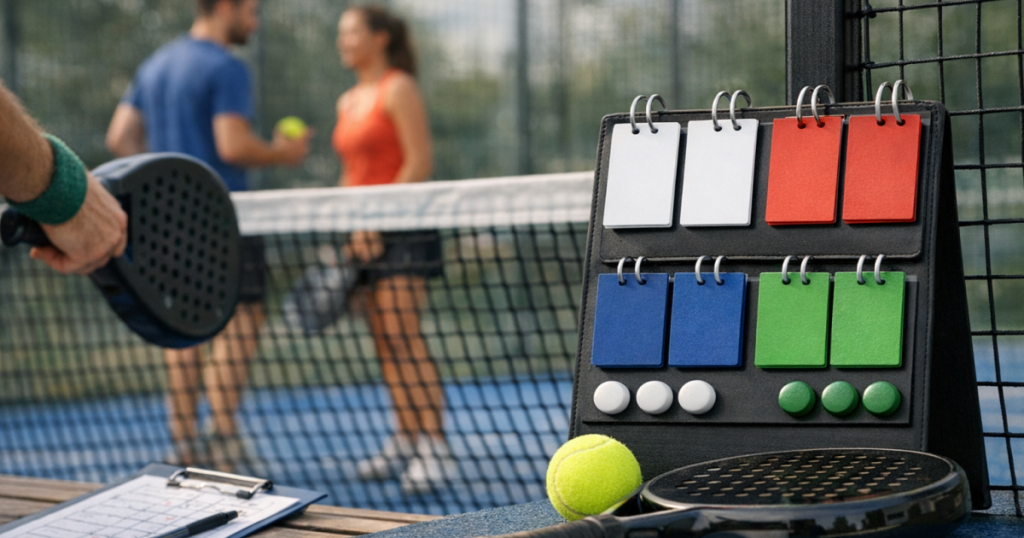
Padel uses tennis-style scoring, but doubles rotation, glass-court rallies and quick club formats can make it feel busier at first. Once you know the rhythm, it is straightforward to keep score in padel without stopping the game every few points.
The key habit is simple: say the server’s score first, confirm the game score before each serve, and agree the format before the first point. That prevents most beginner mix-ups.
What to know first
- Padel points go: love, 15, 30, 40, then game.
- The server’s team score is always called first.
- At 40-40, you either play deuce and advantage, or a golden point if that format has been agreed.
- A set is usually first to 6 games, with a 2-game lead needed.
- At 6-6, many matches use a tie-break, usually first to 7 points with a 2-point lead.
- Club sessions may use shorter formats, timed matches or sudden-death scoring, so confirm the rules before you start.
Step 1: Learn the point order
Each game starts at love-all, which simply means 0-0. The first point won takes a team to 15, the second to 30, the third to 40, and the fourth normally wins the game.
So a basic game might be called like this:
- Love-all: nobody has won a point yet.
- 15-love: the serving team has won the first point.
- 15-all: both teams have won one point.
- 30-15: the serving team has won two points and the receiving team has won one.
- 40-15: the serving team is one point away from winning the game.
- Game: the game is finished and the next service game begins.
The word “all” means both teams are level at that score. You will hear 15-all and 30-all often. At 40-all, players usually say “deuce” rather than 40-all.
Step 2: Call the server’s score first
This is the rule that clears up most confusion. In padel, just like tennis, the score within a game is called from the server’s point of view.
If your team is serving and you have won two points while the other team has won one, the score is 30-15. If you are serving and the other team has won two points while you have won one, the score is 15-30.
A good club habit is for the server to call the score clearly before every first serve. It does not need to be loud or theatrical. A simple “30-15” before starting the service motion is enough. If nobody is sure, stop before the serve, agree the score, then continue.
Step 3: Understand deuce, advantage and golden point
When both teams reach 40, the game score is deuce. What happens next depends on the format being played.
If you are playing advantage scoring
After deuce, a team must win two points in a row to win the game. If the serving team wins the next point, the score is “advantage server”. If the receiving team wins it, the score is “advantage receiver”.
If the team with advantage wins the next point, they win the game. If they lose it, the score goes back to deuce. This can repeat several times, which is why a close game can last much longer than expected.
If you are playing golden point
Some padel clubs and social formats use golden point at deuce. That means the next point decides the game. No advantage, no repeat deuces, no extended game.
In golden point formats, the receiving pair usually chooses which side will receive the serve. This is worth confirming before the match starts, because not every social group explains it the same way. If you are joining a new club night, ask: “Are we playing advantage or golden point?” before the first game.
Step 4: Track games inside the set
Points make up games, and games make up a set. A standard set is usually first to 6 games, but the winning pair must lead by 2 games. That means 6-4 wins the set, but 6-5 does not finish it yet.
Common set scores include:
- 6-0: one pair won every game.
- 6-3: a clear set win.
- 6-4: a normal set win with a 2-game margin.
- 7-5: used when the set reaches 5-5 and one pair wins the next two games.
- 7-6: usually means the set was decided by a tie-break.
When calling the game score in a set, you still call the serving pair’s score first during a game, but the set score is normally said from your pair’s perspective or agreed neutrally. For example, between games you might say, “We are 3-2 up,” or “It is 3 games all.”
If you are still settling into match routines, the first few weeks are also a good time to build other basics. The first month padel plan is a useful next step if you want scoring, positioning and confidence to improve together.
Step 5: Know what happens at 6-6
At 6 games all, many full sets are decided by a tie-break. The usual tie-break target is 7 points, but again the winning pair must lead by 2. So 7-5 wins, 7-6 does not, and the tie-break continues until a pair leads by 2 points.
Tie-break scoring is simpler than game scoring because you count points normally: 1, 2, 3, 4 and so on. You do not use 15, 30 and 40 in a tie-break.
The player whose turn it is to serve usually serves the first point of the tie-break. After that, serve changes every two points. Players also change ends at regular intervals, commonly after every 6 points played. At beginner level, the most important thing is to pause briefly at 6-6 and agree the tie-break routine as a four.
Step 6: Keep the service order straight
Scorekeeping becomes easier when everyone knows who is serving next. In doubles padel, one player serves for the whole game. In the next game, the serve passes to the other pair. Over the set, all four players take turns serving in an agreed order.
At the start of a set, each pair decides who will serve first for their side. Once that order is set, keep it for the set. At the start of a new set, pairs can choose again.
Within each service game, the server alternates sides after every point. The first point of the game is served from the right-hand side. The next is from the left, then right again, then left again. A simple memory aid is that even scores start from the right side: love-all, 15-all, 30-all and deuce.
Receiving positions also matter. A receiving pair normally chooses who receives on the right and who receives on the left at the start of a set, then keeps those sides for that set. This avoids confusion during close games.
Step 7: Agree any club format before the first serve
Not every padel match at a UK club uses a full best-of-three-set format. Social evenings, box leagues, coaching games and open sessions often use shorter versions so that everyone gets a fair amount of court time.
You might come across:
- Timed matches, where the score stands when the buzzer goes.
- One short set to 4 games instead of 6.
- Golden point at deuce to keep games moving.
- A match tie-break to 10 points instead of a full deciding set.
- Americano or Mexicano formats, where partners and opponents rotate.
None of these formats is difficult, but they do change how you keep score. Before starting, ask three quick questions: “How many games are we playing?”, “Are we using golden point?”, and “What happens if we run out of time?” That 20-second chat saves awkward debates later.
Examples you will actually hear on court
Here are a few common score calls and what they mean.
- “15-love” means the serving pair has won one point and the receivers have won none.
- “Love-30” means the receiving pair has won the first two points of the game.
- “30-all” means both pairs have won two points.
- “Deuce” means both pairs have reached 40.
- “Advantage receiver” means the receiving pair won the point after deuce and can win the game with the next point.
- “4-3, our serve” means your pair leads by 4 games to 3 in the set and is about to serve the next game.
- “Tie-break, 5-4” means one pair leads by 5 points to 4 in the tie-break, not by games.
If a rally ends with a ball touching the mesh, glass or court boundary and nobody is sure who won the point, sort that out before adding it to the score. For those situations, the guide to padel fence rules explains what counts as in, out or legal.
Simple habits that stop score disputes
Most scoring problems are not caused by difficult rules. They happen because nobody called the score for three points and then everyone remembers a different version. Use these habits to avoid that.
- Call the score before every first serve.
- Confirm deuce, advantage or golden point before serving at 40-40.
- Say the set score when changing ends or starting a new game.
- Restart the discussion before the next serve, not after another rally.
- Let the server lead the point score, but allow polite correction immediately.
- In social games, prioritise agreement over winning an argument.
If you are practising outside lessons, rehearse the scoring rhythm as part of your rallies rather than treating it as separate admin. The advice on practising between padel lessons can help you build useful habits without overcomplicating your sessions.
Things readers ask
Do you say your score first in padel?
You say the serving team’s score first during a game. If your pair is serving and trailing by two points to one, the score is 15-30, not 30-15.
Is padel scoring the same as tennis?
For standard games and sets, it is very similar: love, 15, 30, 40, deuce, advantage and games within sets. The main beginner differences are club formats, golden point use and the doubles service rotation.
What is the easiest way to keep score in padel as a beginner?
Call the score before every serve and always use the server’s score first. If the score reaches 40-40, pause and confirm whether you are playing advantage or golden point.
What score wins a padel set?
A standard set is usually won at 6 games with a 2-game lead, such as 6-4. If it reaches 6-6, many matches use a tie-break to decide the set.
What happens if nobody can remember the score?
Stop before the next serve and work backwards through the points as calmly as possible. If you cannot agree, replaying the point is often the fairest option in a friendly club game.
Main lessons
Padel scoring feels much easier once you separate it into three layers: points, games and sets. Points use love, 15, 30 and 40. Games build the set. Sets decide the match or the session format you have agreed.
For beginner club play, the most useful habits are clear score calls, early agreement on deuce or golden point, and checking the format before you begin. Do that, and you can focus less on the scoreboard and more on enjoying the rallies.