Good rotation keeps a padel pair calm when the rally gets messy. Once you understand how to rotate positions in padel, you stop chasing every ball and start covering the court as a team.
For beginners, the goal is not fancy movement. It is simple: know when to switch, when to hold your side, and how to tell your partner early enough.
The useful shortcut
Padel rotation is the way two partners swap, recover, and share space during a point. You are not fixed to one half of the court once the rally is live, but you do need a shared plan so both players do not move to the same ball.
- Switch when one player is pulled so far across that staying would leave a big gap.
- Hold your side when your partner can still recover comfortably.
- Call early, using simple words such as switch, stay, mine, yours, up, and back.
- Move as a pair, not as two separate players chasing individual shots.
- After the danger moment, return to a balanced shape before thinking about attacking.
If you are still getting comfortable with serves, faults, walls, and what is allowed during a rally, it is worth checking the basic padel rules first. Rotation makes more sense when the structure of the point is clear.
What rotation actually means in a rally
Most beginner pairs start with one player on the left side and one on the right side. That is useful because it gives each person a clear home area. Rotation does not mean abandoning that completely. It means adjusting when the rally forces you out of shape.
Imagine your partner on the right is dragged wide to the side glass. They reach the ball, but their momentum carries them outside the normal right-side position. If you stay planted on the left, the middle of the court opens up. A simple switch lets you slide across to cover the middle-right space while your partner recovers through the left or back into shape.
The mistake many beginners make is treating every crossing movement as a permanent swap. Often it is only temporary. You switch to survive the next shot, then reset when there is time. Think of rotation as court coverage first, and side preference second.
Step 1: Start with a clear left-right agreement
Before the match or session starts, decide who is playing on which side. This is not about status or ability. It just gives the pair a starting shape.
As a simple beginner rule, choose sides based on comfort. If one player feels more confident with backhand volleys, overheads, or defending the back corner, that may influence the decision. If neither of you knows yet, pick a side and keep it for a few games so you can learn patterns instead of changing constantly.
Before the point starts, serving and receiving rules still matter, so do not treat rotation as a way to ignore the diagonal serve or the agreed return positions. Once the ball is in play, your movement can be more flexible.
Step 2: Use the middle as your reference point
The middle of the court causes the most confusion in beginner doubles. Both players think the other one has it, or both move at once and leave the sides exposed.
A helpful rule is this: the player with the easier, more natural shot takes the middle ball. That is usually the player whose forehand or controlled backhand is lined up without stretching. If both players can reach it, the player moving forward with balance normally has priority over the player moving backwards.
Rotation becomes easier when you stop seeing the middle as a no-man’s land. It belongs to the pair. Decide early, call clearly, and then let the non-hitting player adjust behind the shot.
Step 3: Call the switch before you move too far
Good rotation is mostly communication. The word itself matters less than using it early and consistently.
Keep your calls short. During a rally, there is no time for explanations. Use one-word or two-word calls such as switch, stay, mine, yours, leave, back, and up. If your partner is focused on the ball, call loudly enough for them to act without turning round.
Do not wait until both of you are already in the same corner. If you can see that your partner will be pulled wide or deep, call before the next shot arrives. Early calls make the movement feel calm rather than panicked.
Step 4: Move in an X pattern, not in straight lines
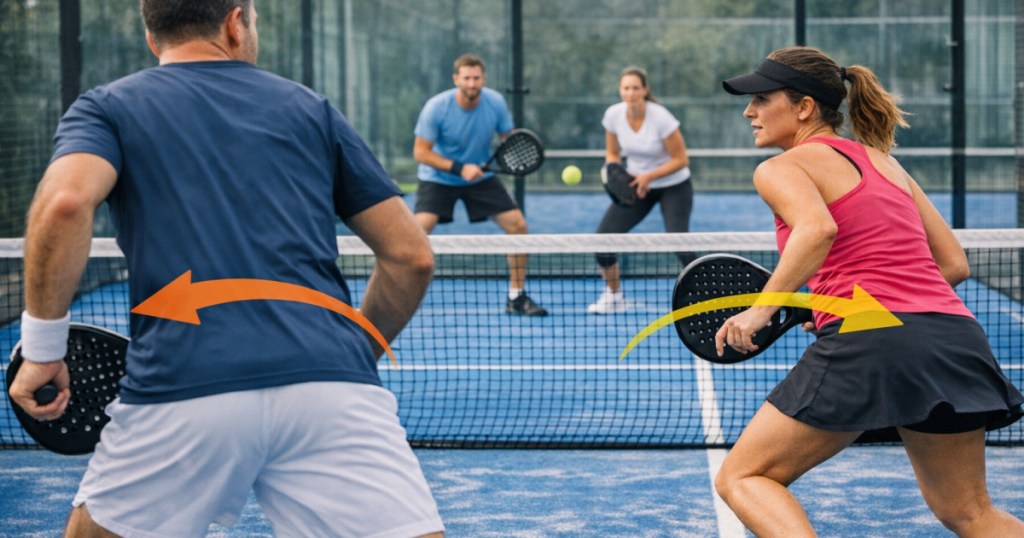
A useful way to picture rotation is an X across your half of the court. If your partner is taken wide and forward, you often slide diagonally towards the space behind or beside them. If your partner is pushed deep into the back corner, you may need to shade towards the middle rather than sprinting to the same corner.
The key is balance. One player goes to the ball. The other protects the space the opponent is most likely to attack. That may be the centre, the open side, or the gap between net and back court.
Try not to run in parallel lines. If both players move sideways together, you can leave a simple gap on the opposite side. If both players move backwards together without purpose, you lose pressure at the net. The best pairs move in relation to each other.
Step 5: Know the common moments to rotate
When a lob goes over one player
If your partner is lobbed and cannot play an overhead comfortably, they may turn and chase towards the back glass. You should usually drop back or slide across to protect the middle. If they recover the ball and stay on the opposite side, accept the temporary switch and rebuild the point.
When one player is pulled wide
A wide ball to the side glass can drag a player outside their normal lane. The non-hitting player should close the central gap rather than admiring the shot. If the wide player recovers quickly, you can return to normal sides. If not, hold the switched shape until the rally slows down.
When both players are at the net
At the net, rotation is smaller but still important. If your partner moves across to cut off a volley, you should slide with them enough to cover the gap, but not so far that a simple ball down the line beats you. Net rotation is usually a shuffle, not a sprint.
When one player is defending and the other is still forward
This is a common beginner problem. One player is stuck at the back dealing with the glass, while the other stays near the net and cannot help. In many cases, the forward player should drop back to restore a side-by-side defensive shape. Once you win time with a lob or slower ball, move forward together again.
Step 6: Reset after the switch
Switching is not the end of the job. After the emergency movement, ask one simple question: are we balanced now?
If you have time, return to your original left-right sides. If you do not have time, keep the switched positions and play the next ball from there. Forcing a reset too quickly can be worse than staying switched, because it creates crossing traffic just as the opponent is hitting.
A good reset usually happens after a lob, a slower defensive ball, an opponent’s mistake, or a shot that gives both players a moment to breathe. Use that pause to say stay or back to normal.
A simple practice drill for beginners
You can practise rotation without making it complicated. Start with two players defending at the back and one or two players feeding gentle balls from the other side.
- Begin in normal left-right positions.
- The feeder plays one ball wide to the right corner.
- The right-side player defends it, while the left-side player slides towards the middle.
- The feeder then plays the next ball into the open central space.
- The pair must decide whether to stay switched or recover to normal sides.
Repeat the same pattern on the left. Keep the pace slow enough that you can call the movement out loud. Once it feels natural, increase the speed slightly or add a lob so you practise recovering after deeper movement.
If you are heading into coached practice soon, rotation is a great thing to ask about. A coach can quickly spot whether your pair is moving too close together, leaving the middle, or resetting too late. For a first lesson or club session, this checklist on preparing for your first padel coaching session can help you arrive with a clearer idea of what to work on.
Common beginner mistakes to avoid
- Both players chasing the same ball: decide who has priority and trust the call.
- Switching silently: your partner cannot adjust if they do not know what you are doing.
- Resetting at the wrong time: crossing back while the opponent is about to hit often creates a bigger gap.
- Standing too close together: support your partner, but leave enough distance to cover the next shot.
- Blaming the missed ball instead of the shape: many errors come from poor spacing before the shot, not the swing itself.
After each point, use a quick neutral comment rather than a long debate. Try: we were too close, I should have switched, or let’s hold sides next time. Short feedback keeps the partnership relaxed.
Quick answers
Do you have to stay on your own side in padel?
No. During open play, you can cross and swap sides with your partner. The important thing is to respect the serve and return structure before the point begins, then move sensibly once the rally is live.
Who should take the ball down the middle?
The player with the easier, more controlled shot should usually take it. If both players are equal, agree a default before the match, then use clear calls when the rally changes.
Should beginners switch positions often?
Beginners should switch when the rally demands it, not for the sake of it. Too much unnecessary movement can create confusion. Start with clear sides, then rotate only when space opens up.
What should I say when I want to switch?
Use a short call such as switch or stay. Add mine or yours for middle balls. The best call is one your partner understands instantly.
Can rotation affect scoring or serving order?
Movement during a rally does not change the score, but serving and receiving order still matter between points. If scoring feels distracting, practise keeping score during a match so your positioning decisions stay separate from the game count.
The big picture
Good partner rotation in padel is not about copying advanced players or running more. It is about covering the court with less panic. Start with agreed sides, protect the middle, call early, switch only when there is a clear reason, and reset when the point gives you time.
For most beginner pairs, the biggest improvement comes from talking sooner and moving in relation to each other. Once that clicks, rallies feel less crowded, defensive corners feel less chaotic, and you give yourself a much better chance of building points together.