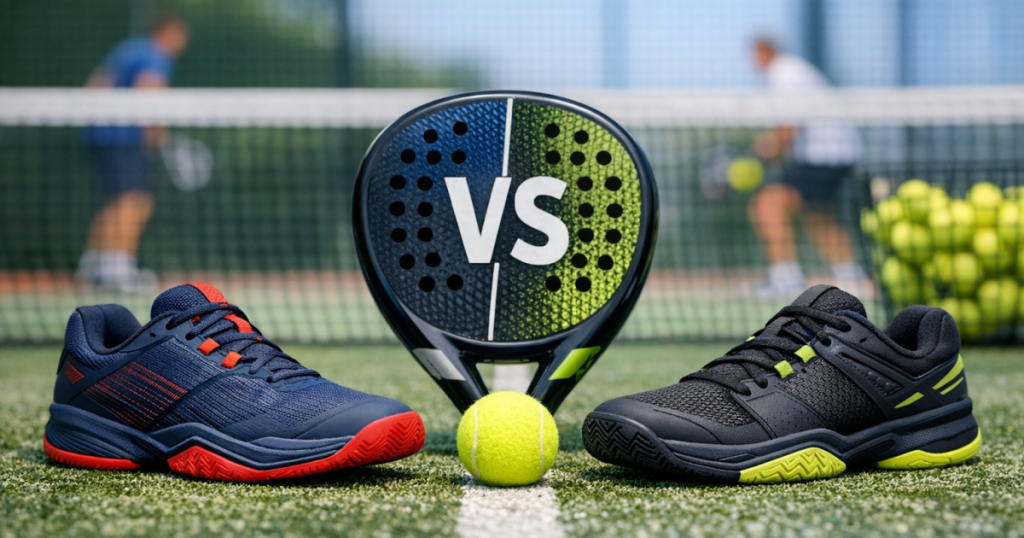
Choosing between the Babolat Jet Premura 2 vs Movea 2 is really a choice between speed and security. Both are padel-specific shoes from the same brand, so the difference is not about one being a “proper” padel shoe and the other being unsuitable. It is about how you move, how much support you want, and whether your club matches feel more like short bursts to the net or repeated lateral scrambling from the back glass.
For many beginners, shoes become important once trainers start sliding, twisting or feeling heavy during side-to-side movement. A padel shoe should help you stop, turn, recover and trust your footing on artificial turf, not just look sporty in the club café.
The short version
The Babolat Jet Premura 2 is the livelier, quicker-feeling option. It is the one to consider if you like a lighter shoe, make sharp first steps, and do not want your footwear to feel bulky during fast exchanges.
The Babolat Movea 2 is the steadier, more supportive-feeling option. It is the safer starting point if you are still building confidence with lunges, recoveries and sudden sideways stops, or if you prefer a more planted feel underfoot.
- Choose the Jet Premura 2 if you value lightness, quick reactions and court feel.
- Choose the Movea 2 if you value lateral support, a secure upper and stability when changing direction.
- For newer players who are unsure, the Movea 2 is usually the more forgiving-feeling pick.
- For active players coming from tennis, squash or badminton, the Jet Premura 2 may feel more natural straight away.
Why padel shoes feel different from ordinary trainers
Beginner padel movement is messy at first. You split-step late, run too close to the ball, plant your outside foot awkwardly, and then have to recover quickly before the next shot. That is exactly where general running shoes can feel wrong. Running shoes are built mainly for forward motion, while padel asks for lateral braking, pivots and short accelerations.
Babolat’s padel shoes are designed around that stop-start pattern. The details vary by model, but the broad aim is similar: grip that works on padel turf, flex for low positions, and enough structure to stop your foot rolling around inside the shoe. If your biggest issue is timing your feet rather than footwear, pair a shoe upgrade with better movement habits; these padel split-step drills are a useful next step.
Fit and first impressions
The Jet Premura 2 gives the impression of being built for players who like to move quickly and stay light on their feet. The upper feels geared towards responsiveness rather than a heavily padded, locked-down sensation. That can be a positive if you dislike stiff shoes, but it also means the fit needs to be right. If your foot slides inside it, the speed advantage disappears.
The Movea 2 has a more support-led feel. It is the shoe that makes the most sense if you want to feel held through the midfoot when you push sideways. That does not mean it is only for advanced players. In fact, beginners often benefit from a more secure shoe because their footwork is still inconsistent and they are more likely to lunge late or stop abruptly.
As with any padel shoe, try both with the socks you actually play in. Walk, jog, side-step and mimic a low volley stance before deciding. A shoe that feels fine standing still can pinch at the toes or loosen around the heel once you start playing points.
Grip on typical UK club courts
Most UK club padel is played on artificial turf, often with visible sand in the surface. The amount of sand, moisture and wear can change the feel of a court dramatically. A dry, sandier court may allow more controlled sliding, while a damp or compacted surface can feel grabbier or slicker in patches.
Both shoes are intended for padel use, so the question is less “will they grip?” and more “how does the grip match your movement?” The Jet Premura 2 is better suited to players who want to feel agile and ready to spring into the next ball. The Movea 2 suits players who want more reassurance when braking hard or reaching wide.
If your club courts vary a lot between indoor and outdoor conditions, avoid judging either shoe from one five-minute knock-up. Pay attention during real points: do you trust your first step? Can you stop without your toes jamming into the front? Does the shoe let you rotate after the ball hits the glass? Those details matter more than a showroom impression.
Support, stability and confidence
This is where the comparison becomes clearest. The Movea 2 feels like the more stability-focused shoe. It is the one that makes most sense for players who are still learning how to stay balanced after a bandeja, recover from the corner, or stretch for a low ball without collapsing through the ankle.
The Jet Premura 2 is not a flimsy shoe, but its appeal is different. It favours players who already move reasonably well and want a lighter, more reactive platform. If you are confident in your footwork, that can feel brilliant. If you are still overreaching and planting late, the extra security of the Movea 2 may help you play with less hesitation.
- For cautious movers: Movea 2 gives a more grounded, reassuring feel.
- For quick movers: Jet Premura 2 feels easier to accelerate and recover in.
- For doubles at beginner club level: Movea 2 may help when points get scrappy and footwork breaks down.
- For players who attack the net often: Jet Premura 2 may feel more responsive during quick volleys and transitions.
Comfort over a full session
Comfort is personal, but the type of comfort differs between these two shoes. The Jet Premura 2 is about feeling lighter and less restricted. That can make a 90-minute club session feel less tiring, particularly if you dislike clunky footwear.
The Movea 2 is more about support comfort: the feeling that your foot is being held in place when points become frantic. Some players find that more relaxing because they do not have to think about their footing as much. Others may prefer the freer feel of the Jet Premura 2.
Beginners should be careful not to equate softness with comfort. A shoe can feel plush in the shop but unstable on court. Equally, a supportive shoe can feel slightly more structured at first, then prove more comfortable once you are moving at match speed.
How they compare with other beginner-friendly shoes
If you are not tied to Babolat, it is worth checking how these shoes sit against other padel models. For example, the Adidas Crazyquick line is another lightweight option aimed at fast court movement, and our Adidas Crazyquick Padel Shoes review explains how that kind of shoe can suit club players who want grip without a heavy feel.
Within Babolat’s own range, the comparison is more straightforward: Jet Premura 2 leans towards speed, Movea 2 leans towards support. Neither is automatically “better” for beginners. The better shoe is the one that reduces your mistakes. If you keep slipping, twisting or arriving late because you do not trust your footing, prioritise security. If your shoes feel heavy and slow, prioritise responsiveness.
Which one should beginners choose?
For a first proper padel shoe, the Movea 2 is the easier recommendation for most early-stage players. That is because beginner padel is full of imperfect movement: late split-steps, rushed recoveries, deep-corner scrambles and awkward sideways braking. A supportive shoe can make those moments feel less chaotic.
The Jet Premura 2 becomes more tempting if you already play racket sports, have decent balance, or know you dislike supportive shoes that feel too built-up. It is also appealing for players who enjoy moving forward quickly and playing sharp volley exchanges at the net.
The key is honesty about your current game, not your target game. Many beginners picture themselves playing fast attacking padel, but spend most points reacting late from the back third of the court. If that sounds familiar, stability matters. If you are already light on your feet and want a shoe that keeps up with you, the Jet Premura 2 is the more exciting option.
Small details to check before buying
Because fit varies by foot shape, do not rely only on model reputation. Check these points before committing:
- Heel hold: your heel should not lift noticeably when you side-step or push forward.
- Toe space: leave enough room for braking, but not so much that your foot slides into the front.
- Midfoot security: the shoe should feel snug across the middle without creating pressure on top of the foot.
- Outsole suitability: confirm the version you are buying is intended for padel or clay-style court movement, not a general gym trainer.
- Return policy: try them indoors at home first so you can assess fit without marking the sole.
It is also worth checking your whole contact setup. Shoes help your feet grip the court, but your racket grip affects how relaxed your upper body feels during movement. If your hand keeps slipping, this guide on how to stop your overgrip slipping mid-match may solve a different but equally annoying confidence problem.
Where the Babolat Jet Premura 2 vs Movea 2 decision lands
The Babolat Jet Premura 2 vs Movea 2 decision comes down to what you want your shoes to do when a point gets untidy. The Jet Premura 2 helps you feel quick and reactive. The Movea 2 helps you feel steadier and more supported. For newer club players, that extra support is often the more useful benefit.
If you are choosing without trying both, the safer beginner route is the Movea 2. If you can try them on and the Jet Premura 2 feels secure around your heel and midfoot, it is a strong choice for players who want a lighter, more agile ride. Either way, judge them on court movement rather than brand appeal alone.
Common questions
Is the Jet Premura 2 too advanced for beginners?
No. A beginner can use it, especially if they already move well from another sport. It is just less forgiving if you want a very locked-in, stable feel.
Is the Movea 2 too heavy for casual club play?
Not necessarily. The Movea 2 is better thought of as support-focused rather than simply heavy. For many beginners, the steadier feel is more helpful than saving a little weight.
Can I use running shoes for padel instead?
You can start in them for a taster session, but they are not ideal for regular play. Padel involves sideways braking and rotation, which running shoes are not primarily built for.
Which shoe is better for outdoor UK courts?
It depends on the court surface and your movement. On variable outdoor turf, many beginners will appreciate the Movea 2’s stable feel, while quicker players may prefer the Jet Premura 2.
Should I size up in Babolat padel shoes?
Do not size up automatically. Try your normal sports-shoe size first, then check toe room, heel hold and midfoot security with the socks you wear for padel.
Main lessons
The Jet Premura 2 is the sharper, faster-feeling shoe. The Movea 2 is the steadier, more confidence-building shoe. If you are still learning positioning, timing and recovery, choose the shoe that helps you stay balanced under pressure. For most beginners, that points towards the Movea 2. For naturally quick movers who want less bulk and more court feel, the Jet Premura 2 is the more enjoyable pick.
Quick Buying Links
Babolat Jet Premura 2
Choosing between the Babolat Jet Premura 2 vs Movea 2 is really a choice between speed and security.
Movea 2 Padel Shoes
Worth considering if its strengths better match your needs.