Knowing where you fit on the padel skill levels ladder makes club play much less awkward. You can choose sessions that feel challenging without being chaotic, explain your experience honestly, and avoid jumping into games that move too quickly before you have the basics settled.
If you are completely new to the sport, it helps to understand how padel works for new players before worrying about labels. Level names are useful, but they are only a shortcut for what you can actually do on court.
What to know first
The short answer: start lower than your ego wants, then move up when your rallies, positioning and decisions become reliable. Most new players are not held back by fitness or effort. They are held back by inconsistent serves, rushing the net at the wrong time, poor use of the glass and not recovering to a sensible court position after each shot.
There is no single worldwide rating system used by every UK club. One venue might use beginner, improver and intermediate. Another might use numbers. A WhatsApp group might simply ask for “mixed improver level” or “low intermediate”. Because padel skill levels are not universal, the best starting point is to assess your game against behaviours, not just labels.
A good level match should feel lively but not unfair. You should be able to keep rallies going, understand the basic rules, and contribute to points without your partner having to protect you every rally. You should also be stretched enough to make mistakes and learn.
A simple level guide for new club players
Complete newcomer
You are at this level if you have never played, or you have only had one casual hit. You may still be learning the court lines, the scoring, where to stand for serve and return, and how the glass affects the ball. The right sessions are taster sessions, beginner coaching, family games or social hits with patient players.
- You can make contact with the ball, but rallies break down quickly.
- You are still unsure when the ball can bounce off the glass.
- You may not yet know where to stand as the server’s partner or returner’s partner.
- Your main aim is to learn the shape of the game, not to win points quickly.
Early beginner
This is where many first-time club players sit after a few sessions. You can serve into the box some of the time, return basic serves, and understand the rough flow of a point. You may still panic when the ball comes off the back glass or when opponents are both at the net.
- You can rally from the back of the court when the ball is comfortable.
- You know the scoring but may still hesitate on some rule situations.
- You often hit too hard when a simple controlled shot would be better.
- You are starting to see why lobs, patience and court position matter.
Confident beginner
A confident beginner can join social games without needing every rally explained. You will still miss plenty, but you can usually serve legally, return into play, and recover after your shot. You are beginning to understand that padel is not just about winners; it is about forcing weak replies and protecting space.
- You can keep a cooperative rally going for several shots.
- You can use a basic lob when opponents crowd the net.
- You know when a point is probably over, even if you still check some details.
- You are learning to move with your partner rather than chasing every ball alone.
If rule confusion is one of the things stopping you from joining games, spend a few minutes on when a point is won or lost in padel. That knowledge makes social matches feel much calmer.
Improver
An improver is no longer just trying to survive rallies. You can handle a wider range of balls, you are using the glass more deliberately, and you are starting to make tactical choices. You still make unforced errors, but you are not constantly surprised by where the ball goes next.
- You can defend from the back and wait for a chance to move forward.
- You can play a controlled lob rather than only a desperate high ball.
- You understand that both players usually move forward and back together.
- You can play with different partners without needing constant reminders.
Lower intermediate
At lower intermediate level, the game becomes more tactical. You can build points, recognise weaker replies, and play with a plan. You may not have advanced attacking shots, but you understand pressure, patience and court position. This is often the level where players start to become regulars at club nights and box leagues.
- You can defend several difficult balls without immediately losing shape.
- You use the lob, chiquita-style soft ball or controlled low shot to change the point.
- You communicate with your partner before and during points.
- You make fewer wild errors when the rally gets faster.
Solid intermediate and above
Above this point, the differences become more detailed. Strong intermediate and advanced players read the ball earlier, use the glass confidently, vary speed and height, and punish weak lobs. They also make better decisions under pressure. For a beginner-focused player, the important thing is not to rush this label. It is better to be a reliable improver than an overwhelmed intermediate.
How to place yourself honestly
Use these checks before choosing a group session, joining a match or describing your level to a club organiser.
- Serve: Can you get most first or second serves in without relying on luck?
- Return: Can you return a steady serve into court rather than gifting free points?
- Rally tolerance: Can you stay in a point for six to ten shots when opponents are not attacking hard?
- Glass use: Can you let some balls rebound from the back glass instead of rushing every contact?
- Net play: Can you volley with control, or do you swing at every ball like it has to be a winner?
- Movement: Do you recover after your shot, or do you watch the ball and leave open space?
- Partnership: Do you communicate and move with your partner, even when you make mistakes?
If most answers are “not yet”, choose beginner coaching or gentle social games. If most are “sometimes”, you are probably in the confident beginner to improver range. If most are “yes, under pressure”, you may be ready for lower intermediate play.
Common starting-point mistakes
Assuming tennis or squash experience makes you intermediate
Racket sport experience helps. You may have better hand-eye coordination, timing and movement than a total newcomer. But padel has different priorities. The walls, smaller court, underarm serve, doubles positioning and slower tactical build-up can catch good tennis or squash players out. Start as an athletic beginner or improver until your padel-specific habits catch up.
Choosing games only by pace
A fast rally does not always mean a high-level rally. Beginners can hit hard and create chaos. Better players often look calmer because they choose safer targets, use height well and wait for the right ball. When judging your level, focus on control and decisions as much as speed.
Moving up after one good session
Everyone has days when the timing feels easy. Before moving up, ask whether you can repeat that level across several games, with different partners, against different styles. Consistency matters more than one strong performance.
Staying too low for too long
The opposite mistake is also common. Some players avoid moving up because they do not want to be the weakest player on court. If beginner games feel too slow, you win without thinking, and your mistakes mostly come from boredom rather than pressure, it is time to test the next level.
What level should you join at a new club?
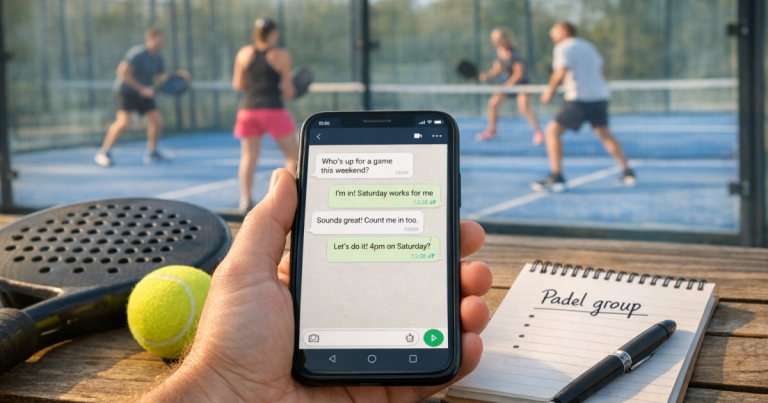
When you visit a new venue, be clear and modest. A useful message is: “I’m a confident beginner, comfortable with scoring and basic rallies, but still improving my glass play.” That tells the organiser more than simply saying “beginner”. If you are not sure, ask for a beginner-friendly social or an assessed session.
Good club etiquette also helps you settle in faster. Arrive on time, rotate fairly, avoid coaching strangers mid-game unless invited, and be honest if a match is above your current level. The basics in following padel etiquette at a new club are just as useful as knowing where you sit on the ladder.
How to move up without forcing it
Progression is usually smoother when you work on one or two clear habits rather than trying to fix everything at once. For most newer players, the biggest gains come from keeping the ball in play, using the lob better, defending calmly after the glass, and learning where to stand with a partner.
- For complete newcomers: learn the scoring, serve rules and basic positions first.
- For early beginners: aim for longer rallies and fewer rushed winners.
- For confident beginners: practise controlled lobs and simple volleys.
- For improvers: work on defending the glass and choosing when to attack.
- For lower intermediates: improve communication, shot selection and consistency under pressure.
A helpful rule is to move up when you can both survive and contribute. You do not need to dominate your current level, but you should be able to support your partner, understand the rhythm of points and recover from mistakes without the match collapsing around you.
FAQ
Should I call myself a beginner if I have played tennis?
Usually, yes at first. Tennis experience helps with coordination, but padel positioning, wall play and shot selection are different. “Beginner with racket sport experience” is an honest description.
How many sessions does it take to reach improver level?
It varies, but regular coaching or weekly social play will usually move you faster than occasional casual games. The marker is not time; it is whether you can rally, serve, return and position yourself reliably.
Is it okay to play above my level?
Occasionally, yes, if the group is happy and the gap is not too large. It becomes a problem if rallies constantly break down or your partner has to cover most of the court.
What if different clubs use different padel skill levels?
Describe what you can do rather than relying on the label. Mention your serving, rally consistency, glass comfort and match experience. That makes it easier for organisers to place you well.
Do I need coaching before joining social games?
No, but one or two beginner sessions can make your first games much easier. You will understand the court, scoring, basic positions and common mistakes before playing with strangers.
Main lessons
Your starting point is not a fixed identity. It is a practical way to find games where you can learn, contribute and enjoy yourself. Begin with a level that feels manageable, pay attention to how rallies break down, and move up when your control, decisions and positioning become more dependable.
The best players to share a court with are not always the flashiest. They are honest about their level, fair with partners, willing to learn and steady under pressure. Build those habits early and your next step in padel will be much easier to find.