If you usually take a spare racket to club night, coaching or a match, learning how to carry two padel rackets properly is a small habit that can save a lot of annoying marks. Most scratches do not happen on court; they happen in the boot, in a shared bag, or while walking between reception and the court.
The good news is that you do not need a huge tour bag to protect them. A sleeve, a divider, sensible stacking and a few routine checks are usually enough for beginner and regular club players.
The short version
- Keep the racket faces separated so the rough or sandy surface of one does not rub against the other.
- Protect the frame edges first, because those raised areas take the knocks when rackets move around.
- Use individual sleeves if you have them, or create a soft divider with a clean towel or clothing layer.
- Do not pack shoes, loose balls, keys or water bottles in the same space as uncovered racket faces.
- Check your grip, wrist strap and zip area before leaving, because snagging and pressure marks often start there.
Why two rackets scratch each other so easily
Padel rackets are awkward to pack because they are wide, rigid and usually have textured faces. Even when they look smooth, dust from artificial turf and tiny grit from court surfaces can sit on the racket face after play. If two rackets are pressed together and moved around, that grit works like fine sandpaper.
The frame is another weak point for cosmetic damage. The outer edge is the part that hits walls, clips the floor and takes most bag knocks. If the frames of two rackets are allowed to knock together repeatedly, small chips and scuffs can appear quite quickly.
It also helps to understand where the vulnerable areas are. If you are still getting used to the terms, this breakdown of padel racket anatomy explains the frame, face, bridge and sweet spot in beginner-friendly language.
Step 1: Clean the contact points before packing
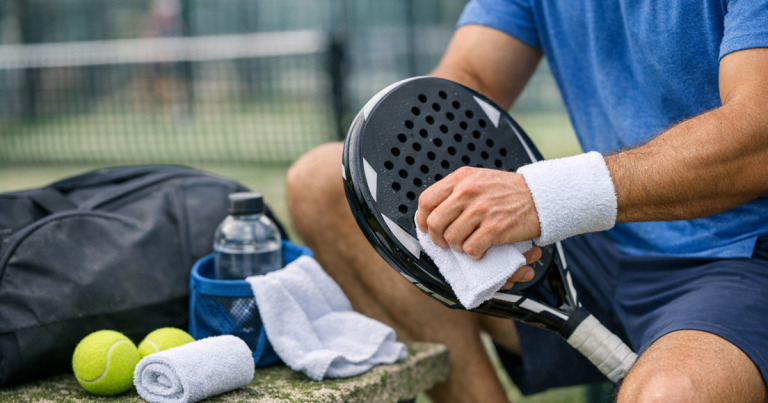
Before you put two rackets together, give both faces and frames a quick wipe with a clean, dry towel. You are not trying to polish them; you are just removing grit, moisture and loose dirt that can rub during the journey home.
Pay attention to the edge of the frame, the holes in the face and the area around the bridge. These spots can hold tiny bits of sand or turf crumb. If the racket is damp from rain, condensation or sweaty hands, let it air for a moment before closing it inside a sleeve or bag compartment.
This habit matters most after outdoor sessions or busy club nights where bags end up on floors, benches and car boots. A racket that looks only slightly dusty can still mark another racket when pressed face-to-face.
Step 2: Use sleeves for each racket when you can
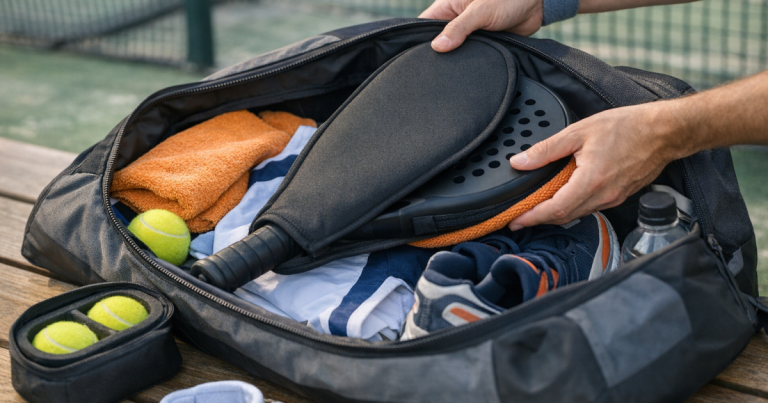
The simplest way to carry two padel rackets without them scratching is to put each one in its own soft cover or sleeve. Many rackets come with a basic cover, and even a thin one is better than direct racket-to-racket contact.
If you have only one sleeve, use it on the racket you care about most, then separate the other racket with a soft layer. A clean microfibre towel, spare top or light hoodie can work as a temporary divider. Avoid using a damp towel after play, because moisture trapped against the face or frame is not ideal.
The sleeve does not need to be bulky. What matters is that the faces cannot grind against each other and the frames are not knocking together with every step. For short trips to your local court, that basic protection is usually enough.
Step 3: Stack them the right way inside a bag
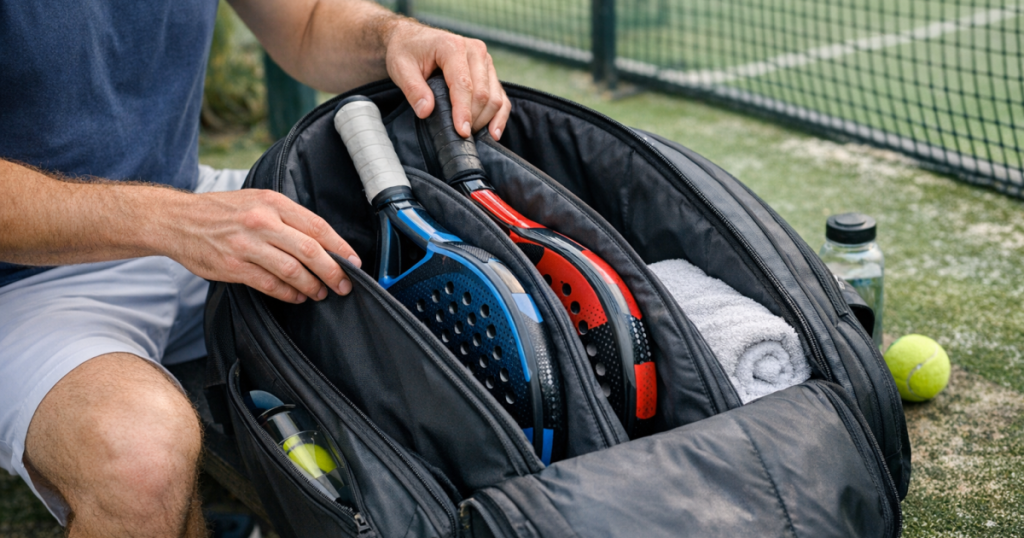
If your bag has a racket compartment, place the rackets flat and parallel, not crossed at an angle. Crossed handles and frames create pressure points, which is where scuffs and indentations tend to appear.
When you carry two padel rackets in the same compartment, the neatest order is sleeve, racket, divider, racket, sleeve or bag wall. If you only have one padded side, put the racket faces towards the softer surfaces and keep the frame edges away from hard items.
Try not to wedge the rackets into a compartment that is already overfilled. A tight zip can press the rackets together and make the divider less useful. If you have to push down hard to close the bag, remove something rather than forcing it.
Step 4: Keep hard items out of the racket space
Most accidental scratches come from other things in the bag, not from the second racket itself. Keys, padel ball tubes, metal water bottles, toiletries, phone chargers and loose coins can all leave marks if they end up in the same pocket.
Use smaller pockets for hard items and keep the racket compartment boring: rackets, sleeves and soft fabric only. If your bag has no separate storage, put hard items inside a small pouch and place that pouch away from the racket faces.
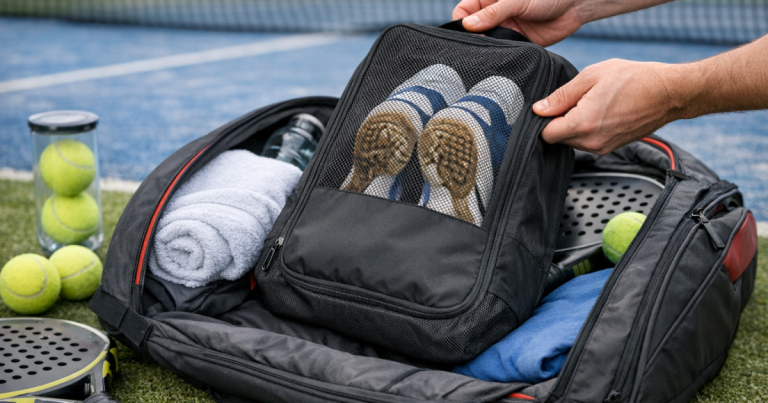
Shoes deserve their own space too. Soles can carry sand, grit and moisture, which is exactly what you do not want rubbing against a racket. If you are juggling kit after a session, this guide on packing padel shoes without dirtying your bag is a useful next step.
Step 5: Watch the handles, grips and wrist straps
Handles are easy to forget because most players focus on the racket face. But when two rackets are packed together, the handles can twist, the wrist straps can catch in zips, and worn overgrips can leave residue or lint on the other racket.
Before closing the bag, tuck wrist straps flat rather than letting them dangle. Keep the grips pointing in the same direction where possible, and avoid wrapping one wrist strap around the other racket. If the grip is very tacky or starting to peel, it is more likely to mark nearby fabric or another handle.
A fresh overgrip can also make the racket easier to hold and less likely to be dropped while carrying kit in and out of the club. For grip feel and a simple beginner upgrade, the Wilson Pro Overgrip review gives a clear example of what a small grip change can do.
Step 6: Be careful in cars, lockers and crowded club areas
Even well-packed rackets can get scratched if the bag is thrown into a boot with other sports kit. Lay the bag flat where it will not slide, and avoid placing heavy items on top of the racket compartment. A racket can survive plenty of normal play, but steady pressure from a heavy bag or crate can still leave cosmetic marks.
In club lockers, place the racket side towards a flat wall rather than against shoes, bottles or metal locker edges. If you are carrying rackets by hand between courts, hold them with the faces together only if at least one is sleeved or there is a soft layer between them.
At busy socials, it is also worth keeping your spare racket inside your own bag rather than leaning it against a bench with everyone else’s kit. Rackets get moved, knocked and mixed up easily when players are rotating on and off court.
Quick packing checklist before you leave
- Are both racket faces clean and dry enough to pack?
- Is there a sleeve, towel or clothing layer between the two faces?
- Are the frame edges protected from knocking together?
- Have you removed keys, coins, ball tubes and bottles from the racket space?
- Are wrist straps tucked in and clear of the zip?
- Can the bag close without forcing the zip over the rackets?
If you can tick those off, your rackets should be well protected for normal trips to the club, coaching session or match.
Helpful questions
Can I carry two padel rackets in one sleeve?
You can for a very short walk, but it is not ideal. One sleeve with two rackets inside still allows the faces and frames to rub together, especially if the sleeve is loose. Add a clean towel or top between them if you have no second cover.
Should the racket faces point towards each other or away from each other?
Either can work if there is a soft divider. Without a divider, do not press the faces together. The texture, dust and grit on one face can mark the other during movement.
Is a small backpack enough for two rackets?
It can be, provided the rackets fit without bending, the zip closes easily, and the faces are separated. If the handles stick out awkwardly or the rackets sit under pressure, use a larger padel bag or carry one racket separately in a sleeve.
Do frame protectors stop scratches in a bag?
They can help protect the outer edge from small knocks, but they do not protect the racket face. You still need a sleeve or soft divider to stop face-to-face rubbing.
What should I do if one racket is already sandy after play?
Wipe it before packing and keep it away from the cleaner racket. If it is wet or gritty, give it the divider side with the towel rather than placing it directly against another racket or the inside of the bag.
Why it matters
Small scratches will not automatically ruin a padel racket, but good carrying habits help your kit last longer and stay nicer to use. For beginners, it also removes one more bit of match-day faff: you know where your spare racket is, it is protected, and you are not worrying about avoidable damage before you even start warming up.
Keep the system simple: clean the faces, separate the rackets, protect the frames and keep hard items somewhere else. Do that consistently and carrying two rackets becomes just another easy part of getting ready to play.