The right padel coaching should make you feel stretched, not lost. If a session is too fast, too advanced or too vague, it can knock your confidence even when the coach is perfectly good.
Good level-matching starts before you book. A few simple checks will help you choose a lesson, group or programme that fits where you are now and where you want to go next.
The short version
For most beginners and early-stage players, the best coaching match is not the most advanced group or the coach with the biggest claims. It is the session where the pace, explanations, feedback and playing standard suit your current stage.
- Choose beginner sessions if you are still learning scoring, glass use, positioning or serve rules.
- Choose improver sessions if you can rally, serve reliably and understand basic court positions.
- Ask how mixed-ability groups are handled before joining.
- Look for clear correction, simple themes and realistic next steps.
- Judge the first session by how much clearer you feel afterwards, not just how hard it was.
Step 1: Name your current level honestly
Most mismatched lessons happen because players book based on what they hope they are, not what they can repeat under pressure. You do not need a formal rating to place yourself sensibly. You just need a clear view of your current habits.
You are likely a true beginner if you are still unsure about the serve, when the ball can hit the glass, how to rotate with a partner, or where to stand after returning. If that sounds familiar, a fundamentals session is usually better than a fast-paced social coaching group.
You are probably an early improver if you can keep a rally going, understand the basic rules, serve in consistently, and recover your position after most shots. At this point, you need more tactical structure: when to lob, when to block, how to build a point, and how to communicate with a partner.
If you are still choosing where to play regularly, the club environment matters too. A welcoming venue with suitable starter sessions can make a big difference, so it is worth reading about how to choose your first padel club before committing to a regular programme.
Step 2: Match the session format to your goal
Different coaching formats suit different problems. A group lesson can be brilliant for rhythm and confidence, but it may not give you enough individual correction. A one-to-one lesson can fix specific technique issues, but it may not teach you how to manage real partner play unless the coach builds that in.
- Beginner group lesson: best when you need rules, basic strokes, court movement and confidence with other new players.
- Improver group session: useful when you can rally but need better positioning, decision-making and consistency.
- Private lesson: helpful for a specific problem such as your serve, bandeja, volley preparation or back-glass return.
- Pair lesson: strong option if you usually play with the same partner and want to improve movement, spacing and communication.
- Clinic or themed session: useful once you know the basics and want focused work on one area, such as defending, lobbing or net play.
Try to avoid booking a session just because the time is convenient. The right format should match the skill you want to improve, not simply the empty slot in your diary.
Step 3: Ask how the coach handles mixed abilities
Mixed-ability groups are common, especially at busy clubs. They are not automatically a problem, but they need careful management. A good coach will adapt drills, rotate pairs sensibly and give different targets to different players.
Before booking, ask one direct question: “What level is this session aimed at, and how do you manage players who are newer or more experienced?” The answer will tell you a lot. Clear answers usually mention current ability, session aims, group size and what a player should already be comfortable doing.
Be cautious if the reply is only “all levels welcome”. That can be fine for a relaxed taster, but it is less helpful if you want structured improvement. Beginners need enough repetition to build reliable habits, while stronger players need enough challenge to stay engaged.
Step 4: Look for progression, not just busy drills
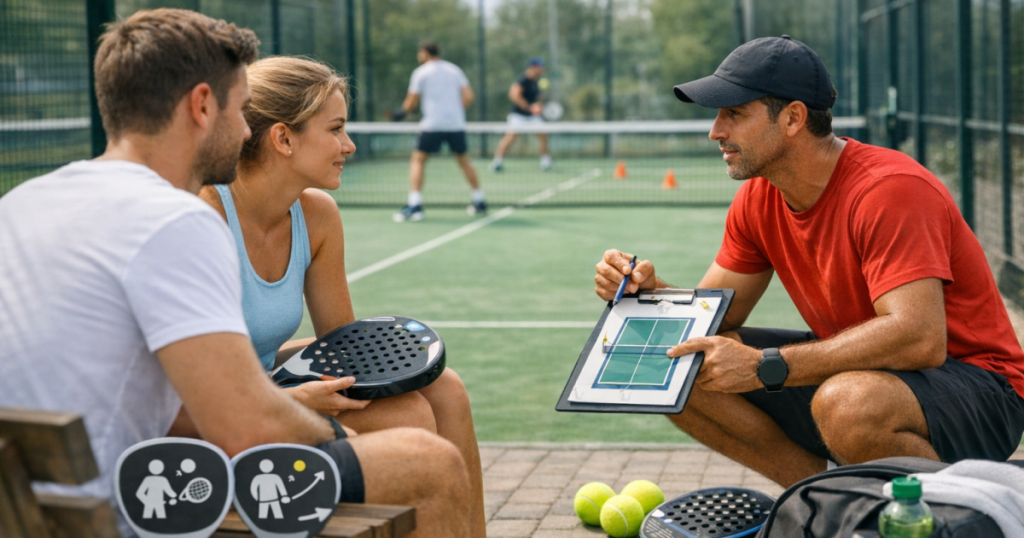
A good session should feel organised. You should understand the theme, why the drill matters, and how it connects to match play. Padel coaching works best when each part of the lesson builds towards a usable skill, rather than jumping between unrelated exercises.
For example, a useful beginner lesson might start with controlled volleys, then add court position, then finish with a simple point where the aim is to hold the net. That gives you a practical link between technique and tactics.
For improvers, progression might mean starting with defensive blocks, moving into lobs from the back corners, and then playing points where the goal is to turn defence into attack. The drill does not need to be complicated. It just needs a clear purpose.
Step 5: Judge the first session properly
After your first lesson, resist judging it only by whether you won points, sweated a lot or liked the coach’s personality. Those things matter, but they are not the full picture.
Ask yourself these questions after the session:
- Did the coach explain things in a way I could use during play?
- Was the pace challenging but manageable?
- Did I get specific feedback, not just encouragement?
- Were the other players close enough to my level for the drills to work?
- Do I know what to practise before the next session?
If you want an example of how a first-lesson environment can feel for newer players, the Rocks Lane Padel coaching review is a useful reference point for what beginners may want to notice.
Examples of good level matches
Here are a few common beginner situations and the type of coaching that usually fits best.
You have played once or twice and feel unsure of the rules
Choose a beginner foundation session or taster group. Your priority is not advanced shot-making; it is understanding the court, scoring, serve, walls and basic positioning. A slower session is not a step backwards. It gives you the base to enjoy matches sooner.
You can rally but lose shape during points
An improver group is likely a better fit than a pure beginner session. Look for work on partner movement, lobs, net recovery and simple point patterns. You need structure more than another explanation of the basic rules.
You keep making the same technical mistake
A private or pair lesson may be worth considering. Specific feedback can help if your serve is inconsistent, your volley preparation is rushed, or you struggle to let the ball come off the back glass. One targeted session can sometimes save weeks of repeating the same habit.
You feel nervous joining club matches
Look for a coached matchplay session rather than a pure drill session. You will still get instruction, but the focus should be on decision-making, positioning and playing with different partners. This is often the bridge between lessons and regular club play.
Red flags that the level may be wrong
A poor match does not always mean the coach is poor. Sometimes the group simply is not right for your stage. Watch for these signs:
- You do not understand the instructions after they are explained.
- You spend most of the session apologising rather than learning.
- The coach gives the same task to everyone despite a clear ability gap.
- Drills break down because the rally speed is far beyond your control.
- You leave with effort but no clear idea of what improved.
- The session feels like a social hit with occasional tips rather than coaching.
If one session feels mismatched, do not give up on coaching altogether. Try a different level, format or coach before deciding it is not for you.
Questions to ask before booking
A short message to the club or coach can save you from joining the wrong group. Keep it simple and specific.
- “I have played a few times and know the basic rules. Would this be suitable?”
- “What should players already be able to do before joining this session?”
- “Is the session mostly drills, matchplay or a mix of both?”
- “How many players are usually in the group?”
- “Do you split players by level during the session?”
- “Is there a next-level group if this one becomes too easy?”
The best answers will help you place yourself without embarrassment. A good coach would rather guide you to the right session than have you struggle in the wrong one.
How to keep improving between lessons
Coaching works better when you arrive with one or two clear things to practise. After each session, write down the main correction in plain language. For example: “recover to the middle after defending”, “prepare volley earlier”, or “use the lob when under pressure”.
Then use your next social game to practise that one idea, rather than trying to fix everything at once. If you are using online coaching alongside club sessions, make sure it supports the same themes rather than adding too many new concepts. The Hello Padel Academy review gives a beginner-focused view of structured learning away from the court.
Questions people ask
How do I know if I should move up from beginner coaching?
Move up when you understand the rules, can serve reliably, keep basic rallies going and know where to stand in common situations. You do not need to be perfect, but you should be able to join drills without constant explanation.
Is private coaching better than group coaching for beginners?
Not always. Group lessons are often better for confidence, rhythm and learning with players at a similar stage. Private lessons are more useful when you have a specific problem that needs individual correction.
What if everyone in the group is better than me?
If the gap is small, it can help you improve. If the gap means rallies keep breaking down or you cannot practise the task, the level is too high for now. Ask the coach which group would fit better.
How many lessons should I try before deciding?
Try two or three sessions if the first one is close to your level. If it is clearly unsuitable, change sooner. The aim is steady improvement, not forcing yourself through sessions that do not match your stage.
Should coaching focus on technique or tactics first?
Beginners need both, but in simple doses. Technique helps you control the ball; tactics help you choose the right shot and position. The best early sessions connect the two rather than treating them separately.
What stands out
The best coaching match is the one that makes your next game easier to understand. You should leave with clearer positioning, one or two practical corrections, and enough confidence to try them in real points.
Be honest about your level, ask specific questions before booking, and judge sessions by clarity as much as intensity. That approach will help you find lessons that support your progress instead of leaving you guessing.