If you keep feeling your padel racket slipping just as you volley, smash or block at the net, the problem is usually fixable without changing your racket. Most grip issues come from sweat, a worn overgrip, the wrong handle thickness, or holding the racket too tightly at the wrong moments.
The aim is not to glue the racket into your hand. You want a secure hold that still lets you relax your wrist, adjust the racket face and recover quickly between shots.
The short version
Start with the simple checks before making bigger changes. A fresh overgrip, better sweat control and a slightly improved grip size solve most slipping problems for beginner and early club players.
- Replace a shiny, smooth or flattened overgrip rather than trying to squeeze harder.
- Use a tacky overgrip if your hand is mostly dry; consider a more absorbent feel if you sweat heavily.
- Check whether the handle is too thin, because a very narrow handle often twists on off-centre hits.
- Dry your palm, wrist and racket handle between games, not only between sets.
- Review your grip pressure and contact point, as late contact can make the racket turn in your hand.
Step 1: Check whether your grip is simply worn out
The first thing to inspect is the surface you are actually holding. If your overgrip looks glossy, feels flat, has dark smooth patches, or no longer has any texture, it is probably past its useful life. Many beginners keep playing with the same overgrip for far too long because it still looks attached, even though it has stopped doing its job.
A worn overgrip does two things badly: it loses friction and it absorbs less moisture. That combination makes you grip harder, which can tense your forearm and reduce racket control. If the racket only starts moving after 20 or 30 minutes, wear and sweat are likely working together.
As a quick test, hold the racket lightly and rotate it a few degrees in your hand. If it turns easily with very little resistance, fit a fresh overgrip before looking for more complicated answers. For a familiar option, the Wilson Pro Overgrip review explains how a small grip change can affect feel without needing a new racket.
Step 2: Choose the right overgrip feel for your hands
Overgrips are not all the same. Some feel tacky, which means they have a slightly sticky surface. Others are more absorbent and cloth-like, designed to manage sweat rather than create a sticky feel. Neither style is automatically better; the right choice depends on your hands and the conditions you play in.
If your hands are usually dry, a tacky overgrip can help the racket sit more confidently in your palm. If your hands get wet quickly, a very tacky grip may feel good for five minutes and then become slippery once moisture builds up. In that case, a more absorbent overgrip, a towel routine, or grip powder may be more useful.
Real products vary, so check the packaging and recent user feedback rather than assuming every overgrip from the same brand feels identical. Tourna Grip Original is a well-known absorbent racket-sport option, while many padel and tennis players use tackier wrap-style overgrips for a softer, grippier feel. The important point is to match the surface to your hand, not to copy the player on the next court.
Step 3: Wrap the overgrip properly
Even a good overgrip can feel poor if it is wrapped badly. Gaps, ridges and loose finishing tape all create movement under your hand. Padel rallies involve quick changes from forehand blocks to backhand volleys, so any looseness in the wrap becomes obvious fast.
A simple wrapping check
- Start at the butt cap and anchor the thin end firmly so it does not shift.
- Overlap each turn evenly, keeping light tension on the overgrip as you wrap.
- Avoid thick ridges where your fingers naturally sit.
- Finish high enough that your top hand position is covered, but do not leave loose material near the throat.
- Secure the end with finishing tape and press it down smoothly.
After wrapping, hold the racket as you would in a match and move through a few shadow volleys. If you can feel a lump under one finger, rewrap it. That small annoyance can become a distraction during a tight game.
Step 4: Make sure the handle is not too thin
A handle that is too thin can make the racket rotate, especially when you hit outside the sweet spot. Beginners often blame wrist strength when the real issue is that their fingers are having to close too far around the handle. That encourages squeezing, which feels secure for a moment but makes fast racket preparation harder.
There is no perfect universal size because hand shape, grip style and racket balance all matter. A useful on-court check is whether you can hold the racket firmly without your fingertips digging heavily into your palm. If the handle disappears into your hand, adding an extra overgrip may improve stability.
Do this gradually. One additional overgrip can make the handle feel steadier; several layers can make it bulky and reduce your ability to adjust the racket face. If you are not sure how the handle, bridge, head shape and sweet spot affect feel, the guide to padel racket anatomy gives useful context before you start changing your setup.
Step 5: Control sweat before it reaches the handle
Sweat does not only come from your palm. It can run down from your forearm and wrist onto the grip, especially during indoor sessions, summer matches or long club nights. If your grip feels fine at the start and then suddenly becomes unreliable, look at your sweat routine as well as the racket.
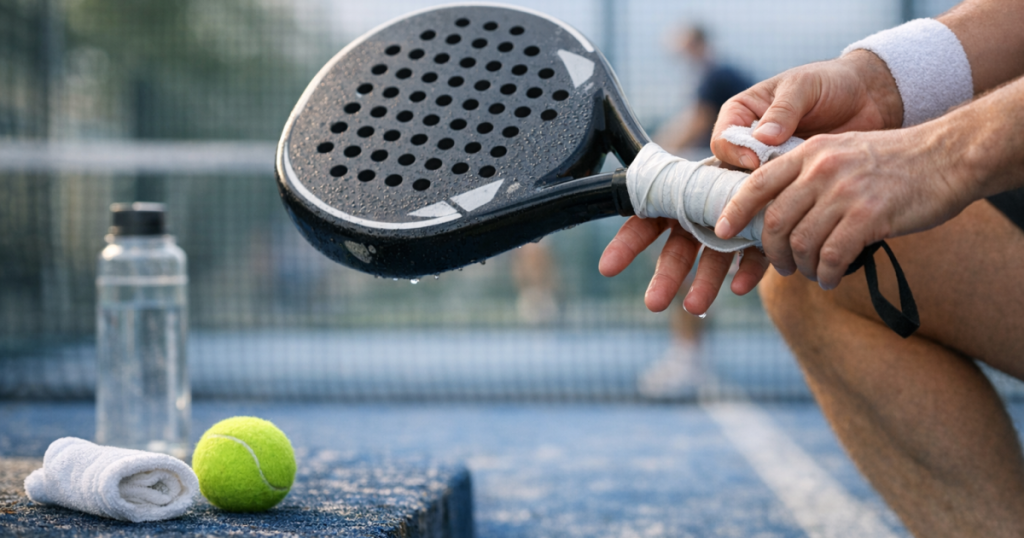
Keep a small towel accessible and use it between games. Dry the palm, the fingers and the lower forearm. A wristband can also help stop sweat travelling down your arm, but it needs to be changed or dried if it becomes soaked. Some players use grip powder or liquid chalk-style products, but test these carefully in practice first because too much can make the grip feel dusty rather than secure.
Do not ignore the handle itself. If the overgrip is damp, pat it dry rather than rubbing aggressively, which can rough up or loosen the wrap. If it stays wet, replace it. Trying to finish a match with a saturated grip usually leads to more tension and worse timing.
Step 6: Relax your hold at the right moments
It sounds backwards, but gripping harder is not always the answer. A death grip can make your arm stiff, reduce touch on lobs and blocks, and tire your hand. Many beginners squeeze throughout the rally, then lose control when they need a quick reaction at the net.
Think of grip pressure as adjustable. Hold the racket securely enough during preparation, firm up through contact, then relax slightly as you recover. You should not feel as though the racket is floating, but you also should not feel your forearm burning after every long point.
Late contact is another common reason the racket twists. If the ball gets too close to your body, the racket face is more likely to open or turn at impact. A better split step, earlier preparation and meeting the ball slightly in front can reduce the feeling of padel racket slipping without changing any equipment.
Step 7: Check your grip position on common shots
Slipping does not always happen on every shot. Notice where it appears most often, because that tells you what to fix.
- Volleys: If the racket turns on volleys, you may be contacting the ball late or holding the handle too low.
- Smashes: If the racket slides during overheads, sweat and grip pressure are likely causes, especially near the end of a session.
- Returns: If hard serves make the racket twist, your handle may be too thin or your contact point may be too far behind you.
- Defensive glass shots: If you lose the racket angle when rushed, practise a shorter backswing and a calmer hold.
Beginners often improve quickly by making the grip more consistent for simple blocks and volleys rather than chasing more power. A racket that stays stable on controlled shots gives you the confidence to build points instead of snatching at the ball.
Step 8: Replace or build up the grip at sensible intervals
There is no fixed number of sessions that suits everyone. A player doing one relaxed social session a week will not wear out grips at the same speed as someone playing several competitive club nights. Instead, use feel-based checks.
Replace the overgrip when it becomes smooth, loses tack, smells strongly, stays damp, or starts peeling at the edges. If you keep adding layers but the racket still turns, remove the old material and rebuild from a clean base. Stacking old, compressed overgrips can create a soft, unstable handle rather than a more secure one.
If you are deciding where grip changes sit among shoes, balls, rackets and other beginner kit, the guide to what is worth spending on can help you prioritise without overbuying.
When a different grip solution may help
If a fresh overgrip and better sweat control do not solve the issue, you can look at more structured changes. Some players use a replacement base grip to refresh the handle underneath the overgrip. Others try a shaped undergrip such as Bullpadel Hesacore Grip, which changes the handle profile and finger placement. Before fitting anything like this, check that it suits your racket handle and that you are happy with a different feel.
Be cautious about making several changes at once. If you add a new base grip, an extra overgrip and a wristband in the same session, you will not know which change helped. Make one adjustment, play a proper session, then decide whether the racket feels more stable.
Quick troubleshooting guide
- The racket slips from the first game: The grip may be too smooth, badly wrapped or the handle may be too small.
- It slips only once you are sweating: Improve towel use, try a more absorbent overgrip, and consider a wristband.
- It twists on hard shots: Check handle thickness, contact point and whether you are hitting off-centre.
- Your hand aches after playing: You may be squeezing too hard to compensate for a poor grip setup.
- The butt cap feels loose: Stop using the racket until you can confirm the handle is secure, as movement there is different from normal grip wear.
Questions people ask
How often should I change my padel overgrip?
Change it when it loses feel rather than after a fixed number of matches. If it is shiny, damp, peeling or no longer grips your hand, it is ready to replace.
Can I use a tennis overgrip on a padel racket?
Yes, many players do. The key is length, feel and how neatly it wraps on your padel handle. Trim excess material if needed and avoid bulky ridges.
Will adding two overgrips stop the racket moving?
It can help if the handle is too thin, but too many layers can make the racket feel rounded and less precise. Start with one extra layer and test it.
Is slipping a sign that I need a new racket?
Usually not. Most cases of padel racket slipping come from the grip surface, sweat management or handle size. Consider a new racket only if the handle or butt cap is damaged, or the racket genuinely no longer suits your level.
Should beginners use a tacky or absorbent overgrip?
Dry hands often suit a tackier feel, while sweaty hands usually need more absorption. If you play in both cool indoor halls and warm outdoor conditions, keep notes on what works best.
In brief
A slipping racket is frustrating, but it is rarely a mystery. Start by replacing the overgrip, then check how it is wrapped, whether the handle is thick enough, and how much sweat is reaching your hand. Add technique checks too: relaxed grip pressure, earlier preparation and cleaner contact all make the racket feel more secure.
Make one change at a time and test it during normal play. When the handle feels dependable, you can focus less on holding on and more on building steady, confident points.