A good lob gives you time, pushes opponents off the net, and turns a rushed rally back in your favour. The fastest way to build a safer, higher lob is to practise padel lob target drills that make depth and height feel repeatable, rather than hoping the shot behaves in a match. You do not need a basket of balls or a private court; a few clear zones, sensible feeds, and honest scoring will do most of the work.
What to know first
- A useful lob is not just high. It must be high enough to clear the opponent and deep enough to stop an easy overhead.
- Most beginner lobs fail because the player opens the racket face too late, swings too hard, or aims at a vague area.
- Targets help because they turn “hit it deep” into something visible and measurable.
- Start with slow feeds before adding movement, pressure, or a live opponent at the net.
- Count quality lobs, not just successful rallies. A lob that lands deep but gives the opponent an easy smash still needs work.
What makes a padel lob useful?
The lob is a reset shot and an attacking setup. From the back of the court, it buys time and gives you a chance to move forward. From a neutral rally, it can push both opponents away from the net and let your pair take the better court position.
The target is usually the deep part of the court, close enough to the back glass that the opponent has to move backwards and make a harder decision. Too short, and the ball sits up for a smash. Too flat, and it gets intercepted. Too long, and it hits the back glass before bouncing, which is out.
Once the basic contact feels settled, padel lob target drills work best when they train three things together: height, depth, and recovery. A nice-looking lob is not much use if you admire it from the back fence while your opponents recover the net.
Set up your targets without overcomplicating it
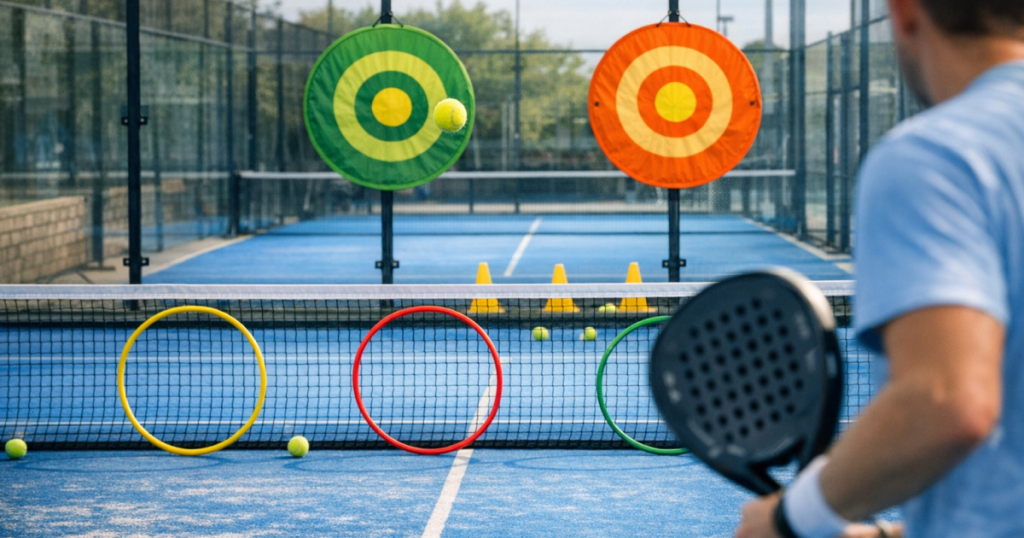
Use the court lines first. For most beginners, the simplest deep target is the area between the service line and the back glass. If you have cones, flat markers, spare ball tubes, or small towels, place them as visual guides rather than obstacles that could distract players.
Try these target zones:
- Safe deep zone: a broad area behind the service line, giving you room for error while still pushing the opponent back.
- Pressure zone: the last metre or two before the back glass, where a good lob becomes harder to attack.
- Corner zone: deep towards the side glass and back glass join, useful when you want to move one opponent away from the centre.
- Middle deep zone: deep between both opponents, helpful when they are unsure who should take the overhead.
Do not start with tiny targets. A beginner-friendly target should reward the right idea before demanding perfect placement. Make the zone smaller only when you can land several controlled lobs in a row.
Drill 1: the deep-zone warm-up
This is the best starting drill because it removes panic. One player feeds a gentle ball to the back of the court. The hitter plays a lob into the safe deep zone, then recovers towards a balanced base position rather than standing still.
Use this sequence:
- Step 1: Feed ten balls to the forehand side at a comfortable pace.
- Step 2: The hitter aims for the safe deep zone, not the sideline.
- Step 3: Score one point for every lob that lands deep and clears the imaginary reach of a net player.
- Step 4: Repeat on the backhand side.
A good score for a beginner is not ten out of ten. Aim first for six controlled lobs from each side. If you are spraying balls long, soften the hand and finish higher rather than swinging faster. If everything drops short, check that your contact point is in front of your body and that your legs are helping lift the ball.
Drill 2: the height gate
Many new players think depth is only about power. In padel, depth often comes from height. A higher arc gives the ball time to travel deep without needing a big swing.
For this drill, imagine a height gate above the net player’s racket. If you have a partner at the net, they should stand still and hold the racket up as a reference, without trying to intercept. The hitter’s job is to clear that height comfortably and land in the safe deep zone.
- Play sets of eight lobs from a slow feed.
- Score two points for a lob that clears the height gate and lands deep.
- Score one point if it clears the gate but lands a little short.
- Score zero if it is low enough to volley or smash easily.
This keeps the focus away from simply “getting it over”. The lob needs a shape: up early, high through the middle of its flight, then dropping late into the back court.
Drill 3: cross-court lob control
Cross-court lobs are often more forgiving because the diagonal gives you more court to work with. They are also useful in club play because many points break down when one player is dragged backwards into the corner.
Start from the right side and lob cross-court to the opponent’s deep right corner. Then repeat from the left side to the opposite deep corner. Keep the feed gentle at first, then gradually make it more realistic.
Use this scoring:
- One point for a lob that lands beyond the service line.
- One extra point if it lands in the pressure zone.
- One extra point if the hitter recovers forward after contact.
That third point matters. In matches, the lob is only half the job. The next step is moving into a better court position. If your issue is reaching the ball late rather than choosing the wrong shot, pair this work with these simple padel footwork drills so the contact feels less rushed.
Drill 4: the corner escape lob
This is the drill that feels most like a real beginner match. The feeder sends the ball into the back corner, either after the glass or as a slower ball that pushes the hitter wide. The hitter’s job is not to play a winner. The aim is to escape pressure with a high, deep lob.
Keep the first version calm:
- The feeder stands near the opposite service box and sends a controlled ball into the corner.
- The hitter lets the ball come into a comfortable contact zone where possible.
- The lob target is the opposite deep half of the court.
- After hitting, the player recovers towards the middle of their side.
Beginners often overhit this shot because they feel trapped. Instead, think “lift and lengthen”. Let the racket face help the ball up, use the legs, and finish smoothly. If you regularly turn easy defensive balls into long errors, the advice in stopping overhit padel balls will match this drill well.
Drill 5: lob, move, and call the next ball
A lob drill becomes much more useful when it includes communication. Play two against two if you can. One pair starts at the back. The other pair starts at the net. The back pair must play a lob into a deep target, then call either “up” if they are moving forward or “stay” if the lob is not good enough to attack behind.
This teaches a simple match habit: do not run forward behind a poor lob. If your lob is short and your pair charges the net, you may be walking into an easy smash or aggressive volley. If the lob is high and deep, move together and take space.
Rotate roles after five lobs per player. In a club session, keep the drill fair by changing feeders, hitters, and net players regularly. If you are organising a mixed-ability group, this guide to how to rotate partners fairly during club sessions can help stop one pair getting all the easier reps.
Common lob mistakes these drills should fix
Hitting the ball too flat
A flat lob travels fast and gives you little margin. If it clears the opponent, it may still fly long. Add height first, then adjust depth. The feeling should be more like lifting the ball with control than driving it through the court.
Aiming only for the back glass
The back glass is not the target. The court before the glass is the target. If the ball hits the glass before it bounces, it is out. Aim for a landing area, not the wall itself.
Standing still after contact
A good lob creates time. Use it. Recover your position, watch your opponent’s body shape, and move with your partner. Even a strong lob can be wasted if you stay pinned to the back corner.
Trying to win the point with every lob
The lob is usually a percentage shot. Its job is to change the shape of the point. If it forces the opponent backwards, gives you time, or helps you take the net, it has done useful work.
A simple 20-minute practice plan
If you only have a short court slot before a match, use this structure. It gives enough repetition without turning practice into a long technical session.
- Minutes 1–4: deep-zone warm-up, forehand and backhand sides.
- Minutes 5–8: height gate drill with a partner at the net as a reference.
- Minutes 9–13: cross-court lobs, alternating sides every five balls.
- Minutes 14–17: corner escape lobs from realistic feeds.
- Minutes 18–20: live point starts where the first shot must be a lob.
Track one number only: how many lobs land deep enough to stop an easy attack. Simple scoring keeps you honest and makes improvement visible from week to week.
Key checks before you make the drill harder
- Can you clear the opponent comfortably? If not, prioritise height before placement.
- Are you landing beyond the service line often enough? If not, use more legs and a smoother finish.
- Are you missing long? Reduce swing speed and make the target zone wider for a few rounds.
- Can you lob from both sides? Many beginners rely on one side and get exposed in matches.
- Do you recover after the shot? Add a movement rule to every drill so the habit becomes automatic.
Only add a faster feed or smaller target once you can repeat the shot calmly. Pressure is useful, but only after the basic shape is reliable.
Common questions
How high should a beginner padel lob be?
High enough that a net player cannot comfortably volley or smash it, with enough arc for the ball to drop deep. If in doubt, choose more height rather than more pace.
Should I practise lobs down the line or cross-court first?
Start cross-court. The diagonal gives you more space and usually makes the shot more forgiving. Add down-the-line lobs once you can control depth consistently.
How many lobs should I hit in one practice?
For most beginners, 40 to 60 focused lobs is plenty. Quality drops quickly when you get tired, so use short sets and swap roles often.
What if my opponents keep smashing my lobs?
Your lob is probably too short, too low, or too predictable. Aim higher, land deeper, and vary between the corner and middle deep zones.
Can I practise this without a coach?
Yes. A coach can help with technique, but a partner, clear targets, and honest scoring are enough to make real progress during regular club practice.
What stands out
The best lob practice is specific. Do not just hit balls upwards and hope they land well. Mark a deep zone, choose a simple score, and connect every lob to the next movement. When you can send the ball high, deep, and recover with your partner, the lob becomes one of the most reliable tools in beginner padel.