A reliable serve is one of the easiest ways to feel calmer at club night, but you do not need a booked court to make progress. You can improve your padel serve at home by rehearsing the grip, bounce, contact point, swing path and target routine in short, controlled sessions.
The aim is not to hit harder. It is to make the same legal, low-risk motion feel familiar so that, once you are back on court, you spend less time guessing and more time starting points confidently.
At a glance
- Work on the serve in parts: grip, ball bounce, contact point, swing path, recovery step and target choice.
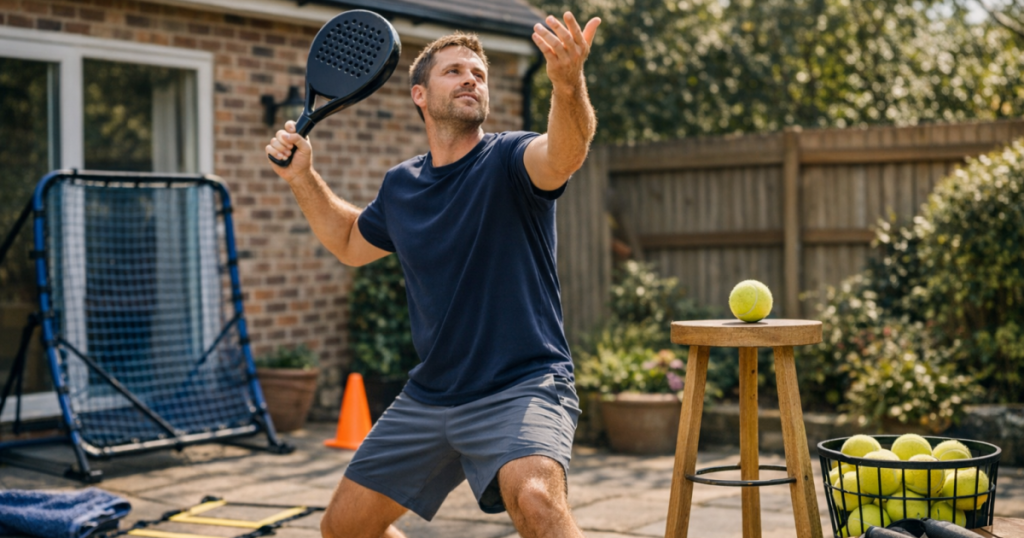
- Use a hallway, garden, garage, driveway or quiet outdoor wall only if you have safe space to swing.
- Keep the practice serve legal: bounce the ball first and strike it at or below waist height.
- Practise at 60–70% pace. A repeatable serve beats a faster serve that misses.
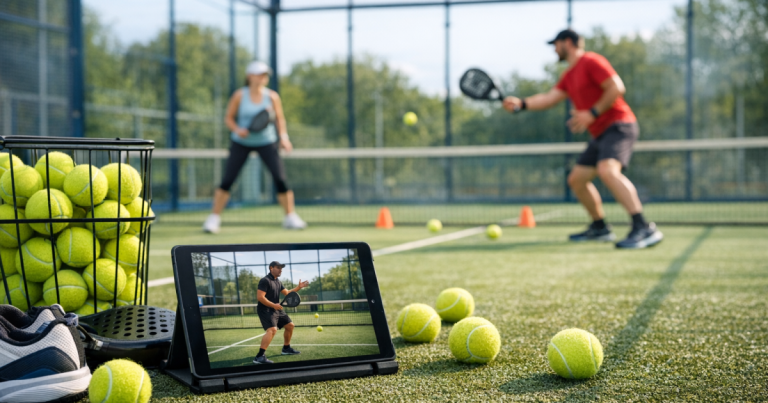
- Film a few repetitions from the side so you can spot high contact, rushed footwork or a changing grip.
Start with the serve you are trying to build
A beginner-friendly padel serve is not a tennis-style weapon. It is an underarm, controlled shot that starts the point legally and gives you time to move into position with your partner. In club play, the serve must be made after the ball bounces, with contact at or below waist height, and it must travel diagonally into the opposite service box.
When you practise without a court, do not worry about recreating a full service box perfectly. Focus on the parts you can control: a stable stance, a calm bounce, a clean contact point and a finish that sends the ball in the direction you intended. Those habits transfer well when the lines, glass and opponents return.
If you are still piecing together the basics of the game, it helps to understand how serving fits with the first few shots of a point. The broader beginner sequence is covered in the first things to learn in padel, including rules, skills and starter gear.
Step 1: Check your grip before you hit anything
Many serve problems begin before the ball is even bounced. If the grip changes every few swings, the contact point changes too, and the serve becomes hard to repeat. For most beginners, a neutral continental-style grip is a sensible starting point because it supports a simple underarm swing and makes it easier to keep the racket face controlled.
Try this no-ball check:
- Hold the racket in front of you with the edge pointing roughly upwards, as if you were holding a small hammer.
- Relax your hand so the grip is secure but not squeezed tight.
- Make ten slow practice swings and check that the racket face returns to a similar angle each time.
- Stop after each swing and notice whether your hand has crept round the handle.
If the handle feels unstable, too slippery or awkward in your hand, read the explanation of padel racket grip, handle size and overgrips before blaming your technique. A small comfort issue can make a simple serve feel much harder than it should.
Step 2: Rehearse the bounce without swinging
The ball bounce is the quiet part of the serve, but it sets up almost everything. A rushed, high or drifting bounce often leads to a late swing and contact above the ideal height. You can practise this indoors with a padel ball, tennis ball, soft practice ball or even a rolled-up pair of socks if space is tight.
Stand in your serving stance and complete sets of ten bounces. Your goal is a ball that rises comfortably into your hitting zone without forcing you to reach, bend sharply or chase it sideways. Keep your non-racket hand low and calm. If the bounce keeps drifting forward, slow down and release the ball from a steadier hand rather than dropping it from too high.
A useful check is to pause after the bounce and ask: could I strike this below waist height without lunging? If the answer is no, the bounce needs adjusting before the swing does.
Step 3: Build a smooth shadow serve
Shadow serving means practising the movement without hitting a ball. It might look basic, but it is one of the best ways to make your motion repeatable away from court. Use a racket if you have safe space; if not, use your hand or a short object to rehearse the path without risking furniture, walls or people nearby.
Break the motion into four beats:
- Set: feet balanced, shoulders relaxed, racket ready.
- Bounce: release the ball in front of your hitting side, not across your body.
- Contact: imagine meeting the ball below waist height, slightly in front of you.
- Recover: finish the swing and take a small step ready for the next shot.
Count the beats out loud if you tend to rush. A steady rhythm matters because serving in padel is followed by movement. You are not just hitting a ball; you are starting a doubles pattern.
Step 4: Add a target, even without lines
You can train aim without a padel court by choosing a safe, simple target. Outside, that might be a chalk mark on a wall, a cone in a driveway or a towel laid on the ground. Indoors, use soft objects only and avoid full swings unless you have enough clear space.
For beginners, the best home target is not tiny. Make it generous and repeatable. Aim for a general channel rather than a perfect corner. On court, a serve that lands consistently to a sensible area is more useful than one occasional serve that clips the ideal spot but misses the next three.
Practise three target ideas:
- Body serve idea: picture serving towards the receiver’s hitting hip to reduce their easy angles.
- Glass-side idea: picture a serve that moves the receiver towards the side glass after the bounce.
- Safe middle idea: picture a steady serve that lands well inside the box when you are nervous.
You are not trying to win the point outright. You are trying to start it with a serve you trust.
Step 5: Practise the serve-and-recover habit
A common beginner mistake is admiring the serve and standing still. In doubles, the serve is only the first job. Your next job is to move into a sensible position so you and your partner are not leaving an easy gap.
At home, serve-and-recover can be practised without hitting a ball. After each shadow serve, take one controlled step forward and slightly towards your intended court position. Stop in a balanced ready shape with your racket up. Do not sprint. The aim is to make recovery automatic, not dramatic.
This matters even more once you begin playing regular doubles, where partner position, serve order and rotation shape what happens next. If those details still feel fuzzy, revisit the guide to padel doubles rules for partners, serve order and rotation.
Step 6: Use a wall carefully for feedback
If you have access to a safe outdoor wall, you can get useful feedback from the ball flight. Stand at a comfortable distance, bounce the ball, serve gently into a low target area and watch whether the ball leaves your racket cleanly. Keep the pace modest. You are checking direction and contact, not trying to hit through the wall.
Look for three signs of a cleaner serve:
- The ball leaves the strings without wobbling wildly off to one side.
- Your contact feels in front of your body rather than trapped beside your hip.
- Your finish points generally towards the target instead of across your body.
If the wall drill becomes messy, slow down or return to shadow swings. Bad repetitions still teach your body something, so make the easy version solid before making the drill more realistic.
Step 7: Film five serves, not fifty
Video is useful because serving often feels different from how it looks. Place your phone safely to the side and film just five repetitions. You do not need a long analysis session. Check one thing at a time.
Use this simple review list:
- Is the contact point clearly at or below waist height?
- Does the ball bounce close enough to your hitting side?
- Does your head stay fairly still through contact?
- Does your grip look the same at the start and finish?
- Do you recover after the serve, or do your feet freeze?
Pick one correction for the next set. Trying to fix five things at once usually makes the motion less natural.
A simple 15-minute home routine
This routine is short enough to repeat a few times a week and structured enough to stop practice becoming random.
- 2 minutes: grip check and slow shadow swings.
- 3 minutes: bounce-only drill, aiming for the same height and position each time.
- 4 minutes: shadow serve with a four-beat rhythm: set, bounce, contact, recover.
- 3 minutes: target visualisation or gentle wall serves if you have a safe place.
- 3 minutes: film five serves, review one point, then repeat slowly.
Keep a small note of what improved. For example: “bounce stayed closer”, “contact lower”, or “remembered recovery step”. That gives your next court session a clear focus.
Common mistakes to avoid
- Practising too fast: speed hides timing problems. Slow, tidy repetitions are more valuable.
- Chasing power: at beginner level, consistency and placement are usually worth more than pace.
- Ignoring the bounce: a poor bounce forces rushed contact, even with a decent swing.
- Changing the target every serve: choose one serve pattern and build trust before adding variety.
- Forgetting the next shot: a serve that leaves you off balance creates pressure straight away.
When home practice is not enough
Home drills can make your motion cleaner, but they cannot fully recreate court lines, glass, receiver pressure or doubles positioning. If the same fault keeps appearing once you play points, a coach can often spot the cause quickly and give you one or two corrections to work on between sessions.
For a sensible next step, compare group and private padel lessons so you can choose the kind of feedback that fits your confidence, budget and playing goals.
Helpful questions
Can I practise a padel serve indoors?
Yes, but keep it to grip checks, bounce drills and shadow swings unless you have a safe, clear space. Use a soft ball or no ball indoors to avoid damage.
How often should I practise serving at home?
Two or three short sessions a week is enough for most beginners. Ten to fifteen focused minutes is better than one long session with tired, careless repetitions.
Should I add spin to my serve yet?
Only after you can land a simple serve consistently. A little slice can be useful later, but adding spin too early often disrupts contact and accuracy.
What should I check first if my serve keeps going long?
Check contact height and racket face angle. Many long serves come from striking too high, opening the face too much or swinging upwards instead of through the target.
Can home drills really improve your padel serve before club night?
Yes. They will not replace court practice, but they can make the movement, bounce and recovery feel more familiar, which usually leads to calmer first serves.
Why it matters
A dependable serve gives you a calmer start to every point. You do not need perfect technique or a powerful swing; you need a legal, repeatable motion that lets you and your partner begin the rally in a decent position.
Use time away from court to tidy the small details: grip, bounce, contact, rhythm and recovery. When those feel familiar, your next club session becomes less about hoping the serve goes in and more about playing the point that follows.