Slow feet in padel usually show up as rushed shots, late contact and awkward lunges near the glass. The right padel footwork drills help you move earlier, stay balanced and arrive with enough time to play a calmer ball.
You do not need a full coaching basket or a perfect training court to improve. Most beginners get faster by fixing three things: ready position, first step and recovery after the shot.
At a glance
- Slow footwork is often a timing problem, not a fitness problem. You may be moving after the ball has already beaten you.
- Small adjustment steps matter. Big lunges make the shot feel desperate and reduce control.
- Recovering to a useful position is part of the shot. Do not admire the ball after contact.
- Drills should feel simple. If the drill is too complex, your movement quality usually drops.
- Practise in short blocks. Five focused minutes is better than twenty minutes of sloppy shuffling.
First, check why your feet feel slow
Before adding drills, work out what is actually going wrong. Beginners often assume they need to be fitter, but slow footwork in club padel is usually caused by one of these habits:
- You stand too upright. A tall stance delays your first step and makes low balls harder.
- You wait to see the bounce. By the time the ball has bounced, you may already be late.
- You move in one big step. Large strides can get you close to the ball but leave you off balance.
- You do not split step. Without a tiny reset as your opponent hits, your feet are often stuck.
- You recover to the wrong place. After playing the ball, you drift or stand still instead of resetting for the next shot.
A simple test: during your next warm-up, ask whether you are late because you cannot reach the ball, or because you reach it with your body falling away. If it is the second one, the drills below should help quickly.
Set your base position before every drill
Good footwork starts before you move. Stand with your feet slightly wider than shoulder width, knees soft, chest up and racket in front. Your weight should feel light on the balls of your feet, not sunk into your heels.
For beginners, the key is not to bounce around endlessly. It is to be ready when the opponent hits. A small split step at that moment lets you push in any direction instead of reacting from a flat-footed stance.
If you are already practising between coaching sessions, it can help to build this into a simple routine. For more ideas away from match play, see this guide to practising padel footwork between coaching sessions.
Drill 1: split step and first-step reaction
This drill fixes the most common beginner problem: reacting too late. You can do it on court, in a sports hall, or in a small open space at home.
How to do it
- Start in your ready position.
- Imagine your opponent is about to hit the ball.
- Make a small split step: both feet leave the floor only slightly and land softly.
- As soon as you land, push one step to the right, left, forwards or backwards.
- Reset to the middle and repeat for 30 seconds.
Keep the first step short and sharp. You are training your body to start sooner, not to sprint. If you have a partner, ask them to point in a direction as you land from the split step. That makes the reaction more realistic without adding pressure.
What it should feel like
You should feel springy but controlled. If your head is bobbing a lot or your feet sound heavy, slow the drill down. Quiet feet usually mean better balance.
Drill 2: two-step adjustment before contact
Many beginners get near the ball and then swing from the wrong distance. This drill teaches you to use small adjustment steps before the shot, which is especially useful for volleys and easy mid-court balls.
How to do it
- Place a marker on the floor to represent the ball contact point.
- Start 2 to 3 metres away in your ready position.
- Split step, then move towards the marker.
- Before you reach it, take two small adjustment steps.
- Stop balanced, hold your racket shape, then recover backwards to your start point.
Do this slowly at first. The aim is to arrive in control, not to win a race. Once it feels easy, add a shadow swing after the adjustment steps.
This drill also helps with overhitting. When your feet are late, your arm often tries to rescue the shot. If easy balls keep flying long, pair this movement work with the advice in how to stop overhitting easy padel balls.
Drill 3: corner recovery after the glass
Slow footwork becomes obvious in the back corners because the ball can change speed after the glass. You need to move, wait, hit, then recover. Beginners often do the first two parts and forget the last one.
How to do it
- Start just behind the service line, slightly towards the middle of your side.
- Move diagonally back towards one corner as if tracking a ball going to the glass.
- Turn your shoulders early and let the imaginary ball come past you.
- Shadow a compact forehand or backhand after the bounce off the glass.
- Recover with quick steps back towards a neutral position.
Work both corners. On the backhand side, resist the urge to turn completely away from the court. You want to create space for the shot while still knowing where the opponents are.
Drill 4: volley reset at the net
At the net, slow feet often look like reaching. Instead of moving your body behind the ball, you stretch your arm and poke at it. This drill builds the habit of adjusting after each volley.
How to do it
- Stand around 1 to 2 metres behind the net in a ready position.
- Take a small split step.
- Move one step to the right and make a short shadow volley.
- Recover to your starting point.
- Repeat to the left, then forwards, then diagonally back.
Keep the racket path compact. The movement should create the shot, not a big swing. After each shadow volley, pause for a fraction of a second in balance before recovering.
Drill 5: serve, step in and recover
The serve is a good place to train footwork because you control the start of the point. A lot of beginners serve and then watch. Better players serve, step in and get ready for the return.
How to do it
- Set up as if serving from the right side.
- Shadow or hit a controlled serve.
- Take two quick steps towards your net position.
- Split step as the imaginary returner makes contact.
- React one step left or right, then recover.
If you cannot get on court, practise the same sequence without the ball. The goal is to connect the serve with the next movement, rather than treating the serve as a separate action.
How often should you practise?
For most beginners, two or three short sessions per week is enough. Try this simple structure:
- 2 minutes: ready position and split step rhythm.
- 3 minutes: first-step reaction drill.
- 4 minutes: adjustment steps before contact.
- 4 minutes: corner recovery or volley reset.
- 2 minutes: slow shadow points, focusing on recovery after every shot.
That gives you a useful 15-minute block. Stop if your technique becomes messy. Tired practice can teach you to move heavily, which is the opposite of what you want.
Simple checks that show your footwork is improving
You do not need complicated tracking to know whether the work is helping. Look for these signs during club games:
- You contact more balls beside your body rather than too close or too far away.
- You feel less rushed on easy volleys.
- You recover after lobs, bandejas and glass shots without stopping to watch.
- Your partner has fewer awkward gaps to cover because you return to position sooner.
- You make fewer errors where the swing felt late before it even started.
Footwear can also affect how confident you feel when changing direction. If new shoes feel stiff, break them in gradually rather than wearing them straight into a long session; this guide explains how to break in padel shoes without getting blisters.
Mistakes that keep footwork slow
- Doing drills too fast. Speed without balance just rehearses panic movement.
- Skipping the split step. This makes every direction change feel late.
- Standing still after contact. Recovery is part of the shot, not an optional extra.
- Using drills only in isolation. Add them into warm-ups so they transfer into real points.
- Trying to copy advanced movement too soon. Build clean basics before adding complex patterns.
FAQ
Can I improve slow padel footwork without a court?
Yes. Split steps, first-step reactions, shadow swings and recovery patterns can all be practised in a small clear space. A court helps with realism, but the basic habits do not require one.
How long before I feel quicker in matches?
Many beginners feel a difference after a few focused sessions, especially if they practise the split step and recovery. Match speed improves when the movement becomes automatic.
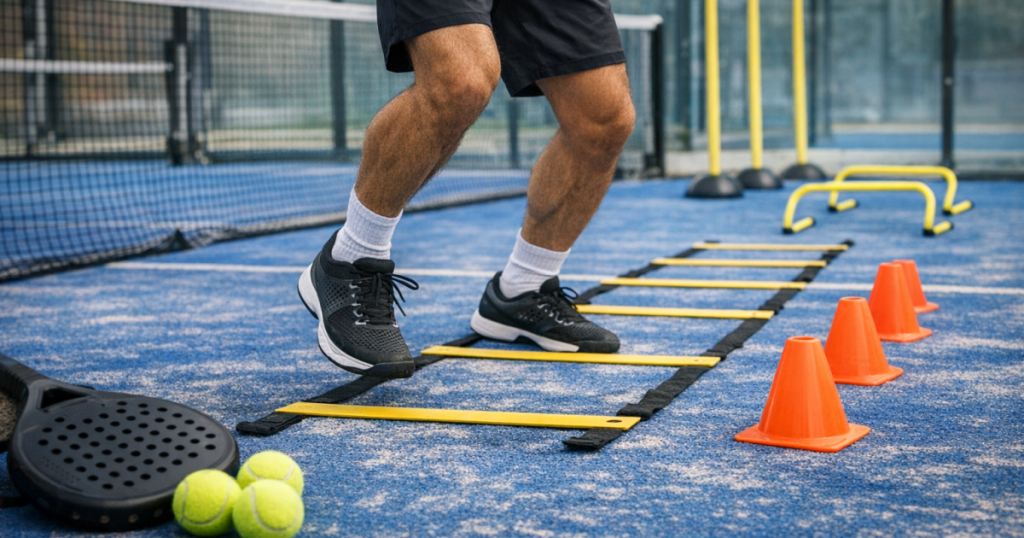
Should I do ladder drills for padel?
Ladders can help rhythm and coordination, but they are not essential. Padel-specific movement, such as split step, adjustment steps and corner recovery, usually transfers better to club play.
Why do I feel fast in drills but slow in games?
Games add decision-making. Keep the drills simple, then use one focus during matches, such as split stepping as the opponent hits or recovering immediately after your shot.
Do I need to be very fit to have good padel footwork?
No. Fitness helps, but early movement, balance and court positioning make a bigger difference for most beginners. Efficient footwork often feels calmer, not harder.
Key takeaways
Fixing slow footwork is less about running more and more about moving at the right moment. Start with your ready position, split step as the opponent hits, use small adjustment steps before contact and recover as soon as the shot is played.
Keep the drills short, repeat them regularly and bring one habit at a time into your next club game. When your feet arrive earlier, your shots usually feel simpler too.