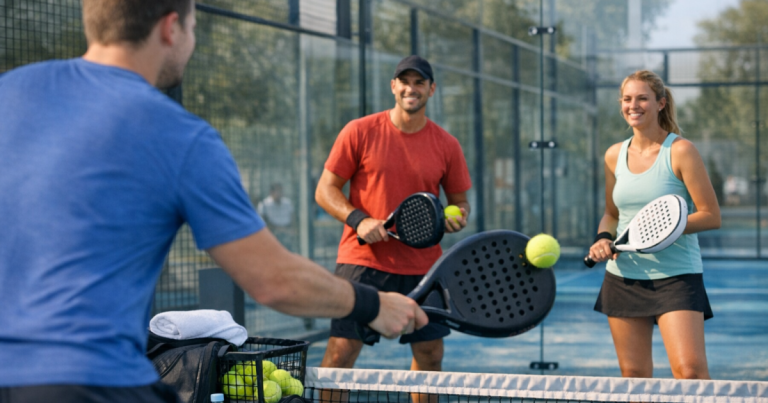
First sessions feel easier when you know where to stand, which walls matter, and what shot is sensible next. These padel basics give you a simple map of the court, the main strokes you will use in early rallies, and the tactical habits that help new players keep the ball in play without overthinking every point.
The short version
Padel is played on a 20 m by 10 m enclosed court with a net in the middle, service boxes near each end, and glass or solid walls that are part of the rally once the ball has bounced. Most beginner points are won by the pair that stays patient, keeps a good court shape, uses the lob well, and avoids trying to finish the rally too early.
- Know the court: the back and side walls are not obstacles; they create second chances when used properly.
- Keep your first shots simple: serve under control, return deep, and aim volleys at safe targets.
- Play as a pair: move up and back together rather than leaving one player exposed.
- Use height: a good lob can reset a difficult rally and help you take the net.
- Make fewer risky choices: most early-level matches reward consistency more than power.
Understanding the court without overcomplicating it
A standard padel court is rectangular, measuring 20 m long and 10 m wide. The net divides the court into two halves, and each half has service boxes marked by a centre line and a service line. Serves are hit diagonally into the opposite service box, similar in scoring pattern to tennis, but the serve itself is underarm after a bounce.
The biggest difference for beginners is the enclosure. The back wall and parts of the side wall are used during play. If the ball lands in your court first, it can rebound off the glass and still be returned. If it hits the wall before bouncing on your side, it is out. That one distinction clears up a lot of early confusion.
The side mesh can also come into play, but rebounds from mesh are less predictable than glass. At beginner level, treat the glass as your friend and the mesh as something to respect. You do not need to read every strange bounce perfectly straight away; just learn to pause, track the ball after the bounce, and give yourself space behind it.
For a fuller breakdown of scoring, serves and how points are counted in club matches, keep padel rules and scoring for beginners handy alongside your first few sessions.
Where to stand as a new player
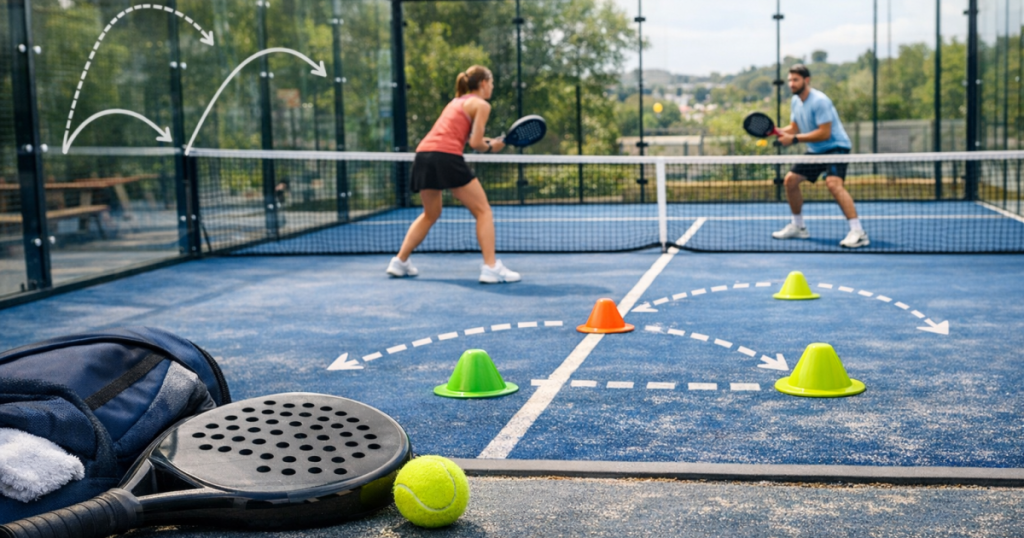
Beginner positioning is less about fixed spots and more about spacing. When your pair is defending, both players are usually nearer the back of the court, slightly in front of the back glass. You want enough room to let the ball pass you and rebound, but not so much room that you are stuck against the wall with no swing.
When your pair attacks, both players normally move towards the net. You do not need to stand on top of the net; a position around the service line or a step inside it gives you time to react while still allowing you to volley. The key is to move together. If one player charges forward while the other stays deep, a big gap opens in the middle.
Think of your partnership as connected by a short piece of string. If your partner moves left, you shade left. If they move back to defend, you recover back as well. This simple habit prevents a lot of easy winners through the centre.
The beginner shots that matter most
Serve
The serve starts the point, but it does not need to be a weapon. A controlled, legal serve gives your pair time to move into a useful position. Aim for depth and consistency rather than speed. Many new players lose cheap points by forcing the serve when a steady one would start the rally perfectly well.
Return
The return is one of the most important beginner shots because it decides whether you survive the first exchange. A safe return is usually deep and cross-court, giving you more space over the net and more court to aim at. If the serve is awkward, blocking the ball back low is often better than swinging hard.
Groundstroke
Your basic forehand and backhand are rally-building shots. Keep the swing compact, finish balanced, and aim away from the side mesh unless you are confident with the angle. At this stage, a medium-paced ball that lands deep is far more useful than a fast shot that clips the glass or fence.
Volley
The volley is played before the ball bounces, usually when you are near the net. Use a short punch rather than a big swing. A good beginner volley often goes towards the opponents’ feet or into the space between them. You are not trying to hit through people; you are trying to make their next shot uncomfortable.
Lob
The lob is a beginner’s best tactical tool. When opponents are at the net, lifting the ball high and deep can push them back, giving your pair time to recover or move forward. Aim for height first, then depth. A rushed, flat lob is easy to smash; a high, patient lob buys time.
Bandeja
The bandeja is the controlled overhead shot used when the ball is high but not ideal for a smash. For beginners, it is enough to understand the idea: keep the ball in play, maintain net position if possible, and avoid trying to win the point with every overhead. It is more of a steering shot than a power shot.
When you are unsure whether a rebound, double hit, wall contact or net touch is legal, the clearer reference is the guide to legal shots, rebounds and point loss.
Simple tactics that work quickly
Beginner padel improves fast when you stop treating each shot as a separate event. The aim is to build a point with your partner. A few reliable patterns will help more than a long list of advanced plays.
- Play cross-court when under pressure: the diagonal gives you more court length and a safer margin over the net.
- Use the middle: shots between opponents create hesitation, especially when both players are new.
- Win the net patiently: do not rush forward after a weak shot; move up when your ball is deep, low or lifted over the opponents.
- Lob to reset: if you are pinned at the back, a high lob can turn defence into a neutral point.
- Aim at feet, not faces: low balls force difficult volleys and are easier to control than ambitious winners.
- Talk early: simple calls such as “mine”, “yours”, “leave” and “back” prevent mix-ups.
Club padel is social as well as competitive, and good communication makes matches more enjoyable for everyone. If you are new to organised games, the guide to padel etiquette and club culture explains the small habits that help you fit in quickly.
Examples from common beginner points
You are returning a steady serve
Do not try to punish it straight away. Return cross-court and deep, then recover with your partner. If the serving pair moves forward, be ready to lob on the next shot. Your first job is to make them play one more ball.
You are trapped near the back glass
Let the ball rebound if it has enough pace, turn your shoulders, and send a controlled ball back into court. If the opponents are close to the net, lift the ball high. If they are deep too, a simple cross-court groundstroke is usually enough.
You get an easy volley
Aim low through the middle or towards the nearest opponent’s feet. Beginners often overhit easy volleys because the ball looks attackable. A controlled volley that forces a weak reply is usually better than a dramatic shot into the glass.
Your partner is pulled wide
Slide across to cover the middle rather than staying rooted to your original side. The open centre is the danger zone. Once your partner recovers, shift back into a balanced shape.
Checks before your next match
Before you start a game, agree on a few basics with your partner. Decide who takes lobs through the middle, how loudly you will call balls, and whether you want to prioritise lobbing or driving returns. These tiny agreements make early matches feel much calmer.
- On serve: get the ball in, then move into position together.
- On return: make the server volley or play one more shot.
- At the net: keep volleys compact and cover the middle.
- At the back: use the walls when the ball has bounced and do not panic near the glass.
- Between points: reset quickly and talk about the next pattern, not the last mistake.
Common questions
Can the ball hit the glass before I return it?
Yes, if it bounces on your side first. After the bounce, it may hit the back or side glass and you can still play it. If it hits the wall before bouncing on your side, it is not a legal ball.
Should beginners try to smash?
Only when the ball is clearly short and high. Most new players are better off using a controlled overhead or a deep placement shot. Smashing from too far back usually gives away points.
Is it better to stand at the net or the back?
Both positions matter. The net is usually the stronger attacking position, but you need to earn it with a good serve, deep shot or lob. When defending, stay calm near the back and use the walls.
Who should take balls through the middle?
Agree before the match, then communicate during the rally. In many pairs, the player with the forehand in the middle takes more of those balls, but clear calls matter more than a fixed rule.
How long does it take to feel comfortable with the walls?
Most beginners need several sessions before wall rebounds feel natural. Start by letting slower balls pass, watching the rebound, and using a compact swing. Confidence comes from repetition, not rushing.
In brief
Once these padel basics feel familiar, the game becomes much less chaotic. Learn the court shape, respect the glass, keep your first shots simple, and move with your partner. You do not need advanced tactics to enjoy early club matches; you need steady decisions, patient rallies and a few patterns you can trust under pressure.