Walking into a club session for the first time can feel more nerve-racking than hitting the ball. Good padel etiquette helps you settle in quickly: you know when to warm up, how to rotate, what to say after a lucky net cord, and how to keep the match enjoyable for all four players.
The short version
- Arrive on time and be ready when your court starts.
- Warm up cooperatively rather than trying to win the warm-up.
- Say the score clearly before serving and call your own faults honestly.
- Respect mixed levels, especially in social sessions and club nights.
- Rotate fairly when the format asks you to change partners or courts.
- Keep advice brief unless someone has asked for help.
- Leave the court tidy and thank the other players afterwards.
None of this is about being stiff or overly formal. Padel clubs tend to be social, relaxed places, but the small habits matter because four people are sharing a tight court, the ball is live off the glass, and rallies can change quickly. A player who communicates well is usually easier to play with than someone who has the biggest smash.
Before you arrive at the club
The easiest way to make a good first impression is to reduce avoidable delays. Check your booking time, know which court you are on, and give yourself enough time to change shoes, fill a bottle and find your group. If you are still new to the format, it is worth reading up on what to expect at your first padel session so the basics do not feel rushed when you get there.
Most clubs run a mix of private bookings, coaching, match play, Americanos, leagues and social sessions. Each format has a slightly different rhythm. A private booking is usually just your group managing its own time. A social session may involve moving courts, changing partners and playing timed rounds. If there is an organiser, listen to their instructions before the first round starts rather than asking another player halfway through.
Kit does not need to be fancy, but it should be court-appropriate. Wear non-marking court shoes, bring enough water, and avoid leaving bags or coats where players might trip. If you borrow a racket, return it promptly and treat it like someone else’s property, because it is.
Warm-up manners that make matches better
A padel warm-up is not a mini match. The aim is to help everyone get their timing, check the bounce, and loosen up safely. Start with steady shots down the middle or cross-court. Give your opponents balls they can hit cleanly rather than firing at their feet straight away.
A sensible warm-up usually includes a few groundstrokes, volleys, lobs and overheads for each player. If one person is clearly not getting many touches, feed them a few balls. Newer players sometimes rush this part because they are keen to start, but a calm warm-up often leads to a better first game.
It is also normal to apologise if you mishit a ball directly at someone during the warm-up. You do not need to make a drama of it; a quick raised hand or “sorry” is enough.
Where good padel etiquette shows up during points
The best club players are easy to share a court with because they communicate clearly and stay fair under pressure. That starts with the serve. Say the score before each point, loud enough for all four players to hear. If you are unsure of the score, stop before serving and check. Sorting it out early is much easier than arguing three points later.
Call balls honestly on your own side. If the ball lands close to a line and you are genuinely unsure, the generous club approach is to give the benefit to your opponents. You will not get every close call right, and neither will they, but a fair tone keeps the match friendly.
For new players, the most common confusion comes from walls, service boxes and whether a ball has bounced before hitting the glass. If you are still building confidence, keep a simple reference handy by reviewing the beginner scoring guide and asking experienced players to explain unusual calls after the point, not while the rally is still live.
Lucky shots and body shots
Padel has plenty of accidental winners: net cords, frame shots, strange rebounds and desperate blocks that somehow die in the corner. A small apology or smile is normal after a lucky shot. It is not an admission that the point should not count; it is just a social signal that you know fortune helped.
Body shots are part of padel, especially at the net, but there is a difference between a legitimate tactical shot and repeatedly blasting at a weaker player from close range in a friendly session. In competitive matches, firmer play is expected. In beginner club play, control and judgement matter more than proving you can hit hard.
Talking during rallies
Communication with your partner is encouraged. Short calls such as “mine”, “yours”, “leave”, “switch” or “watch the lob” are helpful. Long coaching speeches during a point are not. Keep calls clear and avoid distracting opponents just as they are about to hit.
Between points, a quick plan is fine: serve to the backhand, lob more, hold the net, slow the pace down. What rarely helps is blaming your partner, replaying every mistake, or turning a social match into a lesson nobody requested.
Respecting different levels
Club culture works best when stronger players remember what it felt like to be new, and newer players make an effort to learn the flow of play. If you are the stronger player, avoid taking every ball in the middle just because you can. Let your partner play, cover sensibly, and give encouragement that helps rather than overwhelms.
If you are the newer player, be honest about your level when booking or joining a session. There is no shame in being a beginner; problems usually come when someone joins a high-level match without realising the pace, or signs up for “advanced” because the time slot is convenient. A good level match is more enjoyable for everyone.
Mixed-level games can still be brilliant if expectations are clear. Stronger players can practise placement, patience and building points. Newer players can practise positioning, calling the score and recovering after mistakes. The aim is not always to create the most intense match possible; sometimes the aim is to give four people a worthwhile hour on court.
Rotations, club nights and social formats
Many UK clubs use timed rotations for social padel. You might play 12 or 15 minutes, record a score, then move court or change partner. Listen for the whistle, bell or organiser’s call. When time is up, finish the point if that is the local format, then move quickly so the next round starts smoothly.
Do not disappear between rounds without telling anyone. If you need a short break, let the organiser know. Social formats rely on numbers balancing neatly, and one missing player can leave three others waiting.
When rotating partners, reset your attitude each round. You may move from a very strong partner to a complete beginner, or from a calm match to a chaotic one. That is part of the point of club nights: you meet more players, learn different styles and become easier to pair with in future games.
Disputed calls and let situations
Disagreements are usually minor, but how you handle them says a lot. If two players saw a ball differently, pause, speak calmly and avoid turning one call into a character judgement. In friendly play, replaying the point is often the quickest way to keep the match moving, provided everyone agrees.
Let situations can confuse new players because they may involve serves, interruptions or balls entering from another court. If your club has courts close together, stop immediately if a stray ball creates a risk or distraction. For the details, the separate guide to padel let rules explains when points are replayed and what to do during a match.
Try not to weaponise the rules. Knowing the rules is useful; using them to intimidate newer players in a casual session is poor form. If a correction is needed, make it brief and kind: “I think that one is a fault because it hit the side glass first” is much better than a lecture.
After the match
At the end, thank all three players, not just your partner. A racket tap, handshake or simple “good game” is normal depending on the club and the mood of the session. If the match was one-sided, keep the tone generous. If you won easily, avoid giving unsolicited technical feedback. If you lost heavily, resist the urge to explain every point you nearly won.
Collect balls, clear bottles and move off the court promptly when the booking ends. Padel courts are often booked back-to-back, especially at busy indoor venues, and the next group should not lose time while you debrief in the doorway.
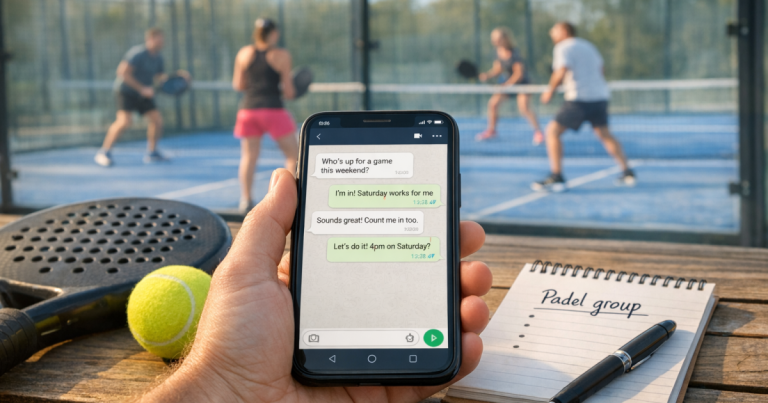
If you enjoyed the game, say so. Club culture is built through small invitations: “Fancy another game next week?” or “Add me to the group if you need a fourth.” Regular padel starts when people know you are reliable, friendly and happy to play in the right level of match.
Common mistakes new players can avoid
- Over-celebrating errors: celebrating a great winner is fine; celebrating every opponent mistake can feel unfriendly.
- Standing too close during someone’s swing: give players space, especially near the glass and at the net.
- Coaching without being asked: one simple tip may help, but constant correction can spoil a social game.
- Ignoring the organiser: in club sessions, the format matters. Follow the rotation even if you would prefer a different pairing.
- Chasing balls onto other courts: wait until play has stopped or ask clearly. Never run through an active rally.
- Letting frustration spread: everyone misses easy balls. Reset quickly so your partner does not feel they are carrying your mood as well as the match.
Helpful questions
Should I tell people I am new before a game?
Yes. A simple “I’m fairly new, so I might ask a couple of rule questions” sets expectations and usually makes people more helpful. It also helps organisers place you in the right level of session.
Is it rude to aim at the weaker player?
It depends on the context. In a competitive match, targeting is part of tactics. In a friendly beginner session, repeatedly isolating one weaker player can make the game less enjoyable, so mix up your shots and keep the tone social.
Can I ask for advice during a club session?
Yes, but choose the moment. Ask between games or after the match rather than during every point. Most experienced players are happy to help when the question is specific and the game can keep moving.
What should I do if my partner keeps criticising me?
Stay calm and use a short boundary: “I’m happy with one tip, but I play better with encouragement.” If it continues in an organised session, speak to the organiser afterwards rather than arguing on court.
Do clubs all follow the same social rules?
The broad manners are similar, but local habits vary. Some clubs are relaxed about replays; others follow competition rules closely. Watch how regulars handle warm-ups, rotations and close calls, then match that standard.
In brief
Good club culture is not complicated. Turn up prepared, communicate clearly, respect the level of the session, and treat close calls with fairness. The players who get invited back are not always the most powerful hitters; they are the ones who make an hour on court feel smooth, welcoming and fun.
As you play more, your understanding of padel etiquette will become automatic. Until then, focus on being reliable, honest and easy to partner. That is more than enough to help you settle into regular club play with confidence.