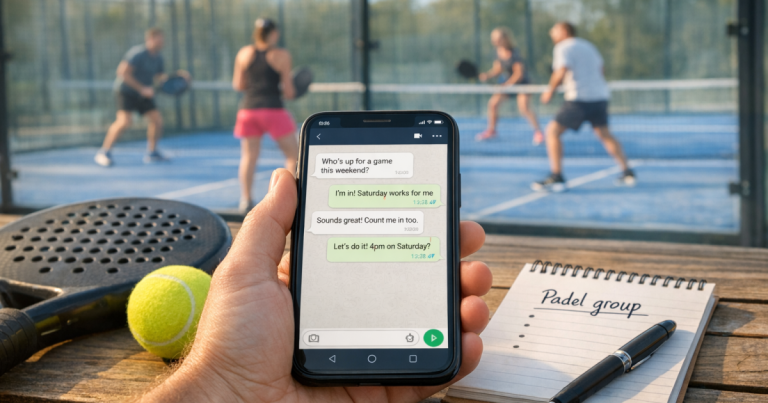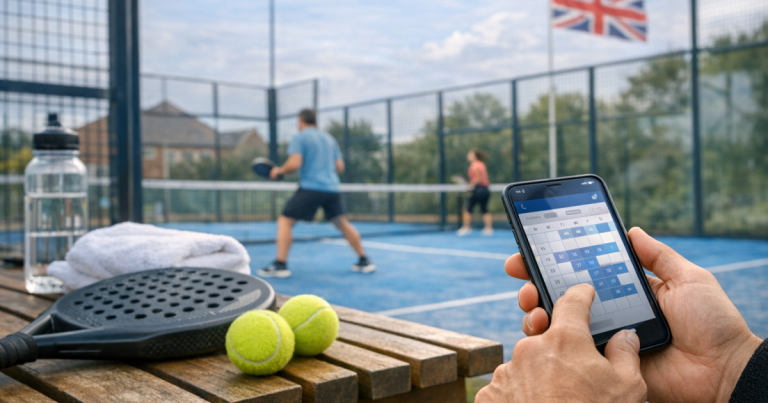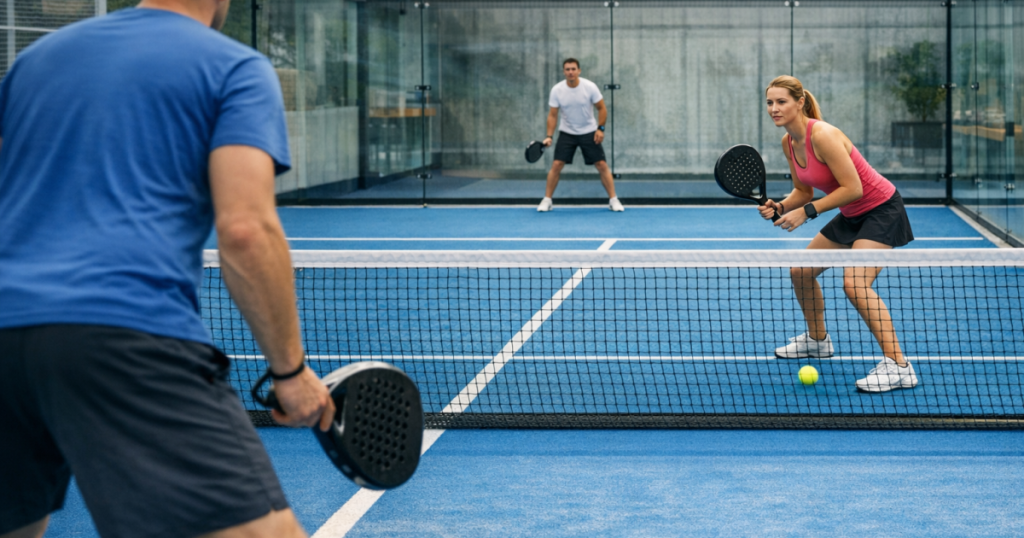
Getting comfortable with padel court basics makes your first club session feel far less chaotic. The markings show where serves must land, the glass and mesh change how rallies develop, and player positions tell you when to attack, defend, or simply stay out of your partner’s way. Once the court layout makes sense, the game starts to feel less like tennis in a cage and more like its own, very readable sport.
A standard padel court is compact, enclosed, and designed for doubles. You do not need to memorise every regulation detail before playing, but you do need to understand the main zones: the service boxes, the net, the back glass, the side walls, and the space around your partner. Those basics help you serve legally, return with more confidence, and stop being surprised when a ball that looks finished comes back off the wall.
The big picture
A padel court is 20 metres long and 10 metres wide, split in half by a net. Each half has two service boxes marked by a centre line and a service line. Unlike tennis, there are no tramlines for singles and doubles because padel is normally played as a doubles game on the full court.
The net is lower than many beginners expect: around 88 centimetres at the centre and slightly higher at the posts. Behind and beside the players are glass walls and metal mesh sections. These are not just boundaries; they are part of the game. After the ball bounces on your side, it can hit the glass and still be returned before it bounces again.
The simplest way to read the court is to think in three layers:
- The front zone: the area near the net, where teams try to volley, apply pressure, and finish points.
- The middle zone: the transition space where beginners often get caught. You may need to move through it, but standing there too long can leave gaps.
- The back zone: the defensive area near the glass, where you have more time to let the ball rebound and reset the rally.
What the lines actually mean
Padel has fewer court markings than tennis, which is good news for beginners. Most of the lines matter mainly for serving. Once the serve is in play, the walls and the ball bounce become more important than the lines under your feet.
The centre line
The centre line runs from the service line towards the back of each half and divides the left and right service boxes. It helps decide where a serve must land. If you are serving from the right side, the ball must land in the receiver’s diagonally opposite service box. The same applies from the left side.
For positioning, the centre line is also a handy reference point. If you and your partner are defending, you usually want to protect your own half while staying close enough to cover the middle together. Balls through the middle create confusion when both players assume the other will take them.
The service line
The service line sits across each half of the court, roughly 7 metres from the net. It marks the back edge of the service boxes. A legal serve must bounce inside the correct diagonal box, including on the line. If it lands beyond the service line or in the wrong box, it is a fault.
During rallies, the service line is useful as a rough depth marker. If you are defending behind it, you can often let the ball travel to the glass and play after the rebound. If you are inside it, you may need to volley, block, or move forward rather than waiting too long.
The outer lines
The side and back lines show the floor boundaries of the court. A ball that lands directly outside these lines is out, unless it has first bounced legally inside the court. A ball can bounce in, hit the glass, and still be playable. That single idea explains why padel rallies feel longer and why beginners sometimes stop too early.
If you are still getting used to when a point is over, pair the court layout with the scoring side of the game. The guide on how padel scoring works explains games, sets, tie-breaks, and golden point in beginner-friendly terms.
How the walls change the game
The walls are what make padel feel different. In tennis, a ball past you is usually gone. In padel, a ball that passes you may come back off the glass at a playable height. That gives you more chances to stay in the point, but only if you learn to pause instead of swinging at everything early.
Back glass
The back glass is your friend in defence. If the opponent hits a deeper shot and you are unsure whether to take it early, watch whether it will bounce near the back of the court. If it does, you may have time to let it hit the glass and rebound towards you.
A common beginner mistake is standing too close to the back glass. That gives you no room to let the ball come off it. As a rough habit, leave enough space behind you to turn, adjust your feet, and swing comfortably. You are not trying to hug the wall; you are trying to use it.
Side glass and corners
The side glass creates angles. A ball can bounce on the floor, hit the side glass, and move away from you. In the corners, the ball may touch the side glass and back glass in quick succession, which can feel awkward at first.
When defending corners, slow your feet down and watch the ball after the bounce. Many beginners chase the ball towards the corner too early, then find it rebounding behind them. If the shot has pace and depth, give yourself room and let the glass do some of the work.
Metal mesh
The mesh is less predictable than glass. A ball hitting the mesh can drop, kick sideways, or die quickly. In normal rallies, if the ball has bounced on the court first, a mesh rebound can be part of the point. On a serve, however, a serve that bounces in the correct box and then hits the metal mesh is a fault. A serve that bounces in the box and then hits the glass is generally fine.
That distinction matters because many beginners aim serves too wide without realising the side mesh can turn an otherwise good-looking serve into a fault. Start with a controlled, reliable serve before trying sharper angles.
Where players stand at the start of a point
Padel positions make more sense when you separate serving, returning, attacking, and defending. The court is small, so two players who move as a pair can cover a surprising amount of space. Two players who move separately leave gaps everywhere.
The serving team
The server stands behind the service line and serves underarm, after bouncing the ball behind the line. The serve goes diagonally into the opposite service box. The server’s partner usually starts near the net, ready to volley the return if it is weak or central.
After serving, the server normally moves forward to join their partner closer to the net. This is because the serving team has the first chance to take attacking position. Beginners do not need to sprint recklessly, but they should avoid serving and then staying planted at the back unless the return forces them to defend.
The receiving team
The receiver stands diagonally opposite the server, usually around or just behind the service line depending on confidence and the type of serve expected. Their partner normally starts in the other half, often a little deeper than the net player on the serving team.
On return, the priority is simple: get the ball back low and controlled. You do not have to hit a winner. A safe return towards the server’s feet, the middle, or deep into the court can neutralise the serving team’s advantage.
Left-side and right-side roles
Most pairs naturally split the court into left and right sides, viewed from your own back wall looking towards the net. The player on the left covers the left half; the player on the right covers the right half. The middle is shared, but it should not be treated as no one’s responsibility.
At beginner level, the player with the easier shot should usually take the middle ball. If both players are right-handed, the left-side player often has a forehand in the middle, while the right-side player may have a backhand. That can influence who calls for it, but communication matters more than theory.
Attack and defence: the two positions that matter most
Padel is often described as a battle for the net. That is mostly true, but beginners can misunderstand it. Being near the net is powerful only when you arrive under control and can volley without leaving huge gaps behind you.
When attacking, both players usually move up together. You stand a few metres from the net, not glued to it. From there, you can cover volleys, react to lobs, and close down weaker balls. If one player is at the net and the other stays deep, the pair becomes stretched and opponents can hit into the open space.
When defending, both players usually drop back together. This gives you time to read rebounds from the glass and play lobs or slower balls to reset the rally. A good defensive position is not passive. It is organised. You are waiting for the right ball to lift over the opponents or to play low through the middle.
The transition between defence and attack is where many new pairs struggle. If you hit a good lob that pushes the opponents back, move forward together. If your lob is short and they can smash or volley down, hold your defensive shape and prepare for the next ball.
Examples that make the court easier to read
Imagine you are receiving serve on the right side. The serve lands in your box and heads towards the side glass. You do not need to panic. If it has bounced first, you can let it reach the glass and then play it after the rebound. If it is heading for the mesh after the bounce, the serve is a fault, so knowing the difference saves unnecessary scrambling.
Now imagine you are defending and your opponent hits a deep ball down the middle. Both you and your partner step towards it. Instead of both swinging, one player should call early. Short words work best: yours, mine, leave, or switch. The smaller the court, the more valuable clear calls become.
Another common situation is the tempting loose ball near the middle of the court. A beginner often runs forward alone to attack it, leaving their partner deep. If the volley is not strong enough, opponents can lob over the advanced player or play into the gap. The better habit is to move as a pair and decide whether you are both attacking or both defending.
Ball condition also affects how court space feels. Older balls can bounce lower and make wall rebounds harder to judge, while lively balls may come off the glass faster. The beginner guide to padel balls, speed, bounce, and replacement explains when a ball is still good enough for drills or club games.
Common beginner misunderstandings
One misunderstanding is thinking the walls are only for advanced players. In reality, learning to let the ball rebound is one of the fastest ways to feel calmer. You do not need perfect technique. You just need to stop treating every deep ball as an emergency.
Another is thinking the lines matter during every rally. Once the serve is in, most of the court markings become less important than bounce order. The key question is usually: did the ball hit the floor inside the court before touching glass, mesh, or anything else?
A third is standing halfway between the net and back glass for too long. The middle zone feels safe because it is neither fully forward nor fully back, but it often leaves you exposed. Deep balls land behind you, volleys come at your feet, and lobs become awkward. Decide with your partner whether you are attacking or defending, then move together.
Before your first club game
When you book a court, check whether the session is social, coaching-led, match play, or open booking. A beginner-friendly social game usually gives you more time to ask questions about walls, serves, and positioning than a competitive box league match. If the booking process feels unclear, the walkthrough on how to book a padel court at a UK club can help you understand the usual steps.
Before stepping on court, take 30 seconds to look around. Notice where the service boxes are, where the side glass changes to mesh, how much space there is near the doors, and whether the court has any local instructions displayed. Then agree with your partner who starts on the left, who starts on the right, and how you will call middle balls.
During warm-up, practise three simple reads: a ball that bounces and hits the back glass, a ball that bounces and hits the side glass, and a serve landing near the side wall. Those few examples teach more than standing still and hitting straight balls back and forth.
Helpful questions
Can the ball hit the wall before it bounces?
No. On your opponent’s shot, the ball must bounce inside your court before it hits the glass or mesh on your side. If it hits the wall first, it is out.
Do the lines matter after the serve?
Not in the same way. After a legal serve, rallies are mainly judged by whether the ball lands in, how it rebounds, and whether it bounces more than once.
Where should beginners stand when defending?
Start deep enough to use the back glass, but not so close that you have no swing room. Move with your partner so you protect both halves and the middle.
Is it better to stay at the net?
The net is strong when both players reach it under control. If you are off balance or your partner is still deep, it may be safer to reset and defend together.
Which side should I play on?
At beginner level, choose the side that feels comfortable and stick with it for a session. Consistency helps you learn angles, rebounds, and shared responsibilities.
Main lessons
The court becomes much less intimidating once you connect the markings, walls, and positions. The service boxes guide the start of each point, the glass gives you extra time when defending, and good pair movement decides whether you are attacking or surviving.
These padel court basics are enough to make a first or second club game feel more organised. Focus on legal serves, patient wall rebounds, and moving with your partner. The more you recognise those patterns, the more the court starts to look like a set of helpful cues rather than a confusing enclosed space.