Walking onto a court for your first few games is much easier when padel rules for beginners feel clear rather than mysterious. Most early confusion comes from four areas: how the serve starts the point, when the walls are live, what counts as a fault, and when a let means you replay the point.
The good news is that padel is beginner-friendly once you understand the basic pattern. Serve diagonally, let the ball bounce once before using the wall, keep the ball inside the court before it touches the opponent’s glass or fence, and replay only in specific let situations. The sections below explain the rules in the same order you will meet them during a normal doubles match.
What to know first
Padel is nearly always played as doubles, with two players on each side of the net. The ball can bounce once on the floor before you hit it, and after that bounce it may rebound off the glass or fence. You lose the point if the ball bounces twice on your side before you return it.
Lines matter, but mainly on the serve. If a serve lands on the correct service-box line, it is in. Once the serve has been returned and the rally is live, you are mostly aiming to make the ball bounce anywhere inside your opponents’ court before it reaches their walls or fencing.
If you are still getting used to the layout, the easiest companion piece is this guide to padel court lines, walls and player positions. Knowing what each part of the court is for makes the rule explanations below much easier to apply.
How the serve works
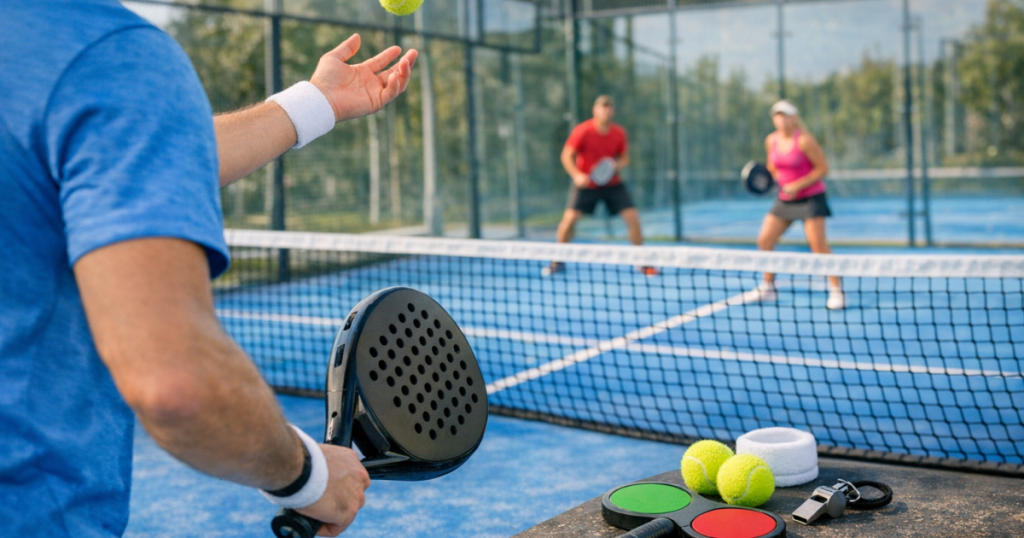
Every point starts with an underarm serve. The server stands behind the service line and serves diagonally into the opposite service box. The ball must be bounced on the ground before it is hit, and the contact should be at or below waist height. At least one foot should remain on or near the ground; it is not a jump serve.
The first point of a game is served from the right-hand side into the receiver’s right-hand service box. The next point is served from the left-hand side, then the server keeps alternating sides for the rest of that game. The same player serves for the whole game, then service passes to the opposing team for the next game.
A legal serve must land in the correct diagonal service box. If it clips the service line, it still counts as in. After landing in the box, the ball may continue towards the glass. However, if the serve lands correctly and then touches the metal fence before its second bounce, it is a fault under the standard rules used in padel clubs.
First serve and second serve
Like tennis, you normally get two serves. If the first serve is a fault, you take a second serve from the same side. If the second serve is also a fault, the receiving team wins the point.
For beginners, the safest serve is not a powerful one. Aim for a controlled, low serve that lands comfortably inside the box and makes the return awkward without risking the fence. Consistency wins far more free points at beginner level than speed.
Common serving faults
A serve is a fault when the basic conditions are not met. The most common beginner serving faults are easy to spot once you know what to watch for.
- The serve lands outside the correct diagonal service box.
- The serve hits the net and does not land in the correct service box.
- The serve lands correctly but then hits the metal fence before the second bounce.
- The server hits the ball above waist height.
- The server does not bounce the ball before hitting it.
- The server steps fully into the court before striking the ball.
- The ball hits the server’s partner, the receiver’s partner, or any player before landing correctly.
At social-club level, people are usually relaxed while beginners are learning. Still, it is worth building good habits early. A legal serve is not just about avoiding faults; it also sets up the first volley and helps your partner know where to stand.
When the walls are part of play
The walls are one of the biggest differences between padel and other racket sports. The key rule is simple: the ball must touch the floor on your side before it can legally rebound off your glass or fence. If your opponent’s shot hits your back glass or side glass before touching the court surface, the ball is out and you win the point.
If the ball bounces inside your court and then hits the glass, it is still live. You can let it rebound and play it before it bounces a second time. This is often the calmest choice when the ball is travelling quickly towards the back of the court.
The same idea applies when you hit towards your opponents. Your shot must bounce on their side before touching their glass or fence. If you hit directly into their back wall, side wall or fence without the ball bouncing first, your shot is out.
There is one useful defensive detail: you can use your own glass to send the ball back over the net. For example, if the ball is behind you, you may play it off your own back glass so that it travels over the net and lands in your opponents’ court. That is legal as long as it crosses the net and lands in.
For a more practical look at judging rebounds, read the beginner advice on using the glass walls in early padel matches. It explains how to let the ball come to you instead of rushing every shot.
Faults during a rally
Once the serve has been returned, the rally continues until one team wins the point or a fault occurs. Many early rally faults come from treating the walls as obstacles rather than part of the court.
- The ball bounces twice on your side before you hit it.
- Your shot lands outside the opponents’ court.
- Your shot hits the opponents’ glass or fence before bouncing on their court.
- The ball hits you, your partner, or anything you are wearing or carrying.
- You hit the ball twice in one stroke or carry it rather than striking it cleanly.
- You touch the net with your racket, body or clothing while the ball is in play.
- You reach over the net to hit the ball before it has crossed to your side.
A ball that clips the net during a rally and lands in the opponents’ court is not a fault. It stays live. There is no automatic replay just because the ball touches the net after the serve has been returned.
What counts as a let?
A let means the point is replayed. In padel, the most familiar let is on serve. If the serve touches the net, lands in the correct service box, and does not then hit the metal fence before the second bounce, it is usually a let. The server repeats that same serve. If it was a first serve, the server takes the first serve again; if it was a second serve, they repeat the second serve.
If the serve hits the net and then lands outside the correct box, it is a fault, not a let. If it hits the net, lands correctly, and then hits the fence before the second bounce, it is also treated as a fault under standard rules.
Other lets can happen when play is interrupted by something outside the point. A ball rolling in from another court is the classic example at busy clubs. If it affects play or creates a distraction, the point is normally stopped and replayed. In friendly matches, call it clearly and early rather than waiting to see whether your shot goes in.
Scoring and match flow in simple terms
Padel scoring is usually the same as tennis: 15, 30, 40 and game. If both teams reach 40, that is deuce. Some clubs and social events use golden point at deuce, where the next point wins the game. Others use advantage scoring, where a team must win two points in a row from deuce.
Matches are commonly played as sets, with the exact format depending on the club session, league or tournament. If you are joining organised games, check whether they use one set, best of three sets, short sets or timed rotations. The rules of a single point stay the same, but the winning condition can change.
If scoring is the bit that makes matches feel rushed, this breakdown of games, sets and winning conditions in padel will help you understand what you are playing before the first serve.
Beginner examples you will see often
The serve lands in, then hits the glass
This is normally fine. If the serve lands in the correct diagonal service box and then rebounds off the glass, the receiver can play it after the rebound. The important exception is the metal fence after the serve, which makes it a fault if touched before the second bounce.
The ball hits the back glass before the floor
That ball is out. Do not try to rescue it. One of the best beginner habits is learning to leave balls that are travelling directly into the glass without first bouncing in.
Your opponent smashes, it bounces, then comes off your back wall
The ball is live. You can let it rebound and return it before it bounces again. This is where calm footwork matters more than a big swing.
Your shot hits the net and drops over
During a rally, that is playable if it lands in the opponents’ court. It might feel lucky, but it is not automatically replayed.
A ball from the next court rolls behind you
Stop the point if it affects play or creates a risk of stepping on it. In club games, safety and fairness matter more than trying to finish a messy rally.
Helpful questions
Can you volley a serve in padel?
No. The receiver must let the serve bounce once before returning it. After the return is made, volleys are allowed during the rally.
Are the lines in or out?
If the ball touches the relevant line, it is in. On serve, the ball must land in the correct diagonal service box, and the service-box lines count as in.
Can the ball hit the fence during a rally?
Yes, after it has bounced in the court. The special fence restriction mainly affects the serve: a serve that lands correctly and then hits the fence before the second bounce is a fault.
Do you replay the point if the ball hits the net?
Only in specific serve-let situations. During a rally, a ball that touches the net and lands in is still live.
Who decides close calls in friendly matches?
Usually the players closest to the bounce make the call. If nobody is sure, replaying the point is often the fairest choice in social games.
Final thoughts
The quickest way to feel settled in early padel matches is to simplify the rules in your head. Serve underarm and diagonally. Let the serve bounce before returning it. Use the walls only after the ball has bounced. Remember that a shot must land in the opponents’ court before touching their glass or fence. Treat lets as rare replays, not a fix for every awkward point.
Once those basics are automatic, you can concentrate on positioning, shot choice and communication with your partner. That is when padel starts to feel less like a list of rules and more like a flowing doubles game.