Your racket takes more knocks than you realise: glass rebounds, low scoops, partner clashes and the odd scrape on the court surface. Good padel racket care is not about being precious; it is about keeping the frame solid, the face consistent and the grip comfortable enough for regular club sessions.
The short version
Most beginner racket problems come from avoidable damage rather than normal hitting. Protect the edges, keep the racket dry, avoid temperature extremes, replace worn grips, and stop using it if a crack changes how it feels or sounds.
- Small paint chips are usually cosmetic, but cracks that spread through the face or frame matter.
- A damp grip can make you squeeze harder, which affects control and comfort.
- Leaving a racket loose in a car boot or pressed under heavy kit is a common way to damage it.
- Structural repairs are rarely ideal for new players because they can change the racket’s feel.
- Replace the racket when it becomes unpredictable, uncomfortable or visibly compromised.
What usually damages a padel racket?
A padel racket is built to hit balls, not walls, floors, fences or other rackets. That sounds obvious, but most beginner damage happens during normal rallies: reaching too low for a ball near the floor, scraping the frame on the glass, or clashing with a partner when both players go for the same shot.
The most exposed area is the outer edge. The edge takes the first hit when you scrape the court, dig out a low ball or catch the side glass. Some rackets have a built-in protector or raised bumper, but no protector makes the racket immune to hard impacts.
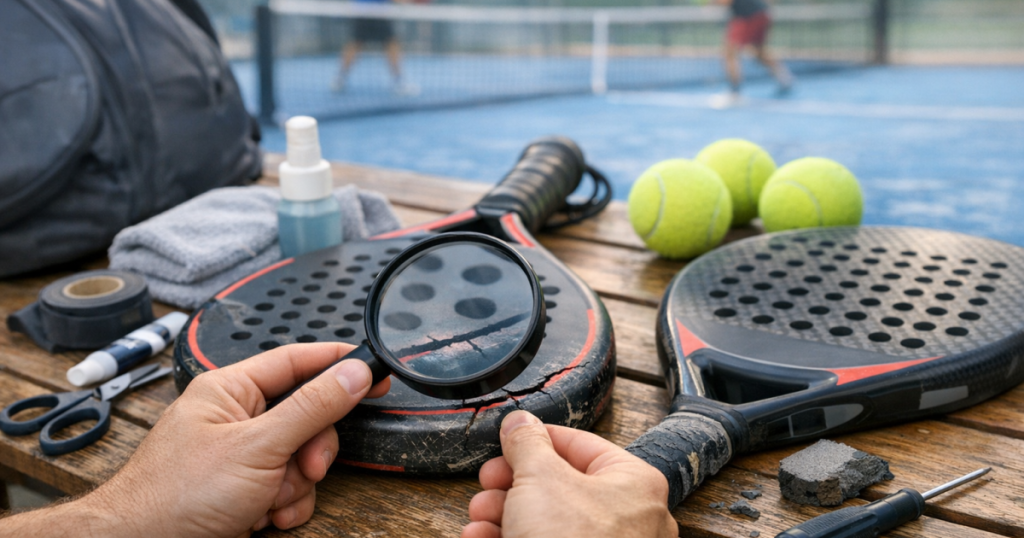
The face can also wear over time. A few marks from balls are normal, but visible splitting, deep cracking, bubbling or a soft-feeling area can suggest that the racket is no longer responding evenly. If the same shot suddenly comes off the face with a dull sound or odd vibration, take a closer look before your next match.
Storage matters too. In Great Britain, damp outdoor sessions and cold car boots are more realistic problems than extreme heat for much of the year, but both heat and cold can be unkind to sports equipment. A racket left in a car for long periods, stored wet in a bag, or pressed underneath shoes and bottles is more likely to age badly.
A simple padel racket care routine
The easiest padel racket care routine is the one you can repeat without thinking. It does not need specialist tools or a long cleaning process. A few small habits after every session will do more than a one-off deep clean every few months.
After every session
- Wipe the face and frame with a soft, slightly damp cloth if they are dusty or marked.
- Dry the racket before putting it away, especially after outdoor play or a wet journey home.
- Check the edge for fresh chips, lifted protector tape or sharp areas.
- Let the grip air briefly if your hand was sweaty, rather than sealing it wet inside a bag.
- Store it in a cover or racket compartment instead of loose with shoes, keys or water bottles.
Avoid strong household cleaners, abrasive pads and soaking the racket. You are only removing surface dirt, not washing the racket like a pair of trainers. If the grip is the main problem, replacing the overgrip is usually cleaner and more effective than trying to scrub it back to life.
Between matches
At home, keep the racket in a dry room at a steady temperature. A hallway cupboard is usually better than a shed, garage or car boot. Do not place heavy bags on top of it, and avoid leaning it where the frame is under pressure for long periods.
If you play several times a week, inspect the grip and edge more often. Regular club play puts repeated stress on the same contact points, so small chips can turn into bigger issues if you ignore them.
How to read common damage signs
Not every mark means your racket is finished. Beginners often worry about the first chip, but cosmetic wear is part of using sports kit. The important question is whether the damage affects strength, comfort or ball response.
Usually cosmetic
- Light ball marks on the face.
- Small paint chips on the edge with no crack spreading from them.
- Minor scuffs from the court surface.
- Discolouration or wear on an old overgrip.
Cosmetic marks are worth watching, but they do not automatically mean you need a new racket. Take a quick photo if you are unsure, then compare it after a few sessions to see whether the mark is growing.
Worth taking seriously
- A crack that runs across the face or around the frame.
- A rattling sound from inside the racket.
- A section of the face that feels unusually soft, raised or uneven.
- A loose handle or movement where the handle meets the head.
- Sharp broken edges that could catch your hand, clothing or another player.
If any of these signs appear, stop treating the racket as reliable match kit. You might still use it gently for warm-ups while you decide what to do, but a structurally damaged racket can make your shots inconsistent and your timing harder to trust.
When a racket feels wrong, it may not just be damage
Sometimes a racket feels poor because it was the wrong match for your game in the first place. A very stiff, head-heavy or small-sweet-spot racket can feel harsh even when it is undamaged. New players often blame technique for everything, but equipment that punishes slight mishits can slow confidence.
If your racket feels uncomfortable on routine shots, check whether the issue is damage, grip size, weight feel or forgiveness. Our guide to forgiving racket shapes and sweet spots explains why some beginner-friendly rackets are easier to control on off-centre hits.
Also think about the balls you use. Very worn balls can make rallies feel flat, while very lively balls can make timing harder for beginners. That does not usually damage the racket on its own, but it can change how much effort you put into each shot.
Can you repair a damaged padel racket?
Some minor issues are easy to sort. An old overgrip can be replaced. Loose protective tape can be removed and reapplied. A dirty face can be wiped clean. Small cosmetic chips can be left alone if they are not spreading.
Structural damage is different. A crack through the frame or face is not the same as chipped paint. DIY glue, filler or tape may hide the problem, but it can also alter the balance, feel and rebound. For most beginners, a repaired cracked racket is unlikely to feel as predictable as an intact one.
If the racket is nearly new and the damage appeared without an obvious impact, speak to the retailer and check the manufacturer’s warranty terms. Keep your proof of purchase and photos of the issue. Do not assume every crack is covered, because impact damage and normal wear are commonly treated differently by retailers and brands.
When replacement makes more sense
Replacing a racket is not about chasing the newest model. It makes sense when the old one is holding back your control, comfort or confidence. For a first-season player, consistency matters more than squeezing a few extra sessions from a damaged frame.
Consider replacing your racket if:
- A crack is growing or reaching the frame edge.
- The racket sounds dull, rattly or uneven compared with before.
- The face has a clear soft spot or raised area.
- The handle feels loose, twisted or unstable.
- You avoid certain shots because you no longer trust the racket.
- You have outgrown a very basic starter racket and now play regularly.
Budget is part of the decision. A casual player may not need to spend heavily, while someone playing weekly may benefit from a more durable and comfortable upgrade. If you are weighing up whether repair, replacement or an upgrade is sensible, read how much you should spend on a padel racket before buying again.
How long should a beginner racket last?
There is no single lifespan that applies to every racket. It depends on how often you play, how hard you hit, how many wall or floor impacts it takes, where you store it, and whether it was built as a light occasional-use racket or a more robust regular-play option.
As a rough practical guide, a beginner who plays occasionally and looks after the racket should expect it to last longer than someone playing several competitive sessions each week. Heavy impact damage can end a racket’s useful life in one point, while careful use can keep an older racket perfectly playable.
Instead of counting months, judge the racket by condition and feel. If it looks intact, feels stable, sounds normal and gives predictable response, it is probably still doing its job. If it has visible structural damage or has become uncomfortable to use, the calendar age matters less.
Buying your next racket after damage
If damage forces a replacement, use it as a chance to choose more carefully rather than simply buying the same type again. Think about what went wrong. Did the edge take constant scrapes because you are still learning low defensive shots? Did a stiff racket feel unforgiving on mishits? Did the grip become slippery too quickly?
For many early-stage players, a round or teardrop racket with a comfortable feel and generous sweet spot is a sensible direction. It will not fix technique, but it can make learning less punishing. If you are still in your first year of regular play, our guide to choosing a padel racket for your first season will help you prioritise control, comfort and realistic progression.
Keep expectations grounded. A more expensive racket is not automatically more durable for your game, and a powerful racket can be harder to control if you are still building timing. The right replacement is the one that helps you play more consistent points, not the one that sounds most advanced.
Questions people ask
Can I keep playing with a cracked padel racket?
You can sometimes finish a casual session with a small surface crack, but you should not rely on a cracked racket for regular play. If the crack spreads, changes the sound, or affects the frame, replacement is the safer and more predictable option.
Is a chipped edge a big problem?
A small paint chip is usually cosmetic. A deep chip with a crack running from it is more serious. Monitor the area after each session and stop using the racket if the damage grows or leaves a sharp edge.
Should I store my racket in the car?
Not for long periods. Cars can become cold, damp or hot, and the racket may get knocked by other kit. A dry indoor space is better for day-to-day storage.
How often should I change the overgrip?
Change it when it feels smooth, slippery, dirty or compressed. Some players need a fresh overgrip every few sessions, while occasional players may get much longer from one.
Does protector tape stop all damage?
No. Protector tape can reduce scuffs and minor edge wear, but it will not prevent all damage from hard impacts with glass, fencing, the floor or another racket.
In brief
Look after the basics: keep the racket dry, store it sensibly, protect the edge, refresh the grip and inspect damage before it becomes a bigger problem. Small scuffs are part of learning padel, but cracks, rattles, soft spots and loose handles are signs to take seriously. When a racket no longer feels predictable, replacing it with a comfortable, forgiving model is usually better than battling with damaged kit.