Your first club match can feel busy: four players moving, glass walls in play, tennis-style scoring, and a few unwritten habits that regulars seem to know automatically. This padel rules cheat sheet gives you the essentials without turning the game into a law exam, so you can get through your first match confidently and ask better questions when something unusual happens.
Padel is usually friendly to beginners, but club matches run much more smoothly when everyone understands the basics: who serves, when the ball is out, how the walls work, and what counts as good court manners. You do not need to memorise every formal regulation before stepping on court. You do need enough understanding to keep rallies fair and avoid stopping play every few points.
Main points
- Padel is normally played as doubles, with two players on each side.
- Scoring is the same basic system as tennis: 15, 30, 40 and game.
- Serves are underarm, hit after one bounce, and must land diagonally in the opposite service box.
- The ball can rebound off the glass after it has bounced on the court.
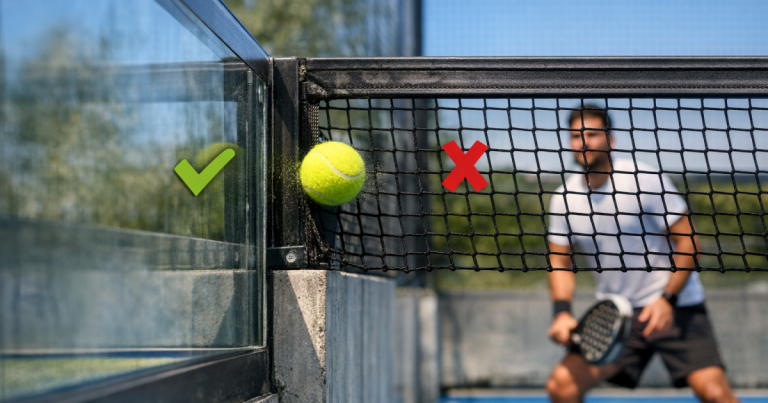
- A ball is out if it hits the glass or fence before bouncing on the opponent’s court.
- You normally get two serves, as in tennis.
- When in doubt at beginner level, pause, agree the call calmly, and replay the point if nobody is sure.
How scoring works in a club match
Padel scoring will feel familiar if you have watched or played tennis. Each game starts at love-all, then moves through 15, 30, 40 and game. If both pairs reach 40, that is deuce. From deuce, one pair usually needs to win two points in a row: advantage, then game.
Some clubs and social sessions use golden point instead of traditional advantage scoring. With golden point, when the score reaches deuce, the next point wins the game. The receiving pair usually chooses which side receives. This is common in time-limited sessions because it keeps matches moving and helps courts finish on schedule.
Sets are commonly played to six games, with a pair usually needing to win by two games. If a set reaches 6-6, a tiebreak may be played. In social beginner matches, formats can vary: some sessions use timed matches, short sets, or first-to-four games. Check the format before you start rather than assuming every club runs the same structure.
Serving rules beginners need most
The serve is one of the biggest differences between padel and tennis. It is not an overhead power shot. It is a controlled underarm serve designed to start the point fairly.
- Stand behind the service line: You serve from behind the line on your side of the court.
- Serve diagonally: The ball must travel into the opposite diagonal service box.
- Let the ball bounce first: Drop the ball, allow it to bounce, then strike it.
- Hit below waist height: The contact point should be below waist level.
- You get two attempts: If the first serve is a fault, you have a second serve.
- Switch sides after each point: The server alternates between the right and left service sides during the game.
A serve is usually a fault if it lands outside the correct service box, hits the net and does not land in, or hits the side fence after bouncing in the service box. A serve that clips the net and lands correctly is usually a let and is replayed, unless your club session has a specific local rule.
If your first club match is part of an organised beginner session, the coach or host may explain the serving order before play begins. If not, just ask. Most players would rather clarify it before the first point than untangle confusion later.
Serving order and changing ends
At the start of a set, one pair chooses who serves first. The serve then alternates between teams each game. Within each pair, partners take turns serving their team’s service games. For example, if you serve your pair’s first service game, your partner serves the next time your team serves.
Players change ends after the first game, then after every two games after that. In casual club matches, people sometimes forget this, especially when the conversation is flowing. It is fine to correct it politely between games.
Receiving positions are simpler than they first appear. At the start of each set, each pair decides who receives on the right side and who receives on the left side. Those receiving sides usually stay fixed for the set. If you are unsure where to stand, ask your partner before the first return game starts.
When the walls are in play
The glass walls are what make padel feel different from most racket sports. The basic idea is simple: the ball must bounce on the court before it can be played off the glass. Once it has bounced, it can hit the back glass or side glass and still remain live.
Here are the wall rules that matter most in your first match:
- Good: Your opponent hits the ball, it bounces on your side, hits the glass, and you return it before it bounces again.
- Good: You let the ball pass you, it hits the back glass after bouncing, and you play it back.
- Out: Your shot hits your opponent’s glass before it bounces on their court.
- Out: Your shot hits the fence or back wall directly without landing in first.
- Usually out: The ball hits court fixtures or areas outside normal playable space, unless the club has a specific rule for that court.
The fence can be trickier than the glass because rebounds are less predictable. In general rallies, if the ball bounces in the court and then hits the fence, it can remain in play. On serve, many clubs treat a ball that bounces in the service box and then hits the side fence as a fault. If there is any doubt, follow the club’s house rule.
What counts as a fault during rallies
Most rally faults are straightforward once you know the pattern. You lose the point if the ball bounces twice on your side, if you hit it into the net, or if your shot goes directly into the opponent’s glass or fence before bouncing on their court.
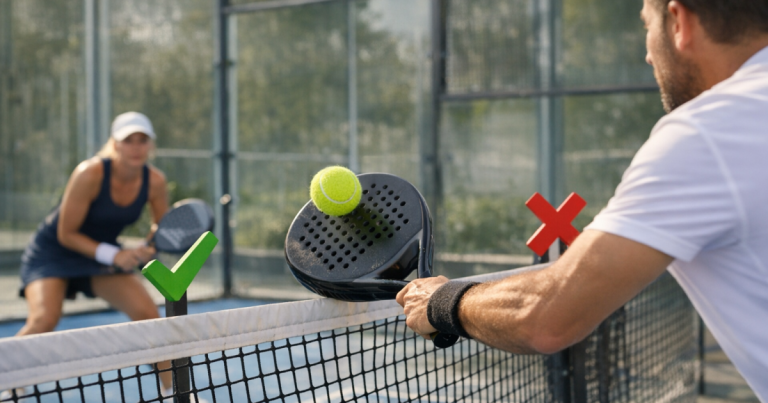
You also lose the point if you touch the net while the ball is live. Avoid reaching over the net unless you are certain the situation allows it. At beginner level, the safer habit is to play the ball on your side and keep your movement tidy around the net.
Double hits and carrying the ball can also be faults, but they are rarely argued over in beginner social play unless very obvious. The spirit of club padel matters: make honest calls, avoid claiming marginal points aggressively, and keep the match enjoyable.
Line calls and close decisions
In padel, a ball that touches any part of the line is in. That applies to serves and rally shots. If you are receiving and the serve clips the service line, play it unless you are certain it was out.
The pair on the side where the ball lands usually makes the call. If you and your partner disagree, the fairest beginner-friendly approach is to give the benefit of the doubt to your opponents or replay the point if nobody had a clear view. Competitive matches may be stricter, but your first club match should not turn into a debate over every painted line.
Good calling habits make you welcome in future games. Call loudly enough for the other pair to hear, use simple words such as “out” or “good”, and avoid making late calls after seeing whether your return was successful.
Club etiquette that matters as much as the rules
Rules keep the score fair; etiquette keeps the match enjoyable. At beginner level, the second part often matters more. Arrive a few minutes early, introduce yourself, and confirm whether the match is social, coached, competitive, or part of a box league.
Wear suitable footwear for the surface and the club’s policy. If you are not sure what is expected, this explainer on whether padel shoes are required for club sessions is a useful next step before turning up in general trainers.
- Bring balls if agreed: Some sessions provide balls, others expect players to rotate responsibility.
- Do not walk behind active points: Wait until play stops before crossing near another court.
- Keep warm-ups short: Hit a few controlled balls rather than trying to win the warm-up.
- Apologise for lucky net cords: It is a small gesture, but it fits the culture of the game.
- Encourage your partner: Mistakes happen quickly in padel, especially with glass rebounds.
- Respect the booking time: Finish promptly if another group is waiting.
Common first-match moments and what to do
The ball hits the glass behind you
If the ball bounced on your side before hitting the glass, it is still playable. Letting the ball come off the back glass is often smarter than rushing a cramped shot. Give yourself space, turn early, and focus on getting the ball back into court.
Your serve clips the net
If it clips the net and lands correctly in the diagonal service box, it is usually a let and you replay the serve. If it clips the net and lands out, it is a fault. If your club uses a variation, follow the session host’s instruction.
You forget the score
Stop before serving and ask. The server should call the score before each point, with their pair’s score first. Saying the score aloud prevents most mix-ups and gives everyone a chance to correct it before the rally starts.
You are not sure whether the ball hit the fence or glass first
Ask the players closest to it. If nobody knows, replaying the point is usually the cleanest option in a social match. Over time you will get better at reading the sound and angle of rebounds.
Different clubs may run slightly different formats
The core rules of padel are consistent, but the way beginner club sessions are organised can vary. Some venues run Americanos or Mexicanos, where partners and opponents rotate. Others run fixed-pair matches, coaching games, or timed social courts. Scoring may be shortened to fit the booking window.
That is why it helps to choose a venue that explains beginner sessions clearly. If you are still finding the right place to play, read how to choose your first padel club before committing to regular sessions. Clear organisation makes rules easier to learn because you are not guessing the format while trying to return serves.
Coached beginner sessions can also be a good bridge between casual rallies and proper matches. A coach can pause play, explain why a point was won or lost, and correct habits before they become automatic. For an example of how first lessons can support new players, see this Rocks Lane padel coaching review.
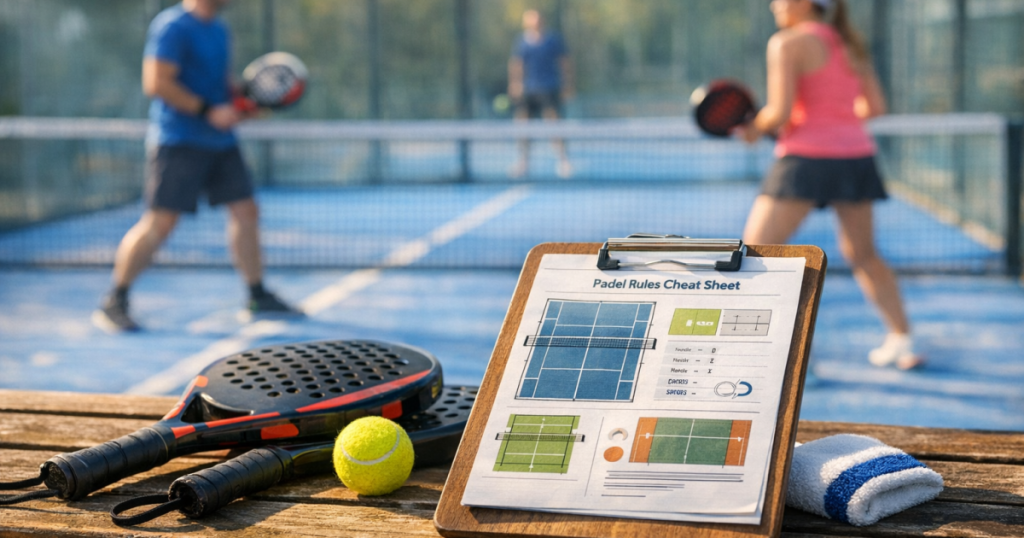
Your first-match padel rules cheat sheet
- Start each game at love-all and score 15, 30, 40, game.
- At deuce, use either advantage scoring or golden point, depending on the session format.
- Serve underarm after one bounce, below waist height, diagonally into the correct service box.
- Use two serves: first serve, then second serve if needed.
- Alternate service sides after every point.
- Keep the same receiving side during a set unless the format says otherwise.
- The ball must bounce before hitting the opponent’s glass or fence.
- After the ball bounces on your side, the glass can help you return it.
- A ball touching the line is in.
- Call the score before serving and resolve doubts calmly.
Questions people ask
Do I need to know every official padel rule before a club match?
No. You should understand serving, scoring, walls, line calls and basic etiquette. Club hosts and regular players are normally happy to clarify unusual situations.
Is padel always played as doubles?
Most club padel is doubles because standard courts are designed for four players. Singles-style practice can happen, but your first club match will probably be doubles.
What happens if the ball hits the glass before the floor?
If your shot hits the opponent’s glass before bouncing on their court, it is out. The ball must land in the court first.
Who calls the ball out?
The players on the side where the ball lands usually make the call. If there is genuine doubt in a social match, replaying the point is often the fairest solution.
What should I say before serving?
Call the score clearly, with your pair’s score first. For example, if you are serving at 30-15, say “30-15” before starting the point.
Main lessons
Your first match does not need to be perfect. The aim is to keep the rally moving, understand why points start and stop, and build confidence with the glass, the serve and the scoring rhythm. If you remember only a few things, remember these: serve underarm and diagonally, the ball must bounce before the opponent’s walls are involved, lines are in, and calm communication solves most beginner confusion.
Padel becomes much easier once the rules stop taking up all your attention. After a few club matches, you will find yourself thinking less about the score and more about positioning, patience and enjoying the rallies.