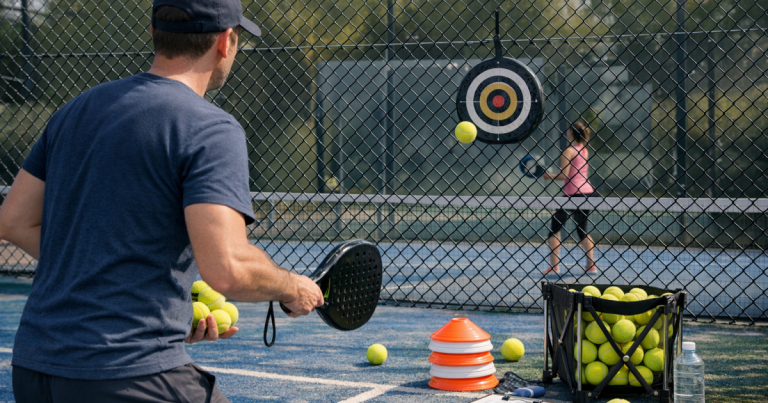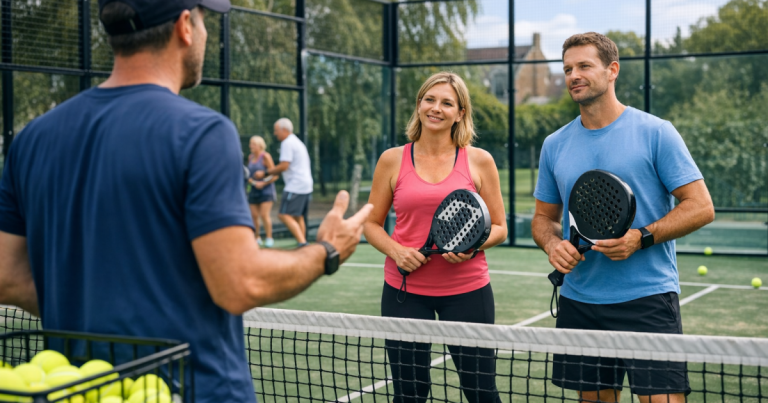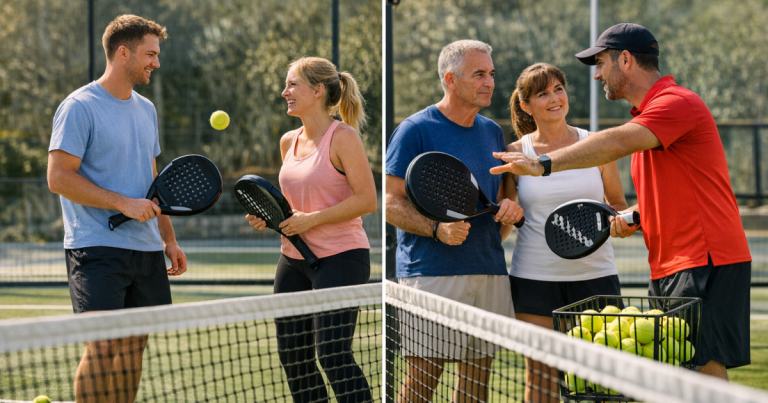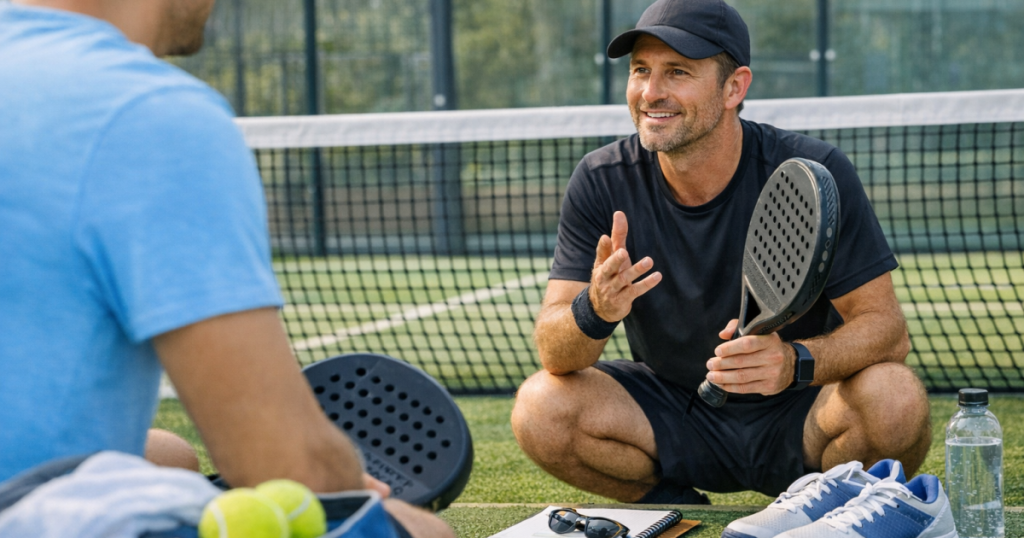
A good coach can make padel feel simpler very quickly, but the best fit is not always the loudest advert or the nearest slot. Before booking a padel coach, ask a few clear questions so you know what kind of session you are paying for, what level it suits, and what you should expect afterwards.
For beginners, the goal is not to find someone who overloads you with tactics. It is to find a coach who can explain the basics clearly, spot your biggest habits, and help you enjoy real club games sooner.
What to know first
The best beginner coaching is specific, organised, and realistic. You want to leave with one or two useful changes, not a long list of corrections you cannot remember once the rally starts.
- Ask whether the coach regularly works with new players, not only competitive juniors or advanced adults.
- Check whether court hire is included in the session fee or paid separately.
- Find out whether the lesson is individual, shared, or part of a group.
- Ask what the first session normally covers, so you can tell whether it matches your needs.
- Make sure you will receive simple practice points after the lesson.
If you already have a club in mind, it also helps to understand the court-booking process before agreeing times. The steps in booking a padel court in the UK are useful if you are arranging a private lesson yourself rather than joining a club-run coaching session.
Step 1: Ask what level the session is really designed for
Beginner can mean different things. Some players mean they have never held a padel racket. Others have played tennis or squash for years and are new only to the walls. A coach should be able to place you without making you feel awkward.
Useful questions include:
- Is this session suitable for complete beginners?
- Do you separate first-time players from improver players?
- How do you adapt the lesson if one person in the group is more experienced?
- Will we cover rules and scoring, or is the session mainly technique?
If you are nervous, say so. A good coach will not treat that as a problem. They should explain how they keep the pace manageable, how many balls you will hit, and whether you will spend time on basic positioning before playing points.
Step 2: Ask what the first lesson will actually include
A vague answer like “we will work on your game” is not very helpful for a new player. You do not need a rigid minute-by-minute plan, but you should get a sensible outline.
For a first beginner lesson, it is reasonable to expect a mix of:
- Warm-up and simple movement around the court.
- Basic grip, contact point, and swing length.
- Forehand and backhand groundstrokes.
- Simple volleys near the net.
- How to recover to a useful court position after hitting.
- A short rally or point-based exercise if the group is ready.
The coach does not have to cover everything in one hour. In fact, trying to fix every shot at once can be counterproductive. Listen for a coach who talks about priorities: control before power, court position before fancy shots, and understanding the wall before attempting advanced patterns.
Step 3: Ask about group size and how feedback is given
Group lessons are often a friendly and cost-effective way to start, but the number of players matters. A group of four can work well because everyone can rotate and rest without standing around too long. Larger groups can still be useful if the coach is organised, but feedback may be lighter.
Ask these questions before you commit:
- How many players are normally in the session?
- Will the coach give individual feedback or mainly demonstrate drills?
- How much hitting time should each player expect?
- Will players be grouped by level where possible?
For a first lesson, you do not need constant technical correction. You do need enough attention to know whether your grip, spacing, and recovery position are roughly on track. If you want detailed work on one issue, a one-to-one lesson or a shared lesson with one other player may suit you better.
Step 4: Ask what costs are included
Padel coaching costs can be presented in different ways, especially at clubs where court hire, coach fees, and guest access may be handled separately. Do not feel embarrassed asking for the full cost before confirming. It is normal and sensible.
Clarify:
- Does the quoted price include court hire?
- Is equipment provided for beginners who do not own a racket?
- Are balls included?
- Is there a club guest fee or temporary access fee?
- What is the cancellation policy?
- Do you pay per session, in a block, or through the club system?
Blocks of lessons can be useful once you know you like the coach, but many beginners are better starting with one session or a short taster. That gives you a chance to assess the teaching style without committing to a programme that may not fit your schedule.
Step 5: Ask how the coach teaches positioning, not just shots
Padel becomes much easier when you understand where to stand. Beginners often focus on striking the ball harder, but many lost points come from being late, too close to the wall, or stuck in the wrong part of the court.
Ask the coach how they teach:
- Where to recover after serving or returning.
- When to move forwards as a pair.
- How to defend near the back glass.
- How to use a split-step before your opponent hits.
- How to avoid leaving your partner exposed.
If the coach can explain positioning in plain English, that is a strong sign. You can also build the habit between lessons with simple court movement work, such as the ideas in padel split-step drills for better court positioning.
Step 6: Ask whether the coach will work with your actual goals
Not every beginner wants the same thing. Some want to feel confident joining social matches. Some want to stop making the same mistake on every backhand. Others are preparing for a friendly box league or regular club game.
Before the lesson, tell the coach what you want from padel. Good goals sound like:
- I want to understand the basic rules and scoring.
- I want to rally without panicking.
- I want to feel less lost when the ball comes off the glass.
- I want to improve my serve and return.
- I want to join club games without holding people back.
A helpful coach will turn that into a simple plan. For example, if your goal is social match confidence, they may spend more time on serving, returning, rotation, and where to stand with a partner. If your goal is technique, they may slow the session down and use more repeated feeds.
Step 7: Ask what you should practise after the lesson
A lesson is only the start. The real improvement comes when you know what to repeat in your next knockabout, match, or warm-up. Ask the coach for two or three practice points, not a whole training manual.
Good follow-up advice might include:
- One technical cue, such as shorter swing or earlier preparation.
- One movement cue, such as recover to the middle of your side after hitting.
- One match habit, such as calling early with your partner.
- One drill you can do with another beginner.
Be wary of advice that is too broad, such as “just play more” or “be more consistent”. Playing more helps, but beginners need a focus. A simple instruction you can remember under pressure is worth far more than a complicated explanation you forget after ten minutes.
Step 8: Ask about lesson format and communication style
The right format depends on how you learn. Some players like demonstration first. Others need to hit a lot of balls and receive short corrections. Some prefer calm coaching; others enjoy a more energetic session. None of these is automatically better, but it helps to know what you are walking into.
Ask:
- Do you demonstrate first, or explain while players hit?
- How do you structure a typical beginner session?
- Will there be point play, or is it mostly drills?
- Do you give feedback during the session or at the end?
- Can I mention if I feel overloaded?
A coach who welcomes those questions is usually easier to learn from. You should feel comfortable asking for clarification, especially when new padel terms appear. Beginner coaching should build confidence, not make you feel as if everyone else already knows the secret language.
Step 9: Ask how they handle doubles teamwork
Padel is a doubles game for most club players, so your coach should not teach every skill as if you are alone on court. Even early lessons can include simple partner habits: calling mine or yours, moving as a pair, and understanding when to attack or defend together.
Good questions include:
- Will we learn basic partner positioning?
- Do you cover communication during points?
- How do you teach beginners to move forwards together?
- Will the session include real doubles scenarios?
This matters because many new players can hit the ball reasonably well in drills, then feel lost in a match. A coach who includes doubles awareness early will help you transfer the lesson into actual play.
Step 10: Ask what happens if the session is not quite right
Sometimes a session is useful but not the right long-term fit. That is fine. Coaching is personal, and you are allowed to choose a coach whose style, pace, and availability match your needs.
Before signing up for a block, ask:
- Can I try one session first?
- Can I move to a different level group if needed?
- Is there a pathway from beginner sessions into social games?
- Will you recommend another coach or group if this is not the best fit?
A confident coach or club should be comfortable with these questions. The goal is not to trap you into sessions; it is to help you become a regular, capable player who enjoys turning up.
Signs you have found a good beginner coach
You do not need to judge a coach by advanced tactics or impressive playing level alone. For new players, the best signs are usually practical and easy to notice.
- They explain one thing at a time.
- They correct the cause of a mistake, not just the result.
- They use language you understand.
- They keep the session moving without rushing you.
- They notice positioning and teamwork, not only the racket swing.
- They give you clear practice points for next time.
- They make club play feel more achievable.
Playing ability helps, but teaching ability matters more. A coach who can help a nervous beginner relax, rally, and understand court position is doing valuable work.
Questions people ask
Should I book one-to-one coaching or join a group first?
If you are completely new and want confidence, a beginner group is often a friendly place to start. If you feel anxious, have a very specific issue, or want faster individual feedback, one-to-one coaching can be more focused. A shared lesson with one friend can be a good middle ground.
How many lessons does a beginner need?
There is no fixed number. One lesson can make the rules, grip, and basic movement clearer. A short run of sessions can help you build habits before they become harder to change. After that, regular play matters just as much as formal coaching.
Do I need my own racket for the first session?
Not always. Many clubs and coaches can provide equipment for first-time players, but you should ask before the session. If you borrow a racket, focus on learning the game rather than worrying about gear straight away.
What if I am not fit enough?
You do not need to be an athlete to start padel. Tell the coach your current activity level so they can keep the session sensible. Beginner lessons should include rests, clear rotations, and drills that match the group.
What stands out
The most important question is not whether a coach has the most advanced session plan. It is whether they can help you take the next realistic step. For a beginner, that usually means cleaner contact, calmer movement, better positioning, and enough confidence to join other players.
Before booking a padel coach, ask about level, format, costs, group size, lesson content, and follow-up practice. If the answers are clear and beginner-friendly, you are much more likely to enjoy the session and use what you learn.
Once coaching starts to make club play feel less intimidating, it is worth reading how to join a club padel game without feeling awkward so your new skills turn into regular match experience.