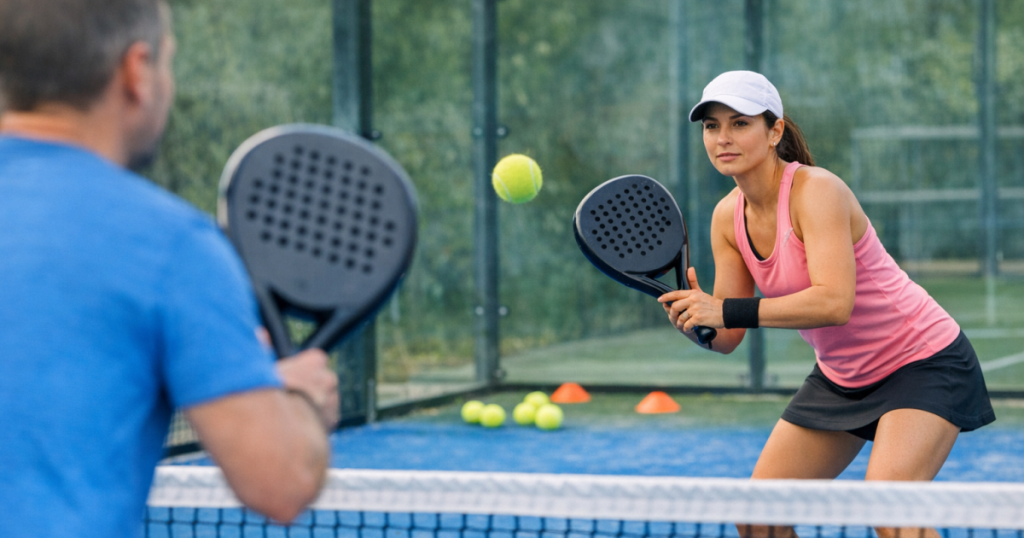
Volley mistakes rarely come from one huge swing; they usually come from a slightly loose grip, a late contact point, or trying to win the point too early. A few simple volley control drills with a partner can make your racket face steadier, your feet calmer, and your targets more deliberate without needing a full coaching session.
Use these drills at the start of a court booking, after a lesson, or before a friendly match. The aim is not to hit harder; it is to make the same controlled volley repeatable under light pressure.
The short version
Good volley control in padel means you can block the ball, guide it into sensible spaces, and recover quickly for the next shot. For beginners, that matters more than trying to finish every volley with power.
- Keep the backswing short and the racket face stable.
- Contact the ball slightly in front of your body, not beside your hip.
- Aim for clear zones rather than tiny targets.
- Use your legs to adjust distance instead of reaching with your arm.
- Add pressure gradually, only once you can repeat the shot calmly.
A useful session can be as short as 15 minutes. One player feeds or rallies from the back, the other practises controlled volleys at the net, then you swap roles.
Set up the practice properly
Start with both players warmed up and moving comfortably. You do not need cones, although they can help. The simplest target is a clear area of the court: deep middle, opponent’s feet, side glass, or a safe cross-court zone.
Before you begin, agree the drill speed. Many beginners turn a control drill into a hitting contest by the third ball. Keep the pace at a level where the volley player can practise good contact rather than just survive.
Use this basic court shape
- The volley player starts around one step behind the net, then adjusts naturally.
- The feeder starts around the service line or baseline, depending on the drill.
- The feeder’s job is to send playable balls, not winners.
- The volley player’s job is to control direction and depth, not smash.
- Swap after 8 to 12 balls so both players stay fresh and focused.
If you are new to match play, it also helps to understand how points flow once drills become games. The basics are covered clearly in this guide to keeping score in your first padel match.
Drill 1: block volleys to the middle
This is the best starting point because it removes the temptation to aim too close to the lines. The feeder plays steady balls towards the volley player’s forehand and backhand side. The volley player blocks each ball back through the middle of the court, aiming for controlled depth rather than speed.
How to do it
- Play 10 feeds to the forehand volley, then 10 to the backhand volley.
- The volley player uses a short, firm movement with very little backswing.
- The target is a safe middle zone beyond the service line.
- Count how many balls land in the zone out of 10.
- Swap roles and repeat.
The key feeling is that the racket absorbs and redirects the ball. If the ball flies long, soften your hand slightly and check the racket face is not too open. If the ball drops short, step forward into contact rather than flicking the wrist.
Drill 2: forehand and backhand alternates
Once the basic block is steady, add movement. The feeder alternates forehand side, backhand side, forehand side, backhand side. The volley player must reset after every shot, returning to a balanced ready position rather than admiring the previous volley.
What to focus on
- Small adjustment steps before contact.
- Racket up between shots.
- Contact in front of the lead foot.
- Quiet wrist through the ball.
- Recovering to the centre of your net position after each volley.
This drill quickly reveals whether your control problem is technical or positional. If you volley well when the ball comes straight to you but lose control when you have to move, the next improvement is footwork, not a bigger swing.
Drill 3: two-target control
For this drill, choose two big target areas: one deep middle and one towards the side glass. The feeder sends steady balls and calls “middle” or “side” before the ball reaches the volley player. The call should come early enough for a sensible decision, not so late that it becomes a reaction test.
This is where volley control drills begin to feel more like padel. You are not just hitting a technically tidy shot; you are choosing a target that makes the next ball easier.
Progression
- Round one: the feeder calls the target before feeding.
- Round two: the feeder calls as the ball crosses the net.
- Round three: the volley player chooses the target and says it out loud before contact.
Saying the target out loud feels odd at first, but it helps beginners stop swinging without a plan. A controlled volley with an average target is usually better than a rushed volley aimed at a perfect one.
Drill 4: volley to the feet
One of the most useful padel volleys is the ball played down towards an opponent’s feet. It is not always a winner, but it often forces a weaker reply. In this drill, the feeder stands around the service line and sends comfortable balls to the volley player. The volley player aims to land the ball low near the feeder’s shoes, without hitting dangerously hard or too close to the body.
How to make it beginner-friendly
- Use gentle feeds and controlled volleys.
- Set a target zone on the court rather than aiming at the person.
- Keep the ball low by closing the racket face slightly.
- Let the ball travel forward off the strings rather than chopping down sharply.
- Reset after each shot instead of rushing the next one.
If you keep hitting the net, your contact point may be too low or too far behind you. Bend your knees, keep the racket head up, and meet the ball earlier. If everything sits up kindly for your partner, your volley may be too flat or too central.
Drill 5: one-up, one-back rally
This drill is simple and very useful for club play. One player stays at the net and practises controlled volleys. The other stays at the back and plays steady groundstrokes or glass returns. The rally continues cooperatively, with the net player trying to keep the back player under mild pressure without ending the point too quickly.
Play to a target number, such as eight controlled volleys in a row. If the net player overhits, misses the target badly, or loses balance, reset the count. Then swap roles.
Why it works
- It trains patience at the net.
- It shows which volleys keep the rally under control.
- It teaches the back player to defend realistic net pressure.
- It creates a rhythm close to friendly match play.
After a few rounds, allow the back player to lob if the volley sits too high. That adds a useful consequence: poor volleys give your partner an escape route. If lobs are becoming a regular part of your rallies, pair this session with these padel lob target drills so both players practise the net-versus-back-court pattern.
Drill 6: soft hands challenge
Control is not only about direction. Sometimes the best volley is the one that takes pace off the ball. In the soft hands challenge, the feeder plays medium-paced balls and the volley player tries to drop the volley short into the service box, making the ball bounce low.
This is not a delicate drop shot contest at first. The goal is simply to feel how grip pressure changes the ball. Too tight, and the ball springs away. Too loose, and the racket wobbles. Aim for a grip that is firm enough to keep the face stable but relaxed enough to absorb pace.
Scoring the drill
- One point if the volley lands in the service box.
- Two points if it lands in the service box and stays low.
- No point if the ball floats high enough for an easy attack.
- First to 10 points, then swap roles.
This drill is especially helpful for players who can make volleys but struggle to vary them. A softer reply can pull opponents forward, open space behind them, and make your next volley easier.
Drill 7: pressure without panic
When the basic drills feel comfortable, add a light competitive rule. The feeder plays from the back. The volley player has to make three controlled volleys before either player is allowed to try to win the point. This stops the net player from forcing the first ball and teaches patience.
Keep the scoring small: first to five points, then change roles. Short games work better than long ones because the quality stays higher and both players get equal turns.
Useful rules to try
- The volley player loses the point immediately for a wild swing.
- The feeder gets a bonus point for forcing a short or high volley.
- The volley player must hit at least one backhand volley before attacking.
- No smashes allowed until the control target has been met.
These rules make the drill more realistic without turning it into a full match. The point is still control first, winning second.
Quick checks when your volleys feel loose
If your partner drills keep breaking down, pause and check one thing at a time. Trying to fix five details at once usually makes the next ball worse.
- Grip pressure: hold the racket firmly enough to stop twisting, but not so tightly that your arm becomes stiff.
- Racket height: keep the racket up before the feed. Starting low makes you late.
- Backswing: the volley is a block and guide, not a full groundstroke.
- Contact point: meet the ball in front of your body, then recover.
- Feet: move your body to the ball instead of reaching from a static position.
- Target size: use bigger zones until your consistency improves.
Grip comfort can also affect control. If your handle feels slippery or too built up, your racket face may move at contact. Before blaming your technique, check whether you need to replace your padel overgrip properly.
A simple 20-minute partner session
If you want a ready-made routine, use this order during a shared court booking. It gives you enough repetition to improve without spending the whole session on one shot.
- Minutes 1 to 3: gentle rally warm-up from the back, then move one player to the net.
- Minutes 4 to 7: block volleys to the middle, forehand then backhand.
- Minutes 8 to 11: alternate forehand and backhand volleys with recovery after every shot.
- Minutes 12 to 15: two-target control, with the feeder calling middle or side.
- Minutes 16 to 18: volley to the feet using a safe court target.
- Minutes 19 to 20: pressure game where the volley player must make three controlled volleys before attacking.
Repeat the same routine for a few sessions before changing everything. Consistency comes from recognising the same ball, making the same simple adjustment, and trusting the shot under slightly different pressure.
Helpful questions
How often should beginners practise volley control?
Once or twice a week is enough if the practice is focused. Even 15 minutes of partner drills before a friendly match can make your volleys calmer and more reliable.
Should I stand very close to the net?
Not usually. Beginners often do better around one step back from the net, where they have time to react and can still close in when the ball is high.
Why do my volleys keep going long?
The most common causes are an open racket face, too much swing, or contact too far behind the body. Shorten the movement and aim for a bigger, safer target first.
Is power important for padel volleys?
Power helps later, but control matters first. A steady volley to the feet or into space usually creates more pressure than a hard shot that rebounds kindly off the glass.
Can two beginners do these drills together?
Yes. Keep the feeds gentle, use large targets, and swap roles often. The drills work best when both players treat the session as cooperative practice rather than a contest.
Key takeaways
Better volley control comes from repeatable habits: a compact swing, a stable racket face, calm feet and a clear target. Start with cooperative feeds, then add movement, target choices and light pressure.
The biggest mistake is trying to finish points before you can control the first volley. Build the skill in layers and your net play will feel more settled in club games, friendly matches and lessons.