Your first service game can feel awkward because everyone is watching and the rules are slightly different from tennis. The aim is simple: serve legally in padel by using an underarm, bounced serve that travels diagonally into the correct service box. Once you know the routine, it becomes a calm reset before each point rather than something to rush.
The serve does not need to be powerful. For beginners, the best legal serve is usually controlled, repeatable and easy to place deep enough that the receiver cannot attack it straight away.
In brief
- Stand behind the service line on the correct side of the centre line.
- Let the ball bounce on your side before striking it.
- Hit the ball at or below waist height with an underarm action.
- Send it diagonally into the opposite service box.
- The receiver must let it bounce before returning.
- You get a second serve if the first one is a fault.
- A serve that clips the net and still lands legally is usually a let, so you replay that serve.
If you want the wider match context around serves, walls, faults and lets, the beginner padel rules guide is a useful next read once this serving routine makes sense.
Step 1: Start on the correct side
Every point starts with the server standing behind the service line. For the first point of a game, serve from the right-hand side of your court into the receiver’s diagonally opposite service box. The next point is served from the left, then you keep alternating right and left for the rest of that service game.
At the moment you strike the ball, your feet should be behind the service line and on the correct side of the centre line. Do not stand on the service line, step over it, or drift across the centre line before contact. Small balance adjustments are normal, but avoid walking, jumping or running into the serve.
A simple check is to look down before you begin: service line in front, side glass or side fence to one side, centre line to the other. If you are in that rectangle behind the line, you are in the right starting area.
Step 2: Bounce the ball before you hit it
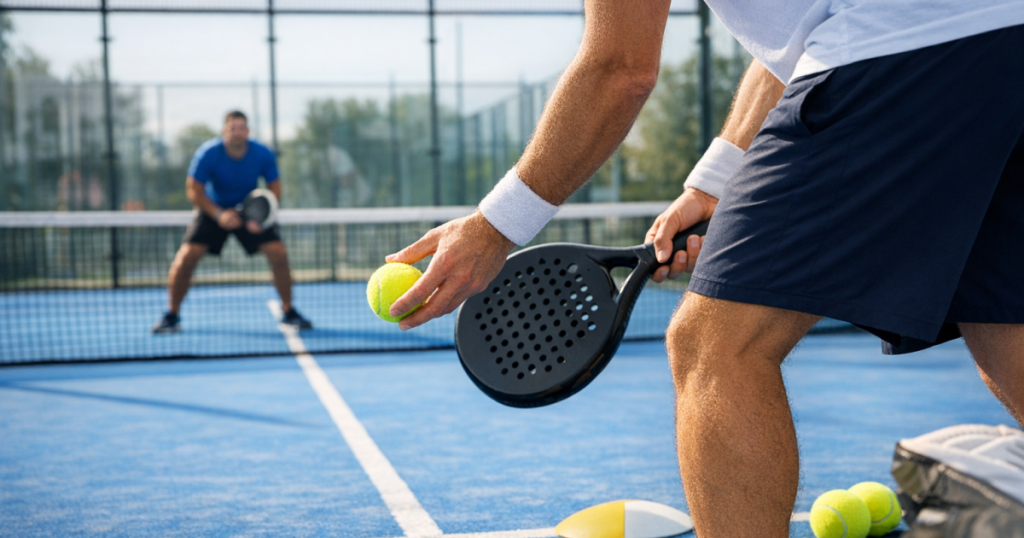
Unlike a tennis serve, a padel serve is not hit from a thrown ball above your head. You must let the ball bounce on your side first, then strike it after the bounce. For a first game, do not overcomplicate this. Hold the ball in front of your hitting side, drop it gently, let it rise to a comfortable height, and swing smoothly through it.
The bounce should happen behind the service line, not inside the court. If your drop sends the ball too far forward and you have to reach across the line, reset before hitting. In a friendly beginner game, it is better to pause and start the motion again than to build a habit of chasing the ball into an illegal position.
Step 3: Keep contact at or below waist height
The most common beginner serving mistake is hitting too high. In padel, the ball must be struck at or below waist height. That means the contact point should be around hip level or lower, not chest height and not shoulder height.
To make this easier, drop the ball rather than throwing it down hard. A high, lively bounce tempts you to hit above the waist. A soft drop gives you more time and keeps the contact point legal.
Your swing should feel like a controlled underarm feed. You can add shape, spin and pace later, but your first priority is a clean, legal motion that you can repeat under mild pressure.
Step 4: Aim diagonally into the service box
The serve must travel diagonally into the receiver’s service box. If you serve from your right, aim into the receiver’s right-side box from their perspective. If you serve from your left, aim into the opposite left-side box.
The ball is in if it lands on the correct service box line. Lines count as part of the court, so a serve clipping the service line or centre line of the correct box can still be good. If it lands outside that box, it is a fault.
For your first match, aim for a generous target rather than the corner. A good beginner target is the middle-to-deep part of the box, with enough margin from the side fence and glass. This reduces faults and gives you time to get ready for the return.
Step 5: Know what happens after the bounce
After the serve lands in the correct box, the next detail matters. If the ball then hits the glass, the serve can still be legal. If it hits the metal fence after bouncing in the service box, that is normally a fault on serve.
This is where many new players get confused, because glass and fence behave differently during the serve. For a clearer explanation of the wall side of the game, read the guide to what happens when the ball hits the glass.
The receiver must also let the serve bounce before playing it. They cannot volley the serve out of the air. Once the serve has bounced legally and the receiver returns it, the point continues like a normal rally.
Step 6: Understand faults, second serves and lets
You get two chances to put the serve in. If your first serve is a fault, you take a second serve from the same side. If the second serve is also a fault, the point goes to the receiving pair.
A serve is a fault if it misses the correct box, is hit above waist height, is hit without the required bounce, is struck from the wrong position, goes directly into the net and does not land correctly, or lands correctly and then hits the metal fence before the second bounce.
A let is different from a fault. If the serve clips the net, lands in the correct service box and remains otherwise legal, you replay that serve. If it was your first serve, you replay the first serve. If it was your second serve, you replay the second serve.
In beginner games, say the call clearly and calmly: fault, second serve, or let. Clear calls stop small rule doubts from turning into awkward conversations.
A simple first-game serving routine
Use the same routine every time so you are not making decisions while nervous. Try this:
- Check the score so you know whether you should be serving from the right or left.
- Stand behind the service line on the correct side of the centre line.
- Choose a safe diagonal target in the receiver’s box.
- Drop the ball gently behind the line.
- Let it bounce, then hit underarm at or below waist height.
- Move into a ready position immediately after contact.
That last step is easy to forget. New players often watch their serve for too long, then get surprised by the return. After serving, recover into a balanced position so you and your partner are ready for the next shot.
Examples of legal and illegal serves
Legal: soft serve into the box, then glass
You stand behind the line, drop the ball, strike it underarm below waist height, and it lands in the diagonal service box. It then carries on into the back glass. That is fine; the receiver plays it after the bounce.
Fault: correct box, then metal fence
You serve diagonally and the ball lands in the correct box, but it then hits the side fence before the second bounce. On serve, that is a fault. You take your second serve if it was your first attempt.
Fault: good direction, contact too high
The ball lands in the right place, but you hit it around chest height after a big bounce. Even if the placement looks good, the serve is not legal because the contact point was too high.
Let: net cord and legal landing
Your serve brushes the net, drops into the correct service box and does not create another serving fault. Call let and replay that serve.
Common first-serve habits to avoid
- Rushing after a fault: Take a breath before your second serve. A rushed second serve often repeats the same mistake.
- Trying to ace people: Padel rewards position and patience more than raw serving power, especially at beginner level.
- Standing too close to the line: Give yourself a little space so a small forward movement does not become a foot fault.
- Throwing the ball into the bounce: A forceful drop creates an awkward high contact point. Let gravity do the work.
- Forgetting the score pattern: Right side for the first point, then alternate sides after each point.
How to practise before a match
You can practise a legal serve in five focused minutes. Hit ten serves from the right side and ten from the left, aiming for a comfortable diagonal target rather than the smallest corner. Count only the serves where your stance, bounce, height and direction are all correct.
If you have a partner, ask them to watch one thing at a time. First ask them to check your feet. Then ask them to check contact height. Then ask whether the ball lands in the correct box. Trying to fix everything at once makes feedback harder to use.
A good benchmark for your first few games is not perfection. It is being able to start most points legally, without feeling rushed or confused.
FAQ
Can I serve overarm in padel?
No. Padel uses an underarm serve after a bounce, with contact at or below waist height. An overarm tennis-style serve is not legal.
Do I get two serves like in tennis?
Yes. If your first serve is a fault, you take a second serve from the same side. Two faults lose the point.
Can the receiver volley my serve?
No. The receiver must let the serve bounce before returning it. After that return, normal rally rules apply.
Is the serve legal if it lands on the line?
Yes. If the ball touches the correct service box line, it is in, provided the rest of the serve was legal.
What is the easiest way to serve legally in padel under pressure?
Use a low, soft bounce, aim for the middle of the diagonal box, and focus on contact below waist height before adding pace.
What to do next
Once the legal motion feels comfortable, start paying attention to placement. Serving slightly deeper can stop the receiver stepping in too easily, while serving with sensible margin keeps your fault count low. As you move towards organised games, it also helps to be comfortable with the flow of club play; the guide to getting into club matches explains one common route beginners use to find games.
The main thing is not to treat the serve as a power shot. In your first padel game, a legal, steady serve that starts the point cleanly is more valuable than a risky one that occasionally looks impressive. Build the habit now and the rest of your service game will be much easier to improve.