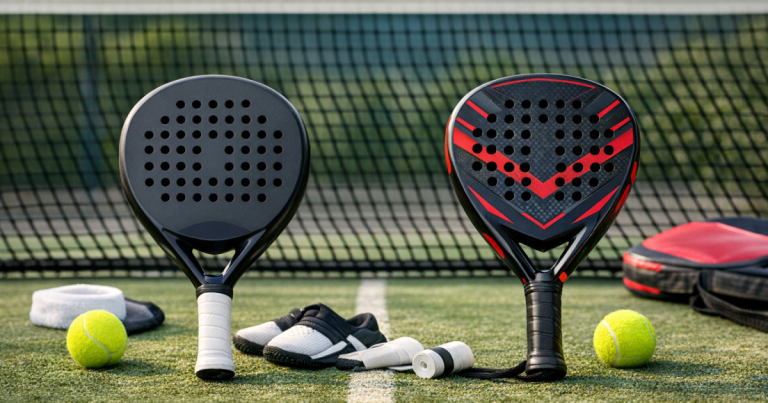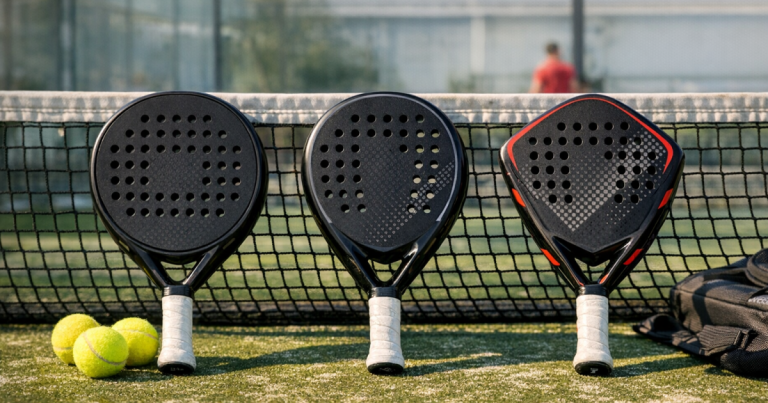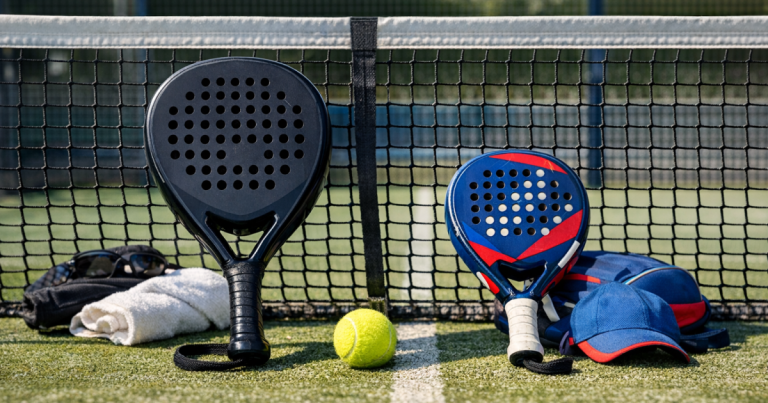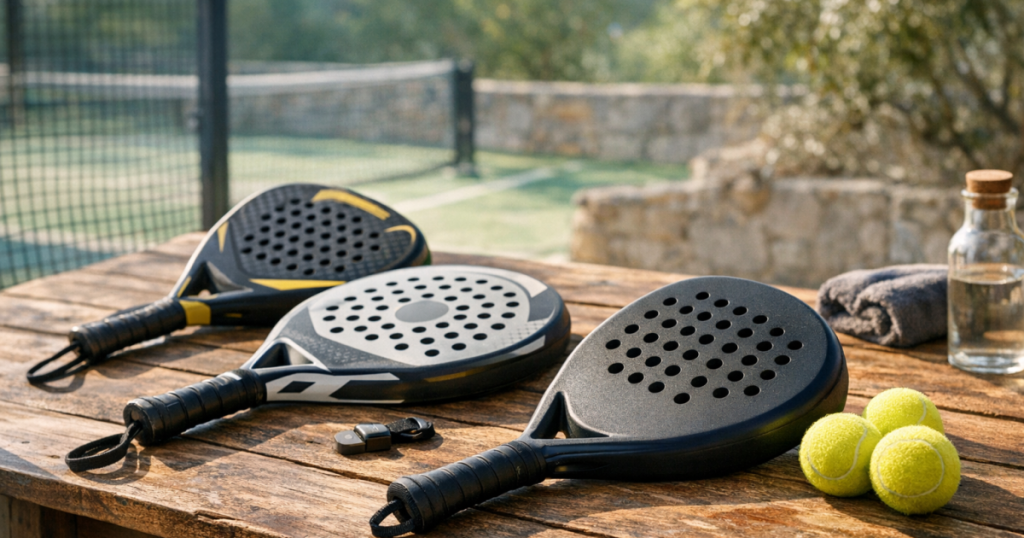
Your first racket should make padel feel simpler, not harder. The three things that most affect that feeling are padel racket shapes, weight and balance. Get those broadly right and volleys feel steadier, lobs are easier to lift, and you are less likely to fight the racket on late defensive shots. Get them wrong and even a technically good swing can feel rushed, heavy or unpredictable.
If you are still deciding what to buy, start with the wider guide to choosing your first padel racket. This page goes deeper into the parts of racket design that beginners often find confusing once they start reading product descriptions.
At a glance
- Round rackets usually give the easiest control and the most forgiving sweet spot for new players.
- Teardrop rackets can feel like a useful middle ground once your timing becomes more consistent.
- Diamond rackets tend to reward advanced hitting but can be demanding for beginners.
- A slightly lighter racket is usually easier to manoeuvre, but ultra-light is not automatically better.
- Low or even balance normally feels more comfortable than head-heavy balance when you are learning.
The three main padel racket shapes
Most adult rackets fall into three broad shape families: round, teardrop and diamond. Brands use their own marketing language, but these shapes give you a helpful starting point when you are trying to predict how a racket might feel in your hand.
Round rackets
A round racket has a wider, more central hitting area and usually a lower balance point. That combination often makes it easier to control the ball when your contact is not perfect. For beginners, this matters because padel involves lots of quick reactions: blocked volleys, balls off the glass, awkward low pickups and defensive lobs under pressure.
The main benefit is forgiveness. If you hit the ball slightly high, low or off-centre, a round racket is less likely to punish you heavily. You may give up some easy power compared with a more aggressive shape, but at the start that is rarely a bad trade. Most new players improve faster when they can keep the ball in play and build reliable technique.
Teardrop rackets
A teardrop racket sits between round and diamond. The sweet spot is usually a little higher than on a round racket, and the balance can feel more neutral or slightly head-biased. This can give a bit more attacking help without feeling as demanding as a full diamond shape.
For early-stage players, teardrop can work well if you already have some racket-sport experience from tennis, squash or badminton. It can also make sense if you are progressing quickly and want something that will not feel too limiting after a few months of regular club play. The caution is simple: if your timing is inconsistent, a teardrop racket can feel less forgiving than a round one.
Diamond rackets
Diamond rackets usually place more mass and more hitting potential towards the top of the racket. They are often associated with power, smashes and aggressive overheads. In the hands of an experienced player, that can be useful. In the hands of a beginner, it can make the racket feel slower to move and harder to control.
The issue is not that diamond rackets are bad. They simply ask more from your technique. If you are still learning where to stand, how to use the glass, and how to prepare early for volleys, a diamond racket may magnify mistakes. Many beginners who buy one because it looks powerful end up shortening their swing, gripping too tightly and losing confidence on basic shots.
Why weight changes the way a racket feels
Padel rackets are commonly listed by weight in grams, and many adult rackets sit somewhere around the mid-300 g range. The exact number matters less than how the racket feels when you move it quickly, but weight is still worth understanding before you choose.
A lighter racket can be easier to manoeuvre at the net and on fast exchanges. It may help if you are smaller, returning from injury, or simply prefer a racket that feels quick in the hand. However, very light rackets can sometimes feel less stable when blocking harder shots, especially if the ball is coming at you with pace.
A heavier racket may feel more solid on contact and can give you a sense of stability through the ball. The trade-off is that it takes more effort to move and stop. Over a full match, that can matter. New players often notice this most on late backhand volleys, defensive wall shots and overheads where the preparation is rushed.
As a broad beginner rule, avoid choosing the heaviest racket just because it promises more power. You are not only hitting one impressive shot in isolation; you are reacting repeatedly over points, games and sessions. Comfort, timing and control are more useful than a few extra kilometres per hour on a smash you do not yet hit consistently.
Balance: the hidden reason two rackets of the same weight feel different
Two rackets can weigh the same on a scale but feel completely different on court. That is usually because of balance. Balance describes where the racket’s weight feels concentrated: closer to the handle, around the middle, or towards the head.
Low balance
A low-balance racket feels easier to move because more of the mass sits closer to your hand. This can make a racket feel lighter than its listed weight suggests. For beginners, low balance is often friendly because it supports quick preparation, softer hands at the net and better control on defensive shots.
Even balance
Even balance is a middle-ground feel. The racket does not feel especially handle-heavy or head-heavy. This can work well for players who want a bit of all-round performance and are not yet sure whether their game will become more defensive, more net-based or more attacking.
High balance
A high-balance racket feels heavier in the head. This can help generate momentum on attacking shots, but it can also make the racket feel slower. Beginners may find it harder to adjust late, especially on volleys and returns. If you are tempted by a head-heavy racket, try to hit with it first rather than judging it only from the product description.
How shape, weight and balance work together
These features do not act separately. The best way to understand a racket is to think of shape, weight and balance as a combined feel.
- A round, medium-weight, low-balance racket usually feels forgiving and easy to control.
- A round racket with more weight can still feel stable, but may tire your arm if you are not used to it.
- A teardrop racket with even balance can feel versatile for an improving player.
- A teardrop racket with high balance may feel more attacking but less forgiving.
- A diamond racket with high balance is usually the most demanding combination for a beginner.
This is why simply asking for a ‘power racket’ or a ‘control racket’ can be misleading. Those labels are useful, but they are shortcuts. A so-called control racket that is too heavy for you may not feel controlled at all. A power racket that you cannot manoeuvre in time will not help you win more points.
Common beginner scenarios
You miss the sweet spot often
Choose forgiveness first. A round shape with low or even balance is likely to help more than a stiffer, more advanced racket. The goal is to make off-centre contact less dramatic while your footwork and preparation improve.
You have played tennis for years
You may be tempted to choose something more powerful straight away. That can work for some players, but padel timing is different. The court is smaller, the walls change the rhythm, and many points are won through placement rather than full swings. A teardrop racket might suit you, but do not ignore comfort and manoeuvrability.
You struggle with wrist or elbow discomfort
Do not chase extra weight or a head-heavy feel. A racket that is too demanding can encourage tension in the hand and forearm. Softer-feeling rackets, sensible weight and manageable balance are usually more beginner-friendly. Pain should not be treated as a normal part of learning; stop playing if discomfort persists and get appropriate medical advice.
You only play occasional social padel
Go simple and forgiving. If you play once every few weeks, you will benefit more from an easy, comfortable racket than one that requires perfect timing. For occasional club sessions, consistency is usually more enjoyable than chasing advanced performance.
What product descriptions do not always tell you
Racket descriptions can be helpful, but they are not the whole story. Terms such as ‘control’, ‘power’, ‘soft’, ‘carbon’ and ‘pro’ can mean different things across brands. Even listed weights may vary slightly from one individual racket to another, so treat specifications as a guide rather than a guarantee.
Materials also affect feel. A racket with a firmer face may feel crisp and direct, while a softer-feeling face may feel more comfortable and forgiving. Core density, surface texture, frame construction and drilling pattern can all play a part. As a beginner, you do not need to decode every technical term. Focus first on whether the racket helps you prepare early, contact the ball cleanly and recover for the next shot.
If you are building your first setup beyond the racket, the guide to what to buy first for beginner padel explains where a racket sits alongside balls, shoes and other useful kit.
Trying a racket before you commit
If your local club has demo rackets, use them. A five-minute knock is helpful, but a full session is better because fatigue changes your opinion. A racket that feels exciting during warm-up may feel slow after several games. A racket that seems plain at first may turn out to be the one that helps you make fewer errors.
When testing, pay attention to practical shots rather than only big winners. Try simple volleys, blocks, lobs, chiquitas, backhand returns and balls that come off the back glass. Beginners often judge rackets by smashes, but most early improvement comes from controlling the ball in realistic rally situations.
- Can you get the racket into position quickly?
- Does it feel stable when you block a firm shot?
- Can you lift lobs without forcing your arm?
- Do off-centre hits stay reasonably controlled?
- Does your hand, wrist or elbow feel relaxed after playing?
Different views you will hear at the club
Ask three padel players for racket advice and you may get three confident answers. One player will say beginners should only use round rackets. Another will say teardrop gives you room to grow. Someone else may tell you to buy a powerful model because you will improve into it.
There is some truth in each view, but context matters. A sporty beginner with strong coordination may adapt to a teardrop racket quickly. A player who wants maximum comfort may be happier with a round racket for a long time. A competitive player moving over from another racket sport may tolerate more weight than someone starting from scratch.
The best answer is not the most advanced racket. It is the racket that lets you play relaxed, repeatable padel now, while leaving enough room to develop. For most beginners, that points towards forgiveness, moderate weight and a balance that does not feel too head-heavy.
Small details that make a big difference
Once shape, weight and balance are broadly right, smaller setup choices can improve comfort. Grip size matters: a grip that is too thin may make you squeeze harder, while one that is too thick can reduce feel and wrist freedom. Many players use an overgrip to fine-tune the handle, but avoid building it up so much that you lose control.
Footwork also changes how heavy a racket feels. If you are late to the ball, almost any racket can feel awkward. Good shoes help you stop, turn and recover on artificial turf, so racket comfort is not only about the racket itself. If you are still playing in running trainers, read the guide to padel shoes for beginners before you settle into regular club play.
Main lessons
For most beginners, the safest starting point is a round racket with a manageable weight and low or even balance. That combination supports control, comfort and forgiveness while you learn the court, the walls and the pace of doubles play.
Teardrop rackets can be a good next step if you already strike the ball cleanly or want a slightly more attacking feel. Diamond rackets are not off-limits forever, but they usually make more sense once your technique, timing and positioning are reliable.
The most important test is simple: does the racket help you play better padel for longer? If it feels easy to move, stable enough on contact and comfortable after a full session, you are much closer to the right choice than any marketing label can tell you.