Once you know where to look, it is straightforward to book a padel court in the UK: choose a nearby venue, check the session type, reserve a suitable slot, and confirm what is included. The main thing is to avoid turning up to an advanced match or a doubles booking without three other players. A few minutes checking the details will make the first session feel far less awkward.
Main points
- Padel courts are usually booked through club websites, booking apps, leisure centre platforms, or by contacting the venue directly.
- Most standard court bookings are for doubles, so you normally need four players unless the venue offers open matches, coaching, socials, or beginner sessions.
- Check whether racket hire, balls, floodlights, parking, changing rooms, and cancellation rules are included before confirming.
- For a first session, choose a beginner-friendly time, avoid peak competitive slots, and arrive early enough to find the court and warm up.
- If you do not yet know your level, pick an introduction session, social mix-in, or beginner match rather than joining a graded game too high for you.
Where UK players usually find padel courts
The easiest starting point is a search for padel courts near your town, city, or postcode. In the UK, courts are found at specialist padel clubs, tennis clubs that have added padel courts, leisure centres, gyms, sports villages, universities, and some private members’ clubs. Availability varies a lot by area, so the nearest court may not always be the best first experience.
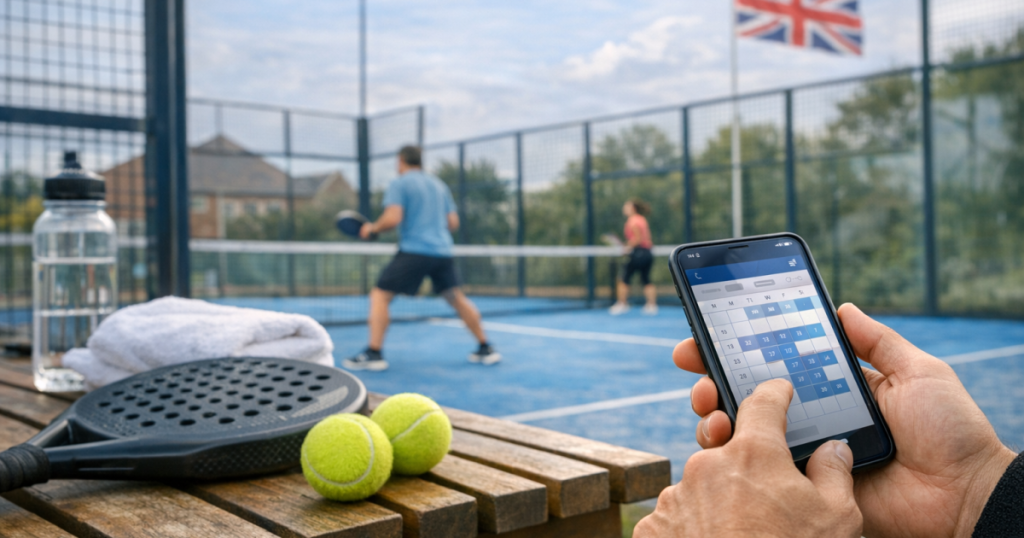
Once you find a venue, look for its booking route. Some clubs let you reserve directly on their website. Others use booking platforms or mobile apps. Some leisure centres require an account with the operator before you can see live availability. A few clubs still handle first-time enquiries by phone, email, or reception, especially for coaching and introductory sessions.
Booking platforms can be useful because they show court times, player levels, and session labels in one place, but the exact process depends on the venue. If you see MATCHi listed by a club, our MATCHi app review for booking club padel courts explains the sort of details worth checking before you rely on it for your first game.
Choose the right type of booking
Not every padel booking means the same thing. A private court booking simply reserves the court for your group. If you choose this, you are normally responsible for bringing enough players, turning up on time, and organising the game. For a full doubles match, that means four players.
An open match or mix-in is different. These sessions are usually designed for players to join individually, with the venue or platform filling the remaining spaces. They can be a good first step if you do not yet have three padel-playing friends, but you should check the level, format, and whether it is genuinely suitable for beginners.
Beginner coaching, taster sessions, and club socials are often the safest entry point for a first visit. They remove some pressure because a coach or organiser usually explains where to go, how the rotation works, and what to do if players have mixed experience. They are also useful if you are not confident with scoring, serving, or court positioning yet.
Check the level before you join
Padel is friendly, but level matching matters. A session labelled “improver”, “intermediate”, or “competitive” may move too quickly for a complete beginner. That can make the game less enjoyable for you and less balanced for the other players. If the booking system uses numbers, colours, or labels, do not guess upwards just to get a convenient time.
Look for phrases such as “beginner”, “intro”, “new players welcome”, “starter session”, or “social”. If you are not sure, contact the venue and say it is your first time. A good club will usually point you towards the right format rather than leaving you to work it out alone.
If you want a clearer sense of where you fit before joining a public session, our guide to padel skill levels and finding your starting point can help you avoid booking into a game that is too fast, too tactical, or too competitive for a first hit.
What to check before you confirm
Before you press confirm, slow down and read the booking details. Many first-time problems come from simple assumptions: thinking racket hire is included, not realising the court is outdoors, or missing a strict cancellation window.
- Number of players: Confirm whether you are booking a whole court, one space in a match, or a place on a coaching session.
- Session length: Common booking blocks vary by venue, so check the start and finish time rather than assuming a standard format.
- Indoor or outdoor court: Outdoor padel can feel different in wind, drizzle, bright sun, or cold conditions. Dress for the court, not just the calendar.
- Equipment: Check whether rackets can be hired, whether balls are supplied, and whether you need to bring anything specific.
- Footwear policy: Some clubs are strict about suitable court shoes. Avoid running shoes with very high, soft soles if the venue advises proper court footwear.
- Arrival instructions: Look for reception details, gate codes, parking information, and whether you need to check in before going to court.
- Cancellation rules: Note the deadline for refunds or credits. Weather rules may differ between indoor and outdoor venues.
Do you need three other people?
For a private doubles court, yes, you generally need four players in total. Padel is designed around doubles, and most UK venues set up normal booking slots with that in mind. Singles-style practice is possible on some courts, but it is not the usual first booking format and may not be offered everywhere.
If you are booking with friends, agree the time before reserving the court. Peak evening and weekend slots can disappear quickly, and cancelling late can be awkward if the venue has a strict policy. Share the booking confirmation with the group so everyone has the address, start time, and arrival details.
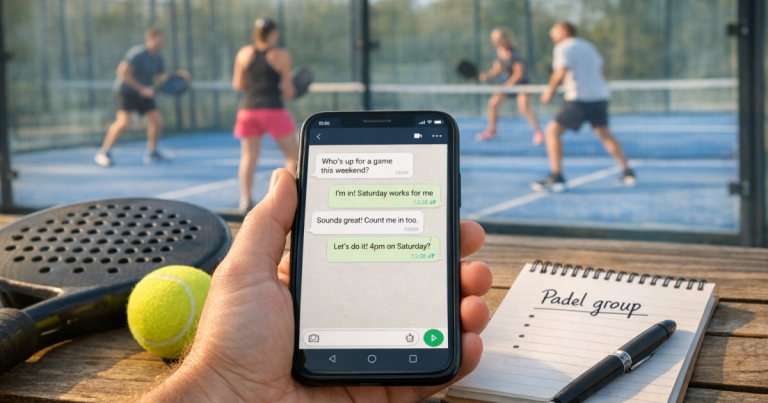
If you do not have a group, search for open matches, socials, beginner club nights, WhatsApp groups run by the venue, or coaching courses. Many clubs use these routes to help new players meet others at a similar level. This is often more enjoyable than trying to persuade three complete newcomers to learn everything at once.
Picking a sensible first time slot
Your first padel court booking is easier when the venue is not at its busiest. If you can, choose a quieter weekday daytime or early evening slot rather than the most popular after-work period. Staff are more likely to have time to help, and you are less likely to feel rushed while finding reception, hiring equipment, and locating the correct court.
Indoor courts are useful for a first session because the conditions are more predictable. Outdoor courts are still perfectly fine, but weather can affect bounce, lobs, and comfort. If the forecast looks poor, check the venue’s weather cancellation policy rather than assuming the booking will move or be refunded.
Also think about travel. A court that is slightly farther away but has clear parking, simple check-in, and beginner sessions may be better than a closer venue with limited information and only competitive open matches.
What to bring for your first booking
You do not need to arrive with a full padel kit. For a first game, the essentials are simple: comfortable sports clothing, suitable trainers or court shoes, water, and a way to access your booking confirmation. If the venue offers racket hire, use that before buying your own racket. It gives you a chance to see whether you enjoy the game and what type of racket feels manageable.
Bring a layer if you are playing outdoors or at an indoor venue that can feel cool between points. Avoid clothes that restrict shoulder movement, because padel involves volleys, overheads, and quick changes of direction. If you already own tennis or squash clothing, it will usually be fine for a first session.
Balls are worth checking carefully. Some coaching or social sessions provide them, while private court bookings may expect players to bring their own or buy a tube at reception. Do not rely on old tennis balls; padel uses its own balls, and tired balls can make rallies feel flat and harder to judge.
Know the basics before you step on court
You do not need to memorise every rule before playing, but knowing a few basics makes the first session smoother. Padel is played over a net, usually as doubles, with walls in play after the ball bounces. The serve is underarm, the ball must bounce before you hit it on the serve, and points use tennis-style scoring.
The serve causes a lot of early confusion because it looks simple but has specific requirements. If you want a quick confidence boost before your booking, read our explanation of padel serve rules covering bounce, box, height and faults. You do not need to be perfect, but understanding the legal serve helps the first game flow.
On the day, keep rallies going rather than trying to win every point with power. Padel rewards control, patience, and using the glass sensibly. New players often improve fastest when they focus on getting the ball back, recovering position, and communicating with their partner.
Common first-booking mistakes
- Booking a court instead of a player space: If you reserve the whole court, you usually need to organise the players yourself.
- Joining the wrong level: A convenient time is not worth it if the session is clearly above your current ability.
- Assuming equipment is included: Racket hire and balls vary by venue and booking type.
- Arriving at the start time: Aim to arrive early so you can check in, change, find the court, and ask any quick questions.
- Ignoring outdoor conditions: Wind and wet surfaces can affect play, comfort, and whether the session goes ahead.
- Not reading cancellation terms: Some bookings lock in earlier than you might expect, particularly at busy clubs.
A simple first-booking plan
If you want the lowest-stress route, follow this order. First, find two or three nearby venues and check whether they offer beginner sessions. Second, decide whether you are joining alone or booking with friends. Third, choose a beginner-friendly slot and read the booking notes carefully. Fourth, confirm equipment, arrival instructions, and cancellation terms. Finally, arrive early and treat the first session as a learning experience rather than a performance test.
After that first game, it becomes much easier. You will know how the venue works, how long you like to play, whether you need coaching, and what sort of players you enjoy playing with. That is when padel starts to feel less like a new activity and more like a regular part of your week.
Questions people ask
Can I book a padel court as a complete beginner?
Yes, but choose the right format. A beginner coaching session, taster, or social is usually better than joining an ungraded competitive match for your first visit.
Do I need to be a club member?
Not always. Many UK venues allow pay-and-play bookings, while others give members priority or better access to peak times. Check the venue’s booking page before creating an account.
Can two people play padel on a normal court?
You can practise with two people, but standard padel is doubles. For a proper first match, plan for four players or join a session where the venue fills the spaces.
What happens if it rains on an outdoor court?
Policies vary. Some venues cancel, credit, or reschedule affected sessions, while others make decisions close to the start time. Always read the weather and cancellation rules before confirming.
Should I buy a racket before my first booking?
No. If racket hire is available, use it for your first session. Once you know you want to play regularly, choosing your own racket becomes a more informed decision.
What to remember
The best first padel booking is not necessarily the cheapest, closest, or soonest available. It is the one that matches your level, gives you clear instructions, and removes avoidable stress. Start with beginner-friendly sessions where possible, check the practical details, and give yourself time to settle in before the first ball is served.