Yes, you can play a volley in padel, and net play is a huge part of the game once the serve and return are out of the way. The tricky bit for beginners is knowing when the ball must bounce, what counts as touching the net, and whether glass or fencing changes the decision.
The good news is that the core rule is simple: during a rally, you may hit the ball before it bounces on your side, provided the ball has crossed the net and you do not commit a net or court fault.
The big picture
Volleying is legal in normal rallies. You will see it constantly in club padel because taking the ball early helps a pair hold the net, reduce the opponents’ time, and finish points with controlled pressure rather than wild power.
- You can volley during a rally once the ball has crossed onto your side of the court.
- You cannot volley the serve return as the receiver. A serve must bounce in the correct service box before it is returned.
- You lose the point if you touch the net with your body, clothing or racket while the ball is in play.
- Your volley must land in the opponent’s court before it hits their glass, fence or back wall.
- You cannot hit the ball before it reaches your side, apart from the rare bounce-back situation explained below.
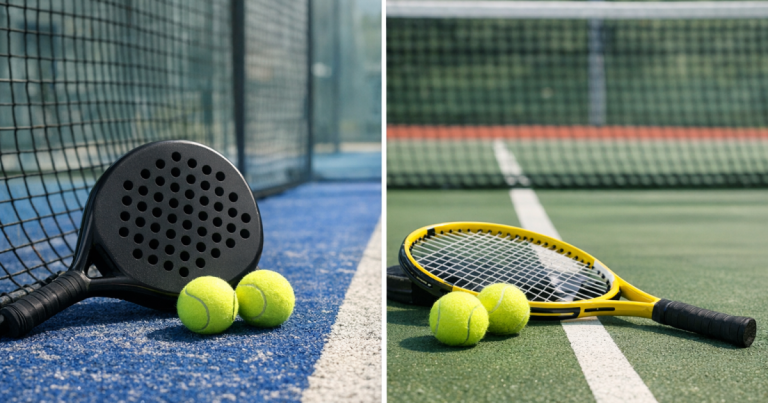
If you are coming from tennis, it is worth reading the wider padel rules versus tennis rules because the walls, underarm serve and service bounce change how net play feels.
When a volley is legal
A legal volley in padel happens when the opponent hits the ball over the net, it crosses onto your side, and you strike it before it bounces. That might be a soft block volley, a firmer punch volley, a controlled angle, or a higher attacking shot near the net.
The ball does not need to bounce on your side during a rally. In fact, trying to let everything bounce usually makes the game harder because the ball can then hit the glass and force you backwards. At beginner level, the aim is not to smash every ball; it is to meet the ball in front of your body and send it to a sensible target.
A typical legal pattern looks like this: your opponent plays a groundstroke from the back, the ball clears the net, you are already near the service line or net, and you block it back into their court before it drops. As long as it lands in the opponent’s court first, the shot is in play.
The serve is the big exception
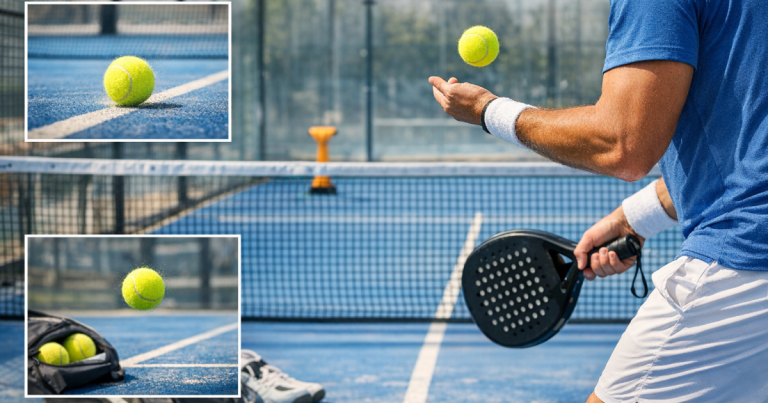
The most common beginner confusion is the serve. In padel, the receiver must allow the serve to bounce in the correct diagonal service box before returning it. You cannot stand inside the service box and volley the serve out of the air.
Once the receiver has returned the serve, normal rally rules apply. The serving pair may then volley the next ball if it comes over the net. This is why many serving teams try to move forwards quickly after serving: the serve itself is controlled and underarm, but the third shot can be used to take a stronger court position.
The server’s partner can start closer to the net, but they still cannot interfere with the receiver or cross into the opponent’s side. In a friendly club game, this is usually straightforward: serve legally, let the return happen, then play the point as a normal rally.
Net touches: the easy fault to avoid
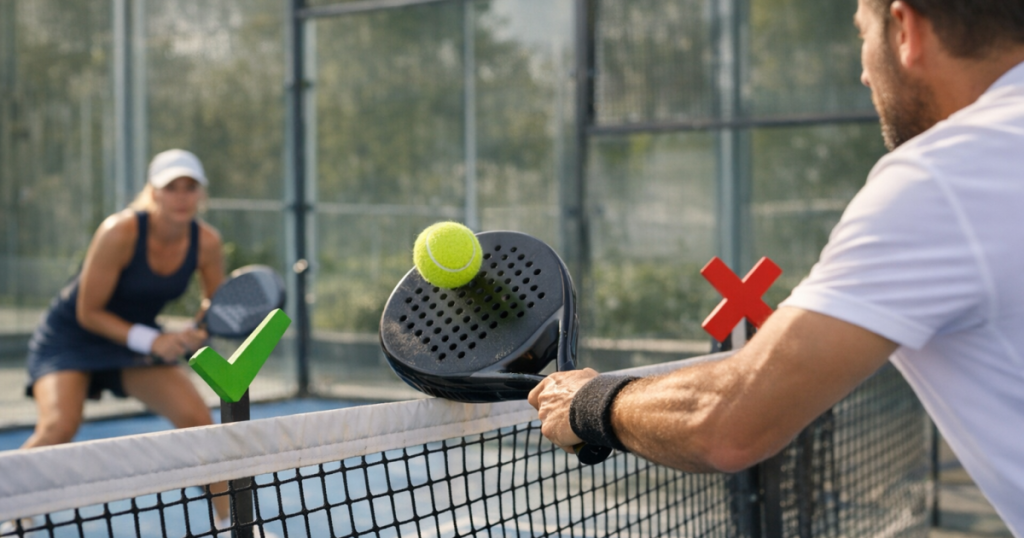
At the net, the biggest risk is not the volley itself. It is touching the net while trying to reach for the ball. If your racket, hand, shirt, shorts or any part of your body touches the net while the point is live, you lose the point.
This matters most on close balls. Beginners often lean forward, stretch too far, and clip the tape with the racket after contact. The shot may feel good, but the touch still makes it a fault. A useful habit is to keep your last step balanced rather than lunging with all your weight over the net.
You should also avoid using the net as a brake after a quick movement. Even a light brush is enough. If you cannot reach the ball without falling into the net, it is usually better to leave it or accept that your opponent has played a good shot.
Can your racket cross the net?
Your racket can finish over the net as part of a natural follow-through, provided you hit the ball after it has crossed onto your side and you do not touch the net or the opponent’s court. What you cannot do is reach across and strike the ball before it has crossed the plane of the net.
There is one unusual exception. If the ball bounces on your side, hits your glass or spins back over the net towards the opponents’ side, you may be allowed to reach across to play it, as long as you do not touch the net or the opponents’ court. This comes up occasionally after heavy spin or a ball that rebounds sharply off the glass, but it is not something beginners need to chase often.
For most club rallies, keep the simple version in mind: let the ball come to your side, hit it cleanly, and stay off the net.
Where your volley has to go
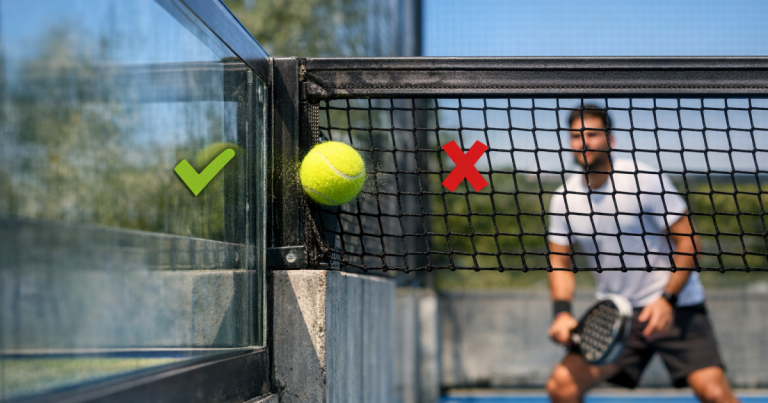
A volley must still land correctly. If you hit the ball directly into the opponent’s glass, back wall or side fence before it touches their court, it is out. The ball has to land on the floor of the opponent’s court first.
After it lands, it can then hit the glass or fence and remain in play depending on the situation. This is one of the reasons volleys into corners are so useful. You are not trying to hit the wall first; you are trying to make the ball bounce in the court and then carry on towards the glass or side structure in an awkward way.
For beginners, safer targets are usually:
- deep through the middle, between the two opponents;
- towards the opponent’s feet if they are moving forwards;
- into the corner, with enough margin to land inside the court first;
- soft and low when the opponents are stuck near the back glass.
Trying to hit tiny angles too early often creates errors. A steady volley that lands deep is usually more valuable than a spectacular winner that clips the side glass first and loses the point.
What happens if the ball hits the net?
During a rally, if the ball hits the net and still goes over into the opponent’s court, the point continues. There is no automatic replay just because the ball clipped the tape. If it comes over to you after touching the net, you can volley it as long as it has crossed onto your side and you do not touch the net yourself.
Serves are different. A serve that clips the net and then lands correctly is normally treated as a let and replayed, provided it also meets the service rules. If it clips the net and lands out, it is a fault. The exact call can feel fiddly at first, so in social games it helps to pause and agree the call calmly rather than rushing the next serve.
Net position and beginner decision-making
Being at the net does not mean standing with your toes almost touching it. Many beginners get too close, then struggle to react to lobs or fast balls into the body. A better starting position is often a step or two behind the net, balanced, with the racket up and enough room to move backwards.
In mixed-level games, the stronger pair will often test whether you know when to volley, when to let the ball pass to the glass, and when to retreat for a lob. If that sounds familiar, the advice in handling your first mixed-level padel match can make those points feel less chaotic.
A good beginner rule is to volley when the ball is comfortable and in front of you. If it is dipping sharply below net height, jammed into your body, or flying high enough for the opponents to lob over you, a softer reset may be smarter than forcing an attack.
Common volley mistakes beginners make
- Volleying the serve: the receiver must let the serve bounce first. This is the clearest illegal volley situation for new players.
- Reaching over too soon: wait until the ball has crossed onto your side before making contact.
- Touching the net after a good shot: the quality of the volley does not matter if you touch the net while the point is live.
- Hitting straight into the glass: the ball must land in the opponent’s court before it hits their glass or fence.
- Swinging too much: most padel volleys are short, compact blocks rather than big tennis-style swings.
- Standing too close: leave yourself space to react to lobs and balls aimed at your feet.
How to practise the rule in real games
The best way to get comfortable is to play points where you deliberately focus on one rule at a time. For one game, concentrate on not touching the net. For the next, focus on letting the serve bounce and then moving forwards after the return. Then try to place volleys deep rather than going for winners.
When playing with newer partners, it helps to say the rule out loud after a confusing point: “That serve had to bounce,” or “That hit the glass before the floor, so it is out.” Keep it light and friendly. Padel is social, and clear calls stop small rule misunderstandings turning into awkward moments.
If you need more regular practice, finding consistent partners is often more useful than another rules video. The guide to finding people to play padel with is a good next step if you are moving from occasional sessions into weekly games.
Questions people ask
Can you volley a serve in padel?
No. The receiver must let the serve bounce in the correct service box before returning it. After the return, normal rally rules apply and volleys are allowed.
Can you stand right at the net?
Yes, there is no offside-style rule, but standing too close can make it harder to react and easier to touch the net by mistake.
Is it out if my volley hits the opponent’s glass?
It is out if it hits the glass before landing on the court. It is fine if the ball lands in the opponent’s court first and then reaches the glass.
Can you volley in padel after the ball clips the net?
Yes, in a rally you can volley a ball that clips the net and crosses to your side. The same normal rules apply: no net touch and the ball must be on your side.
Can my racket go over the net after I hit the ball?
A natural follow-through can cross the net line, but you must not hit the ball before it reaches your side or touch the net or opponent’s court.
What stands out
Volleying is not just allowed in padel; it is one of the main ways points are built. The important limits are easy to remember: do not volley the serve return, do not touch the net, do not strike the ball before it crosses, and make sure your shot lands in the opponent’s court before it hits the glass or fence.
For beginners, that is enough to play confidently at the net without overthinking every call. Keep your movements balanced, use compact swings, and treat the volley as a control shot first. The winners will come once the rules and timing feel natural.