When a rally gets messy, most beginner arguments come down to one question: was that ball still live? Understanding padel rally rules helps you react quicker, avoid accidental point losses and feel more confident in club games.
The good news is that rally play is much easier to follow once you separate three things: where the ball bounced first, what it touched afterwards, and whether a player interfered with the court, net or opponent.
The short version
- A rally continues until the ball bounces twice, lands out, hits the wrong surface first, or a player commits a fault.
- You can hit the ball before it bounces, after one bounce, or after it rebounds off your glass, as long as it has not bounced twice.
- Your shot normally needs to go over the net and land in the opponent’s court before it hits their glass or fence.
- A net cord during a rally is usually fine if the ball goes over and lands in.
- Touching the net, double-hitting the ball, or letting the ball hit you can cost you the point.
What makes a shot legal during a rally?
A legal rally shot is one where you make a clean contact and send the ball over the net into the opponent’s court, either directly or by using your own glass first. The ball may be hit as a volley before it bounces, or after it has bounced once on your side.
The key beginner rule is simple: you do not have to wait for the ball to bounce. Volleys are legal in open play, provided the ball has crossed onto your side of the court and you do not touch the net. Many new players stand back and let too many balls drop because they are unsure, but volleying is a normal part of padel.
If you are still getting comfortable with the wider match structure, it helps to pair rally knowledge with the basics of serving and scoring. Our guide to padel rules and scoring for beginners in the UK explains how rallies fit into games, points and service order.
The one-bounce rule is the centre of most decisions
During a rally, each side is allowed one bounce before returning the ball. If the ball bounces once on your side, you can still play it. If it bounces a second time before you hit it, your side loses the point.
This is where many close calls happen. A ball that drops near the back glass may look as though it has bounced twice when it has actually bounced once on the floor and then hit the glass. That is still playable. The second bounce means a second contact with the floor, not a bounce off the wall.
A helpful way to read the rally is to ask: did it touch the court surface once or twice? Floor, then glass, is alive. Floor, then floor again, is dead.
How rebounds off the glass work
Padel becomes much more fun once you trust the glass. If the ball bounces in your court and then hits the back or side glass, you can still return it before it drops to the floor again. This is one of the biggest differences between padel and tennis.
For example, if your opponent hits a deep shot that lands near your baseline and rebounds off the back glass, you can let it come off the wall and then play it forwards. That is legal because the ball has only bounced once on the floor.
You can also use your own glass to help return the ball, often called a counter-wall shot. For a beginner, the safest version is striking the ball into your back glass so it rebounds over the net and lands in the opponent’s court. It takes timing, but it is a legal tactic when executed cleanly.
Once you understand padel rally rules, the glass stops feeling like an obstacle and starts becoming part of your decision-making. You begin to recognise which balls should be volleyed, which should be played after the bounce, and which are better left to rebound.
What happens if the ball hits the fence?
The fence can confuse beginners because it behaves differently depending on when the ball hits it. If your shot crosses the net, lands in the opponent’s court, and then hits their side fence, the rally normally continues. Your opponent may play the ball if they can reach it before a second bounce.
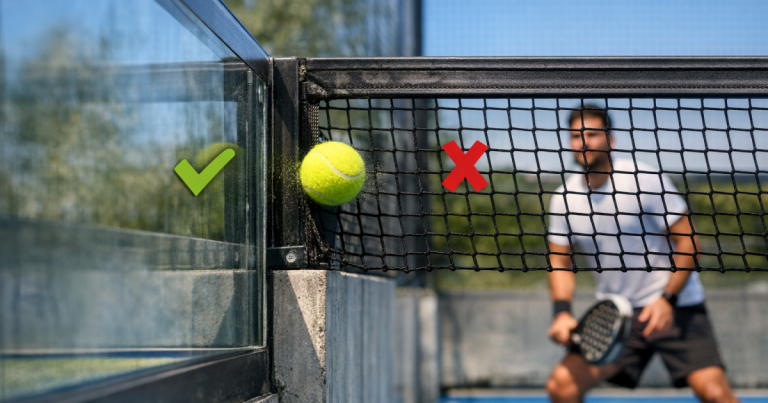
However, if your shot goes straight into the opponent’s fence or glass before bouncing on their court, you lose the point. The first contact on their side must usually be the floor, unless the opponent volleys it before it lands.
Here are some common examples:
- Your shot lands in the service box or back court, then hits the glass: legal and live.
- Your shot lands in the court, then hits the side fence: legal and live.
- Your shot hits the opponent’s glass before the floor: point lost by you.
- Your shot hits the opponent’s fence before the floor: point lost by you.
- Your opponent volleys your ball before it lands: legal if they make clean contact.
Net cords, lets and balls near the net
During a rally, a ball that clips the net tape and still goes over is usually live if it lands in the opponent’s court. It does not automatically become a let. This is different from certain serve situations, where a net touch can lead to a let depending on where the ball lands.
If the ball hits the net and drops back onto the hitter’s side, the hitter loses the point. If it goes over but lands outside the court boundaries or hits the opponent’s glass before the floor, it is also out.
For serve-specific situations, read how padel let rules work during a match. It is worth separating service lets from rally net cords, because mixing them up is a common beginner mistake.
Actions that lose the point
Some points end because of where the ball lands. Others end because of what a player does. These are the faults you are most likely to see in early club games:
- Letting the ball bounce twice: once the ball touches the floor for a second time on your side, the rally is over.
- Hitting the ball twice: a deliberate double contact is not allowed. A single clean swing is the aim.
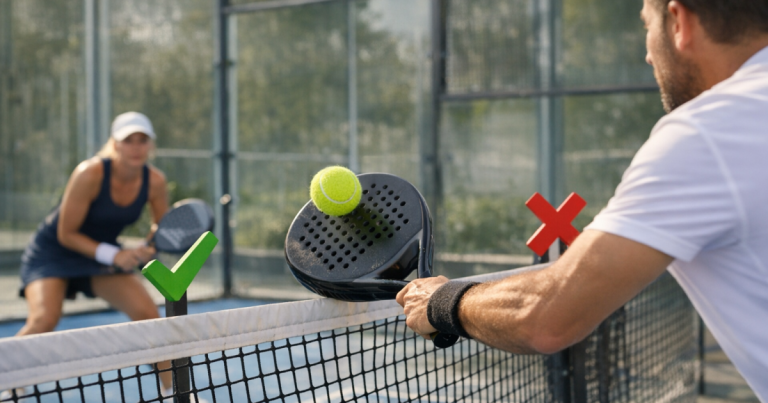
- Touching the net: if your racket, body or clothing touches the net while the ball is live, you lose the point.
- Being hit by the ball: if the ball touches you or your partner during the rally, your side loses the point.
- Hitting before the ball crosses: you generally need to let the ball come to your side before striking it.
- Sending the ball out directly: if your shot lands outside the court or hits the wrong surface first, the point is lost.
There are rare advanced situations where a player may reach across the net after the ball has bounced on their side and spun or rebounded back over. For most beginner matches, keep the simpler habit: play the ball on your side, avoid the net, and finish your swing naturally without invading your opponent’s space.
Close-call examples you will actually see
The ball bounces, hits the back glass, and comes forward
Keep playing. That is one floor bounce followed by a wall rebound, so the ball is live until it bounces on the floor again.
The ball hits the back glass first on your side
If your opponent’s shot reaches your back glass without landing in your court first, it is out and you win the point. The ball must land in before it can use the wall.
You hit the net tape and the ball drops in
In a rally, that is normally legal. If it crosses the net and lands in the opponent’s court, play continues.
Your partner is struck by your opponent’s shot
Your side loses the point. It does not matter whether the ball might have landed out afterwards; contact with a player ends the rally.
The ball lands in, hits the side fence, and shoots sideways
That is live. It may be awkward, but your side can still play it before a second floor bounce.
Why beginners disagree about rally calls
Most disputes are not about the rules themselves; they are about what people saw. Padel is fast, the glass changes the ball’s direction, and doubles partners often have different sight lines.
At friendly club level, the best habit is to call clearly, stay consistent, and give the benefit of the doubt where you genuinely cannot tell. If a ball was too close to call and nobody has a clear view, replaying the point is often the calmest social solution, even though competitive formats may apply stricter procedures.
Good etiquette matters as much as rule knowledge when you are joining new groups. If you want to avoid awkward first-match moments, our guide to padel etiquette and club culture for new players covers calling balls, rotating partners and fitting into UK club sessions.
Common questions
Can I volley every ball in padel?
You can volley in open play as long as the ball has crossed to your side and you do not touch the net. You cannot volley a serve return; the serve must bounce first.
Is the ball still live after it hits the glass?
Yes, if it bounced in the court first and has not bounced on the floor a second time. A wall rebound is not the same as a second bounce.
Do I lose the point if my racket crosses the net?
Not automatically. A normal follow-through can cross the plane of the net after contact, but you must not touch the net or hit the ball before it has crossed to your side.
What if the ball hits both the glass and fence?
Look at the first contact after it crosses the net. If it lands in the court first, it is generally live. If it hits glass or fence before the floor, it is out.
Should friendly matches replay disputed rally points?
If nobody has a clear view, replaying the point keeps the game moving and avoids tension. In organised matches, follow the competition or club procedure.
Main lessons
Rally rules become much easier when you focus on sequence. Did the ball land in first? Has it bounced twice on the floor? Did anyone touch the net, get hit, or interfere with play? Those three checks solve most beginner rally questions.
As you play more, the glass and fence will feel less unpredictable. You will start to know when to step in for a volley, when to wait for the rebound, and when a point is already over. That confidence makes rallies smoother, fairer and much more enjoyable.