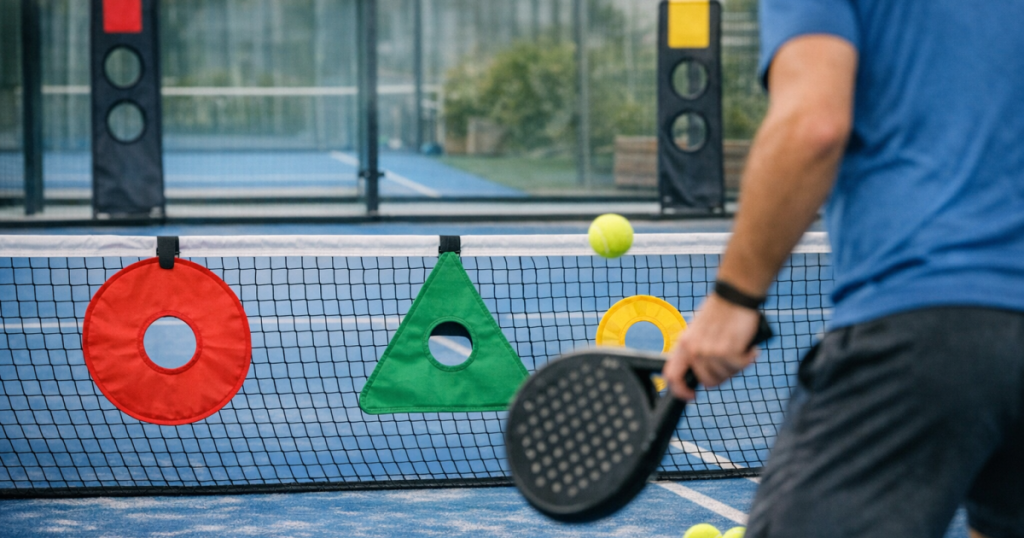
Accuracy drills can feel vague when you are new to padel: you hit ten balls, miss five, and still cannot tell whether your aim improved. Used well, padel training targets give you a clear place to aim, but they work best as feedback tools rather than magic shortcuts.
The main mistake is making the target too small, too early. In real club play, useful accuracy is not about clipping a tiny cone once; it is about sending the ball repeatedly into a sensible zone while staying balanced, recovering well, and choosing the right shot.
The short answer
Targets are worth using for accuracy drills if they help you measure control without changing your technique for the worse. For most beginners and early club players, the most useful setup is a large target zone rather than a tiny object.
- Use bigger zones when learning a shot, such as a service box corner, side glass area, or deep cross-court section.
- Use smaller markers only when the basic movement and contact feel reliable.
- Judge success by repeatability, not by one perfect ball.
- Remove the target if it makes you tense, late, or too focused on steering the racket.
That makes targets useful, but not essential. A clear line on the court, a cone near the glass, or a mental zone can do the same job if you practise with purpose.
What targets actually improve
Accuracy in padel is not just hand-eye coordination. It depends on footwork, contact point, racket face, shot selection, and how much margin you give yourself. Padel training targets are helpful because they make one part of that process visible: where the ball ends up.
They are especially useful for three beginner problems. First, they stop you hitting without intention. Second, they show whether your misses follow a pattern, such as always drifting short or too central. Third, they make practice feel more game-like because you are aiming into areas that matter rather than simply keeping the rally alive.
Targets do not fix contact on their own. If you are regularly mis-hitting, framing the ball, or changing your swing every shot, start with the basics of your racket sweet spot and a calmer, more repeatable contact before making the drill more precise.
Start with zones, not bullseyes
For beginners, a target should usually be an area about the size of a realistic landing zone, not a single tiny marker. A good starting zone might be one quarter of the service box for serves, the last metre or two of the court for deep groundstrokes, or a broad cross-court lane for bandejas and controlled volleys.
Here is a simple progression:
- Stage 1: choose a generous zone. Aim for an area you could realistically hit during a rally. The goal is confidence and shape, not perfection.
- Stage 2: track ten balls. Count how many land in the zone. Do not stop after one miss; you need a small sample to spot a pattern.
- Stage 3: adjust one thing. Change only one variable, such as aiming slightly higher over the net, preparing earlier, or turning your shoulders more fully.
- Stage 4: shrink the zone slightly. Only make the target smaller when you can hit the larger zone consistently without rushing or forcing the shot.
- Stage 5: add movement. Once the shot works from a static feed, recover to base, split-step, then hit towards the same area again.
This matters because padel rewards margin. A player who can hit eight out of ten balls into a safe deep zone will usually progress faster than a player who hits one spectacular ball onto a tiny marker and misses the next five.
Three useful accuracy drills with targets
1. Serve placement into wide and body zones
Place two visual zones in the service box: one towards the side glass and one closer to the receiver’s body. These can be flat marker discs, strips of low-tack tape outside the main bounce area, or simply two imagined rectangles.
Hit ten serves to the wide zone, then ten to the body zone. Count only serves that are legal and land in the intended area. If you are new to serving, start at a comfortable pace. A slower serve that lands reliably teaches more than a hard serve that gives you no feedback.
2. Cross-court forehand or backhand consistency
Pick a large cross-court landing area that keeps the ball away from the middle but still gives you margin over the net. Feed or rally gently with a partner and aim for the same zone for ten to twenty balls.
Look for miss patterns. If balls keep dropping short, your target may be too ambitious or your preparation too late. If they keep going into the side glass too early, give yourself a wider margin and aim more through the court rather than at the line.
3. Controlled volley to the back corner
At the net, choose a deep target zone near the back corner rather than trying to hit a winner. Ask your partner to feed easy balls and focus on a compact volley, stable body position, and recovery after the shot.
The target should encourage control, not panic. If your volley becomes jabby or rushed, make the zone bigger and reduce the pace. Accuracy drills should help your decision-making, not tempt you into low-percentage shots.
How to set up a target drill properly
A good drill is simple enough that you can repeat it without constant discussion. Before you start, agree the shot, the target zone, the number of balls, and what counts as a success.
- Use the same ball condition for the set. Switching between very lively and tired balls makes results harder to read. If you play club box leagues, it is worth understanding how ball behaviour affects rallies; our review of consistent balls for box league practice gives useful context.
- Keep the feed realistic. A perfect hand feed can help at first, but club rallies include movement, awkward heights, and recovery. Add those gradually.
- Write down a simple score. For example: 6 out of 10 into the deep cross-court zone. That gives you a benchmark for next time.
- Rest before your technique collapses. Fatigue changes footwork and contact. Short sets with focus beat long sets of tired repetitions.
If you practise indoors on a court that feels dusty or slick, be careful not to blame every miss on your aim. Slips and hesitant movement can affect accuracy before the racket even reaches the ball, so it may help to review guidance on choosing shoes for slippery indoor courts.
When targets can hold you back
Targets become unhelpful when they make you play padel like a carnival game. The court is not asking you to hit a single object; it is asking you to make repeatable decisions under pressure. If the target changes your body language, timing, or shot choice, it is doing too much.
Common warning signs include:
- You slow your swing down so much that the shot no longer resembles match play.
- You stare at the target and lose awareness of your opponents or partner.
- You aim too close to the glass, fence, or line before you have enough control.
- You judge the drill as a failure after one or two misses.
- You hit harder because the target makes the drill feel like a challenge rather than a learning tool.
The fix is usually simple: enlarge the area, reduce the pace, or change the scoring. Instead of “hit the cone”, try “land seven out of ten balls in this safe deep quarter”. That encourages the type of accuracy that transfers to matches.
How to measure progress without overcomplicating it
You do not need a detailed spreadsheet. Pick one shot and one target zone for two or three practice sessions. Record your score out of ten, then add one short note about the main miss.
For example:
- Session 1: 4 out of 10 deep cross-court, mostly short.
- Session 2: 6 out of 10, better height over the net.
- Session 3: 7 out of 10, missed wide when rushing.
That is enough information to guide your next drill. If the number improves but your movement gets worse, slow down and rebuild the shot. If the number stays the same but the misses become smaller, that is still progress.
What people usually ask
Do beginners need special target equipment?
No. Flat markers, cones placed safely away from feet, tape used carefully, or clear court zones can all work. The important part is having a visible aim and a consistent way to count results.
Should I use targets in every practice session?
No. Use them when you want feedback on a specific shot. Some sessions should focus on rhythm, positioning, communication, or point play without extra objects on court.
Are small targets better for advanced accuracy?
Only after you can already hit larger zones consistently. Smaller targets can sharpen focus, but they can also reduce margin and encourage risky habits if used too soon.
Can targets help under match pressure?
Yes, if you connect them to real tactical zones. Practising a deep cross-court ball, a safer serve location, or a controlled volley area is more transferable than aiming at random spots.
The big picture
Training targets are worth using when they make practice clearer, calmer, and more measurable. They are not a shortcut to accuracy, and they should not replace good footwork, clean contact, or sensible shot choice.
For most early-stage club players, the best approach is to start with large zones, count repeatable results, and make the drill slightly harder only when the shot holds up. Used that way, a simple marker can turn vague practice into useful feedback without making padel feel more complicated than it needs to be.