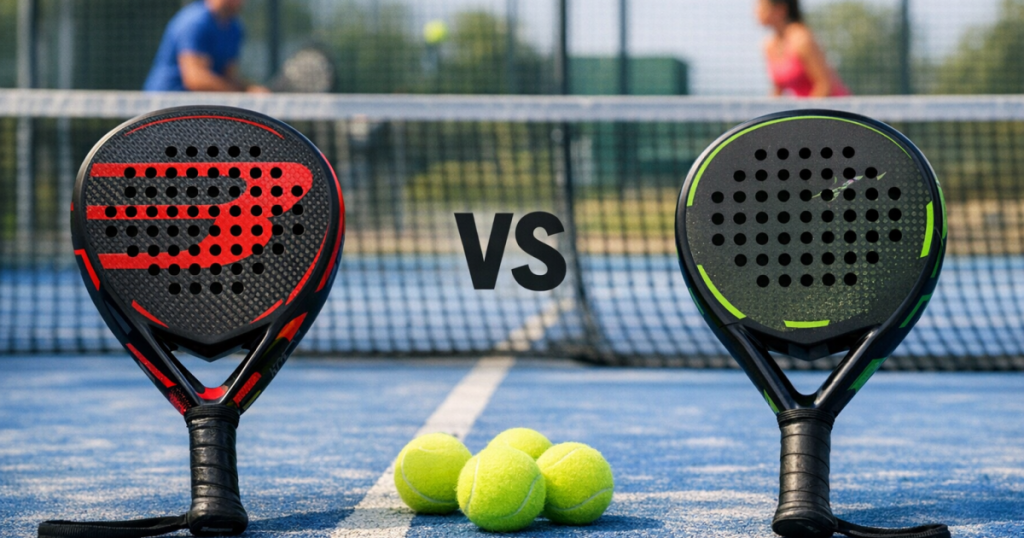
Choosing your first serious racket can feel harder than it should, because two rackets can both be popular and still suit very different players. The Bullpadel Hack 02 vs Wilson Blade decision is a good example: one leans towards a more attacking, assertive style, while the other is usually the more sensible route for steady club progress. If you are moving on from hire rackets, the real question is not which one sounds more advanced. It is which one helps you strike cleanly, recover quickly and enjoy longer rallies.
The short answer
Most newer club players should start by looking at the Wilson Blade padel range before jumping to the Bullpadel Hack 02. The Blade is generally the friendlier option if you want a racket that lets you build timing, defend calmly and play mixed-level games without feeling rushed.
The Bullpadel Hack 02 makes more sense if you already hit confidently, like an attacking game and do not mind a racket that can feel less forgiving when your contact point is late or off-centre. It is the more ambitious pick, not necessarily the better beginner pick.
At a glance
- Safer beginner choice: Wilson Blade Padel Racket, assuming you choose a version with a manageable weight and balance for your level.
- More aggressive choice: Bullpadel Hack 02 2022 Padel Racket, better suited to players who already swing with confidence and want a more attacking feel.
- Best for club progression: Wilson Blade, because newer players usually benefit more from control, comfort and repeatable contact than from extra power.
- Best for power-focused improvers: Bullpadel Hack 02, if you can already manage faster exchanges and are not relying on the racket to rescue mistimed shots.
- Big thing to verify: exact model, weight, balance, condition and grip size. Both names can appear across different versions, so do not buy from the name alone.
How they feel in real club play
Bullpadel Hack 02: more assertive, less forgiving
The Hack line is closely associated with attacking padel, and the Hack 02 sits in that world. For a confident player, that can be fun: volleys feel decisive, overheads feel purposeful and you are encouraged to take the ball early. For a newer player, the same character can expose problems quickly. If your preparation is late, your grip changes are messy or you often contact the ball away from the sweet spot, you may get less help than you expect.
That does not make it a bad racket. It simply means it asks more of you. A beginner who is athletic, plays other racket sports and already likes stepping into the ball may enjoy it sooner than someone who is still learning court positioning and shot selection. If your current issue is keeping rallies alive, the Hack 02 may make practice feel harder before it feels rewarding.
Wilson Blade: steadier and easier to grow with
The Wilson Blade padel range is usually the easier recommendation for early-stage players because it tends to suit a more balanced, controlled game. Rather than pushing you towards one big attacking identity, it gives you room to learn the basics: blocking at the net, lifting the ball from the back glass, playing sensible lobs and resetting points when you are under pressure.
That matters in UK club games, where you might be paired with different partners, play indoors one week and outdoors the next, and face opponents who win points through consistency rather than raw pace. A racket that helps you put the ball in good areas is often more valuable than one that only shines when you are already in command.
Side-by-side breakdown
Power and finishing shots
If you mainly judge a racket by how it feels on smashes, the Bullpadel Hack 02 is likely to catch your attention first. It is the more attack-minded option and suits players who want to finish points when a short ball appears. The trade-off is that power only helps when you can set up properly. Beginners often lose more points from choosing the wrong attacking shot than from lacking power.
The Wilson Blade is the calmer choice here. It should still allow you to put volleys away and play positive overheads, but it is less about trying to overpower the point. For most beginners, that is a benefit. You can develop a better sense of when to attack instead of feeling tempted to swing too hard from awkward positions.
Control and rally tolerance
Control is where the Wilson Blade makes its strongest case for newer players. If you are still learning to use the glass, defend low balls or guide volleys into the corners, a more manageable racket can make the game feel slower and clearer. You still have to make good decisions, but you are less likely to feel punished for every small timing mistake.
The Hack 02 can offer strong control in the hands of a player who is already technically tidy, but it is less of a safety net. If your backswing gets too big or your footwork stops, the ball can fly, sit up or drop short. For a player building confidence, those errors can be frustrating because it is not always obvious whether the problem is technique, timing or the racket’s feel.
Forgiveness on off-centre contact
Forgiveness is not glamorous, but it is one of the most important buying criteria for beginners. In a normal club match, you will not always contact the ball perfectly. You will stretch for volleys, defend after the glass and react to opponents who hit at your body. A racket that behaves reasonably well when contact is not perfect helps you stay in the point.
This is another reason the Wilson Blade is likely to be the better fit for most first upgrades. The Hack 02 becomes more appealing once your contact quality is already reliable. If you regularly frame balls or feel late on faster volleys, prioritise forgiveness before power.
Net play and quick reactions
At the net, both rackets can work, but they reward different habits. The Bullpadel Hack 02 suits a player who gets the racket up early, uses compact movements and wants to punch through volleys. If you are balanced and prepared, it can feel direct.
The Wilson Blade is usually easier to manage during quick exchanges. That matters when you are learning to split-step, close the net and keep your racket face stable. If your hand gets tense or your grip shifts during points, it is worth fixing that before blaming the racket. The guide on stopping your overgrip slipping mid-match is a useful next step if your racket feels secure at first but starts twisting as soon as rallies get busy.
Which player should choose which racket?
Choose the Wilson Blade if you want the easier route into regular matches
The Wilson Blade is the better fit if you are still moving from casual games into regular club padel. It is a sensible choice for players who want to improve without making the racket the centre of every mistake. If your goals are cleaner volleys, fewer unforced errors and more confidence defending from the back of the court, start here.
- You play once or twice a week and want predictable handling.
- You are still learning when to lob, block, reset and attack.
- You want a racket that works for mixed-level games.
- You prefer control and comfort over a more demanding power feel.
- You are buying without a long demo session and want the lower-risk option.
Choose the Bullpadel Hack 02 if you already play assertively
The Bullpadel Hack 02 is the more appealing option if you are not a complete beginner and already enjoy taking charge of points. It suits players who can prepare early, keep volleys compact and generate their own timing. If you have come from tennis, squash or badminton, you may adapt faster than someone completely new to racket sports, but padel still rewards patience and positioning more than swinging hard.
- You like attacking at the net and finishing shorter balls.
- You already make consistent contact under pressure.
- You are comfortable with a racket that may not flatter mistimed shots.
- You want a more ambitious racket and are willing to grow into it.
- You have tested something similar and liked the firmer, more direct feel.
Buying checks before you commit
Do not treat either name as a complete specification. Padel rackets can vary by version, release, weight range, balance, surface and condition. That matters even more if you are buying a discounted older model or a used racket from another club player.
- Check the exact version: Make sure the listing matches the racket you think you are buying. Product names can be shortened online, and small wording differences may point to a different model.
- Look beyond the headline shape: Shape gives clues, but balance and feel matter too. A racket can look manageable and still feel demanding in quick exchanges.
- Inspect the frame if buying used: Cosmetic scuffs are normal, but cracks, soft spots or suspicious repairs should make you pause.
- Budget for grip setup: A fresh overgrip can change how secure the racket feels. If the handle feels too thin or slippery, fix that before deciding the racket is wrong.
- Protect the frame early: If you are playing close to the glass or digging out low balls, a protector can reduce cosmetic damage. Follow a careful method for fitting a padel racket protector without bubbles rather than rushing it onto a dusty frame.
It is also worth thinking about what else is holding back your game. A racket upgrade can help, but it will not solve poor spacing, late preparation or rushed footwork. If you are regularly caught in no-man’s-land, a more forgiving racket will help a little, but better movement will help far more.
Value for beginners: where your money makes the biggest difference
For an early-stage player, value is not just about getting the most advanced racket for the lowest price. It is about buying something you can use well now and still enjoy as your game improves. A demanding racket bought too early can slow your learning because you start adjusting your swing to survive the racket, rather than building simple, repeatable technique.
That is why the Wilson Blade is usually the stronger value pick for a first serious padel racket. It is more likely to stay useful across coaching sessions, social matches and your first competitive club games. You can learn defensive patience, net positioning and controlled attacking patterns without feeling as though every rally depends on perfect timing.
The Hack 02 can still be good value for the right player. If you already know you like its style, and you are choosing it for clear reasons rather than because it sounds more advanced, it may be a racket you enjoy for a long time. Just be honest about your current level. The best-value racket is the one that helps you win more ordinary points, not just the one that feels exciting during warm-up smashes.
Practical recommendation
If you are a newer player choosing between these two, pick the Wilson Blade unless you have a specific reason to choose the Bullpadel Hack 02. The Blade is the more forgiving, flexible route for building a dependable club game. It should make it easier to rally, defend, learn patterns and play with different partners without constantly fighting the racket.
Choose the Bullpadel Hack 02 if you are already an assertive player who wants a more attacking racket and accepts the learning curve. It is better for confident improvers than for first-time buyers who still need help with control and consistency.
A simple way to decide is this: if your biggest problem is generating enough threat when you are already in good position, the Hack 02 deserves a look. If your biggest problem is keeping the ball in play, defending calmly or making clean contact under pressure, the Wilson Blade is the smarter buy.
Quick Buying Links
Bullpadel Hack 02
The Bullpadel Hack 02 vs Wilson Blade decision is a good example: one leans towards a more attacking, assertive style, while the other is usually the more sensible route for steady club progress.
Wilson Blade Padel Racket
At a glance Safer beginner choice: Wilson Blade Padel Racket, assuming you choose a version with a manageable weight and balance for your level.
Common questions
Is the Bullpadel Hack 02 too advanced for beginners?
For many beginners, yes. It is not impossible to use, but it is better suited to players who already prepare early, strike cleanly and want a more attacking feel. If you are still building consistency, a more forgiving racket is usually the better path.
Is the Wilson Blade padel racket only for beginners?
No. The Wilson Blade can suit beginners and improving club players because a balanced racket remains useful as your tactics improve. It is not just a starter option; it is a sensible choice for players who value control and predictability.
Should I buy either racket without testing it?
Only if you are comfortable with the risk and can verify the exact model. If possible, borrow a similar racket at your club or test one during a session. Even ten minutes of volleys, lobs and back-glass defence can tell you more than a product listing.
Would coaching help more than changing racket?
If your errors come from positioning, grip changes or shot choice, coaching may help more than a new racket. Before spending heavily, read what to ask before booking a padel coach so you can get targeted help rather than a generic lesson.
What should I upgrade after choosing a racket?
Start with the basics: good padel shoes, fresh overgrips and suitable balls for your club conditions. Those small upgrades often improve comfort and consistency more than beginners expect.