Buying your first padel racket is exciting, but it is also one of the easiest places to overspend. The right starter choice is not the most powerful or expensive racket on the wall; it is the one that feels comfortable, helps you keep the ball in play, and makes regular club sessions more enjoyable.
For most beginners, the smartest approach is to choose forgiveness over prestige. You can always upgrade later, once your technique, preferred shots and playing frequency are clearer.
The short version
- Prioritise comfort, control and a large sweet spot over raw power.
- Choose a manageable weight rather than assuming heavier means better.
- Start with a round or easy all-round shape unless you already have strong racket-sport experience.
- Avoid paying extra for advanced features you cannot yet judge on court.
- Test or borrow if you can, then set a firm spending ceiling before browsing.
Step 1: Decide what the racket needs to do for you
A beginner racket should make the game easier, not punish small mistakes. At this stage, your main jobs are learning to contact the ball cleanly, recovering to the right position, defending from the glass and building confidence in longer rallies.
That means your first padel racket should help with three things: control, comfort and forgiveness. Control helps you place the ball without swinging wildly. Comfort matters because stiff, demanding rackets can feel harsh when you are still finding the centre of the face. Forgiveness gives you a little help when you hit slightly off-centre, which happens a lot during early sessions.
If a racket is described mainly around explosive power, professional-level attack or maximum output, treat that as a sign to slow down. Those qualities can be useful later, but they often come with trade-offs that newer players notice more: less forgiveness, more timing demand and a harder feel.
Step 2: Get the weight right before worrying about style
Weight is one of the biggest comfort factors. A racket that is too heavy can make late reactions harder, especially in quick exchanges at the net. A racket that is too light may feel easy to swing but less steady when blocking fast balls. The aim is not to find the lightest racket possible; it is to find one you can move smoothly for a full match.
If you are new to racket sports, lean towards a comfortable, manageable weight and avoid anything that feels tiring during warm-up. If you have played tennis, squash or badminton, you may cope with a slightly heavier option, but padel still uses different movements and more compact reactions.
Balance matters too. Two rackets can have similar listed weights but feel very different in the hand. A head-heavy racket can feel more demanding, while an even or lower balance often feels easier for beginners. For a deeper explanation of the trade-off, read this guide to light versus heavy padel rackets.
Step 3: Start with an easier racket shape
Padel rackets are commonly described as round, teardrop or diamond shaped. You do not need to obsess over the labels, but they are useful shorthand.
- Round rackets: usually the safest beginner route because they tend to feel controlled and forgiving.
- Teardrop rackets: often sit in the middle, giving a blend of control and attacking potential.
- Diamond rackets: generally aimed at stronger attacking players who already time the ball well.
There are exceptions, so do not buy from shape alone. Still, if you are choosing without much testing time, a round or easy all-round model is normally the lower-risk starting point. You are trying to buy more good contacts, not more bragging rights.
Step 4: Do not pay extra for labels you cannot feel yet
Racket marketing can be full of terms about carbon layers, surface texture, core feel, balance points and pro-player input. Some of these details matter, but not equally to a beginner. If you cannot yet tell why one face material suits your game more than another, it is sensible not to pay heavily for that distinction.
Instead, use product descriptions to check the basics: listed weight, shape, balance, player level, whether the racket is framed around control or power, and whether the retailer clearly states the model is beginner-friendly or intermediate-friendly. If the description assumes an advanced attacking style, that is a clue.
Real models can be useful reference points, even if you do not buy them. For example, compare how retailers describe the Head Graphene 360+ Alpha Elite against the Bullpadel Hack 02 2022 Padel Racket. Look at the language around shape, balance and playing style, then notice how different the intended player can be. There is also a more detailed comparison of the Head Graphene 360+ Alpha Elite and Bullpadel Hack 02 if you want to see how two recognisable rackets can point towards different needs.
Step 5: Set a budget ceiling before you browse
Overspending usually happens when you start shopping before deciding what is enough. Set a firm ceiling that would still leave room for court bookings, shoes, balls and basic accessories. A slightly less exciting racket plus more playing time is usually better than a premium racket that eats into your sessions.
Be careful with “reduced from” pricing. A discount can be genuine, but the important question is whether the racket still fits your level. A heavily reduced advanced racket is not automatically a good beginner purchase. If it is too demanding, the discount does not help your forehand, volleys or confidence.
Also avoid buying only because a strong player at your club uses a certain model. Their timing, swing speed and tactical choices may be very different from yours. A beginner-friendly racket is not a downgrade; it is the right tool for the stage you are actually in.
Step 6: Try before buying when possible
If your club has hire rackets, demo rackets or friendly regulars who will let you have a short hit, use that chance. You do not need a long trial to learn something useful. Ten minutes can tell you whether a racket feels awkward, too head-heavy, too harsh or surprisingly natural.
When testing, keep the checks simple:
- Can you react quickly at the net without feeling late?
- Do off-centre hits still travel reasonably well?
- Can you block fast balls without the racket twisting too much?
- Does your arm or wrist feel tired unusually quickly?
- Can you keep lobs and simple groundstrokes under control?
Do not judge only on your best smash. Beginners win far more value from a racket that helps with ordinary balls: returns, blocks, lobs, controlled volleys and defensive shots after the glass.
Step 7: Keep the rest of your kit sensible too
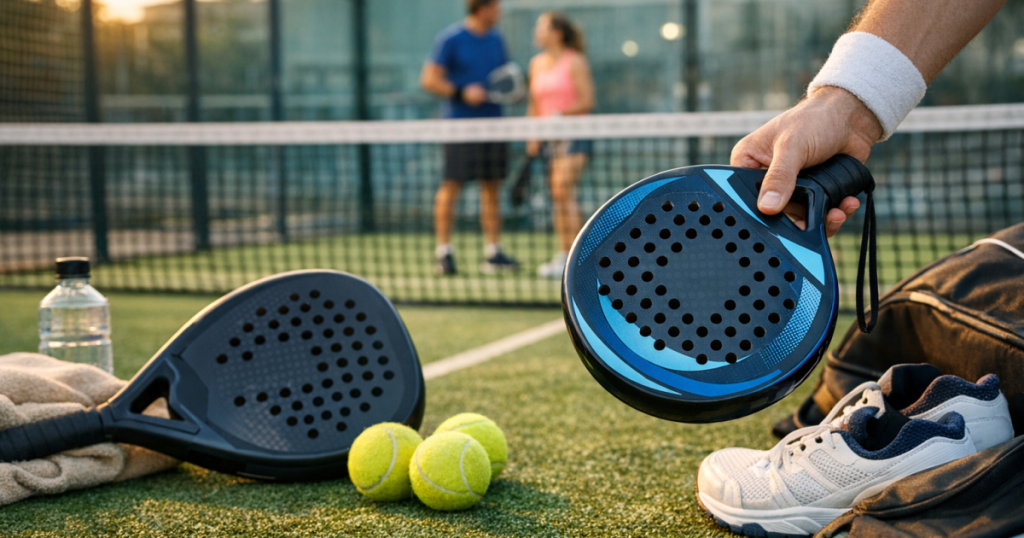
The racket gets the attention, but it is only one part of your early padel setup. Good court shoes, comfortable clothing, a few balls and spare overgrips can have just as much impact on whether you enjoy your first few sessions. If all your budget goes into the racket, you may end up cutting corners elsewhere.
Before buying, it is worth checking your full starter setup against a simple padel starter checklist. That helps you see the racket as one decision within the bigger picture of playing regularly, not as the single thing that will make you improve.
Common overspending traps
- Buying too advanced too soon: a powerful racket can make timing errors more obvious, not less.
- Choosing by looks: colour and finish are nice, but comfort matters more once the match starts.
- Ignoring weight and balance: a racket can look perfect online and still feel slow in your hand.
- Copying professional players: elite rackets are built around elite technique and physical preparation.
- Assuming expensive means forgiving: price and beginner suitability are not the same thing.
Questions people ask
Should my first racket be round or teardrop shaped?
Most beginners are safer with a round racket because it usually feels more forgiving and controlled. A teardrop shape can work if it still feels easy to manoeuvre and is not marketed mainly as a power racket.
How much should I spend as a beginner?
Spend enough to get a comfortable, recognised padel racket from a reliable retailer, but do not stretch your budget for advanced features. Keep money aside for court time, shoes and replacement grips.
Is it worth buying second-hand?
It can be, provided you can inspect the racket carefully. Check for cracks, soft spots, heavy frame wear and a worn grip. If the condition is unclear, a modest new racket may be the safer choice.
Can I use a tennis racket for padel?
No. Padel uses a different racket type and court environment. Use a proper padel racket so you can learn the correct contact, control and movement from the start.
When should I upgrade?
Upgrade when you play regularly and can explain what your current racket lacks. If you simply want more consistency, lessons and court time may help more than a new model.
Final thoughts
The best beginner purchase is the racket that helps you enjoy more rallies, practise more often and avoid unnecessary strain or frustration. Choose comfort first, keep the shape and weight friendly, and do not let premium marketing push you beyond what you can actually use on court.
If you are still unsure, borrow or demo a couple of rackets, write down what felt comfortable, then buy within your pre-set ceiling. That simple process will usually beat impulse shopping and leave you with more budget for the thing that improves your padel most: playing regularly.