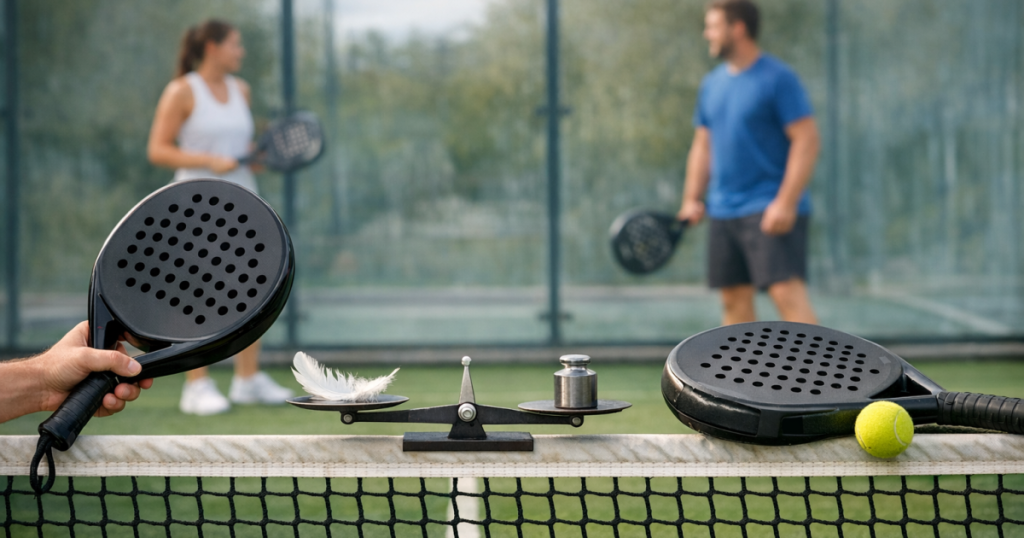
A racket that feels fine for the first five minutes can feel very different at 5-5 in the second set. Getting light vs heavy padel rackets right is less about proving strength and more about finding a weight you can swing cleanly, defend with, and recover from without your wrist, elbow or shoulder feeling overworked.
For beginners and early club players, comfort should usually come before raw power. A racket that is slightly easier to move often helps you learn better timing, get into position earlier and keep rallies alive. Once your technique improves, you can decide whether extra weight, a different balance or a firmer feel genuinely adds anything to your game.
Main points
- Lighter rackets usually feel easier to manoeuvre, especially at the net and when defending against fast balls.
- Heavier rackets can feel more stable through contact, but only if you can swing them without rushing or tensing up.
- The listed weight is not the whole story. Balance, shape, grip size and added accessories change how heavy the racket feels in the hand.
- Beginners should avoid choosing the heaviest racket simply because it promises more power. Clean contact creates useful pace.
- If a racket causes recurring discomfort, do not play through it. Drop intensity, check your technique and get appropriate help if pain continues.
What racket weight actually means
Padel racket weight is normally listed in grams. Many adult rackets sit somewhere around the mid-300 g to high-300 g range, although exact ranges vary by brand, model and production batch. Two rackets with similar listed weights can still feel very different once you start volleying, blocking lobs or reacting to body shots.
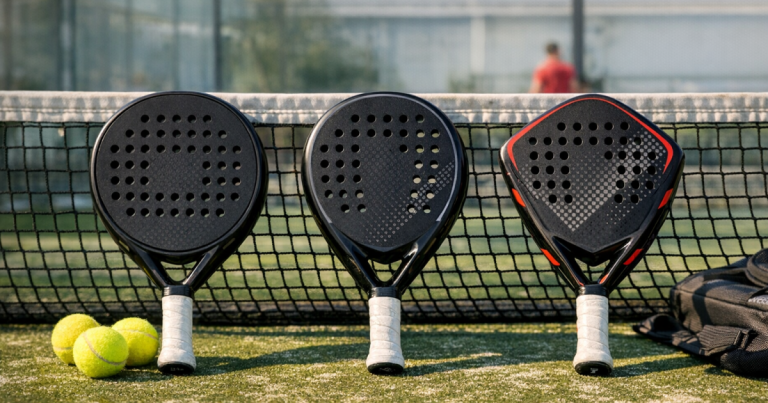
That is because weight is only one part of the feel. A racket with more mass towards the head can feel slower to move than a racket of similar weight with more mass nearer the handle. A round, control-focused racket may feel easier to guide, while a diamond-shaped racket can feel more demanding if the balance sits higher.
This is why beginners should not judge a racket by the number alone. If you are still building your first setup, it is worth reading a broader padel starter checklist so you can think about racket, shoes, clothing and court readiness together rather than treating the racket as the only important choice.
Why light vs heavy padel rackets is not just about strength
It is tempting to think a heavier racket is for stronger players and a lighter one is for weaker players. That is too simple. The real question is whether you can control the racket at match speed, not whether you can swing it once in a shop or during a warm-up.
A lighter-feeling racket can help when you are learning to react quickly. Beginners often lose points because the racket arrives late, the backswing gets too big or the wrist tightens under pressure. A more manoeuvrable feel gives you a little more time to block, guide and reset.
A heavier-feeling racket can help when you already have decent preparation and compact technique. Some players enjoy the extra stability when blocking hard shots or playing through the ball. But if the added weight makes you late, it can reduce control rather than improve it.
The key is repeatability. A comfortable racket is one you can use for a full club session, including the last few games when your footwork is slower and your concentration dips.
What a lighter racket tends to feel like
A lighter racket is usually easier to accelerate and recover. That can be reassuring if you are new to padel, play only once a week, share equipment at club sessions or are still working out your preferred playing style.
Where a lighter feel helps
- Defence: You can get the racket into position faster when balls come at the body or low near the side glass.
- Net reactions: Quick volleys, blocks and small adjustments often feel less rushed.
- Long sessions: Less strain through the forearm can make social games and coaching sessions feel more manageable.
- Learning technique: It can be easier to practise compact swings instead of forcing power from the arm.
The trade-off is that some lighter rackets may feel less solid against heavy shots, particularly if the racket is also soft, head-light or has a small sweet spot. That does not make them bad. It simply means you may need to focus on clean positioning rather than expecting the racket to do the work.
What a heavier racket tends to feel like
A heavier racket can feel more planted at impact. For players with sound timing, that can make blocks, volleys and overheads feel more controlled. The racket may feel as though it carries through the ball with less flutter.
Where extra weight can help
- Stability: The racket can feel steadier when absorbing pace from harder hitters.
- Depth: With good technique, it may be easier to send the ball deep without snatching at the shot.
- Confidence on volleys: Some players like the feeling of a racket that does not twist as easily in the hand.
The downside is fatigue. If the racket becomes harder to lift, your contact point may drift back, your wrist may start doing too much and your swing may become late. That is when extra weight stops feeling like control and starts feeling like work.
The hidden factor: balance
Balance is the reason two rackets with similar weights can feel completely different. A head-heavy racket can feel powerful but slower. A head-light racket can feel quick but may offer less punch. An even balance sits somewhere between the two.
Beginners often do well with a racket that feels neutral or slightly easy to move. That does not mean every beginner needs the lightest possible model. It means the racket should help you prepare early, hold a simple shape and make clean contact without dragging your arm through the shot.
Shape also matters. Round rackets often place the sweet spot in a more forgiving area, which can suit early-stage players. Teardrop and diamond shapes can reward more advanced striking, but they may feel less forgiving if your contact point is inconsistent. For a wider explanation of style, balance and playing priorities, see our guide to control vs power padel rackets.
Small additions can change the feel
Your racket does not stay exactly as it comes out of the wrapper. Overgrips, frame protectors and even dampeners can alter the feel. The change might sound small on paper, but you may notice it during quick exchanges or long matches.
- Overgrips: Adding one or more overgrips can make the handle feel fuller and may shift the feel slightly towards the hand.
- Frame protectors: A protector at the top of the racket can make the head feel a little heavier.
- Grip condition: A worn, slippery grip can make any racket feel harder to control because you start squeezing too tightly.
If you are testing rackets, try to use a grip setup similar to the one you will play with. A demo racket with a thin, tired grip may not give you a fair impression of the model.
Useful examples without getting trapped by brand labels
Some rackets are marketed around control, others around power, and many sit in the middle. Names can be helpful, but they should not replace how the racket feels in your hand. A model such as NOX AT10 Genius 18K, Adidas Metalbone or Babolat Technical Viper may appear in conversations at clubs or online, but you should still check the listed weight range, balance and shape for the exact version you are considering.
The same applies when looking at more beginner-friendly or control-led rackets. Do not assume one brand is automatically light, heavy, easy or difficult. Brands often make several versions for different playing styles. A racket that looks similar from a distance may feel completely different once you start defending off the glass.
If you are weighing up specific rackets, it can help to read a comparison that explains feel rather than just listing features. For example, our look at the Head Graphene 360+ Alpha Elite and Bullpadel Hack 02 shows how two recognisable rackets can appeal to different player priorities.
How to judge comfort during a demo or club hit
A five-minute hit can be misleading if you only try easy forehands. Use a short, varied test so you feel the racket in realistic situations.
- Start with volleys: Stand at the net and check whether you can make small, relaxed movements without the racket feeling slow.
- Defend low balls: Ask for balls near the side glass or back glass. If the racket feels late every time, it may be too demanding.
- Play overheads without forcing: You should be able to prepare smoothly. If you need to muscle every bandeja or vibora, the setup may not suit you yet.
- Notice your grip pressure: If you are squeezing hard just to keep control, the racket may be too heavy, too head-heavy or simply not a good fit.
- Check the end of the session: The best signal comes after you have played for a while. Comfort late in the session matters more than first impressions.
When possible, demo rackets during the type of session you normally play. A racket that feels exciting during a gentle knock-up may feel less useful in a busy four-player game with quick reactions and imperfect footwork.
Common beginner mistakes
Choosing weight for power alone
Power in padel is not only about racket weight. Positioning, timing, contact point and shot choice matter more. Many beginners hit harder with an easier racket because they arrive earlier and swing more freely.
Copying a stronger player
A regular competitive player may enjoy a heavier or more head-heavy racket because their technique supports it. That does not mean the same racket will help you. Your best choice is the one that makes your normal shots better, not someone else’s highlights.
Ignoring discomfort
Some adjustment is normal when trying a new racket, but sharp pain or recurring soreness is not something to push through. Rest, reduce intensity and get suitable help if discomfort continues. A racket should support your game, not become a weekly problem.
Testing only attacking shots
Beginners often test smashes and forehands first. Padel is full of blocks, lobs, resets and awkward recoveries. A comfortable racket should help with those less glamorous shots too.
A sensible starting point for early-stage players
For most beginners, a comfortable starting point is a racket that feels easy to manoeuvre, forgiving on off-centre hits and stable enough for normal club pace. You do not need to chase the lightest racket available, but you should be cautious about going very heavy or very head-heavy before your technique is consistent.
If you are between two options, choose the one you can control when tired. That simple rule prevents many poor purchases. You can always move towards a heavier, firmer or more power-focused racket later, once you know your preferred side, common shot patterns and how your body responds to regular play.
It is also worth thinking about your playing routine. Someone playing one relaxed session a fortnight may value easy handling above everything. Someone taking coaching and playing twice a week may grow into a slightly more stable racket sooner. The right answer depends on how you actually play, not just where you hope your game will be in six months.
Things readers ask
Is a lighter padel racket always better for beginners?
No. A lighter feel can help beginners react and learn, but the racket still needs enough stability for clean contact. The best beginner option is comfortable, forgiving and easy to control for a full session.
Can a heavy racket cause elbow or shoulder discomfort?
It can contribute if it makes you swing late, grip too tightly or force shots with your arm. Technique, playing volume and grip setup also matter, so do not blame weight alone.
Should women automatically choose lighter rackets?
No. Racket choice should be based on comfort, timing, strength, playing style and experience rather than gender. Many players prefer a lighter feel, but it is not a rule.
Does adding an overgrip make a racket too heavy?
Usually not by itself, but it can change the feel. If the racket already feels close to your limit, extra grip layers or a head protector may make it feel less nimble.
How long should I test a racket before deciding?
Try to use it for a realistic club session if possible, not just a few warm-up shots. Pay attention to late-session control, comfort and whether your normal shots improve.
Final thoughts
The right racket weight is the one that lets you play relaxed, prepare early and repeat good contact under pressure. Lighter rackets can make padel feel easier to learn, while heavier rackets can add stability for players who already control their timing well.
For most early-stage players, the safest path is to start with comfort and manoeuvrability, then move towards extra weight only when it clearly improves your game. A racket should help you enjoy more rallies, make better decisions and come back for the next session feeling ready to play again.