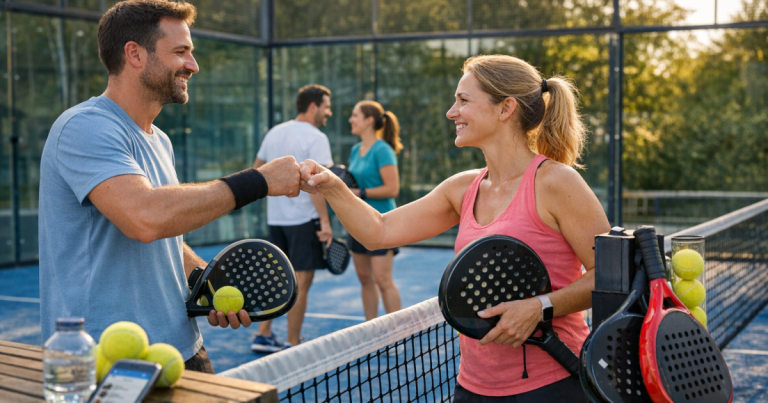
Walking into a busy club night can feel a bit awkward when everyone else seems to know each other already. If you are trying to find a padel partner at your local club, the best approach is to be visible, honest about your level, and easy to arrange games with.
Most regular pairings do not start with a perfect match on day one. They usually come from mix-in sessions, beginner groups, short chats after games, and a few low-pressure repeat bookings.
What to know first
- You do not need a fixed partner before joining a club night; many players arrive solo.
- Your playing level matters less than your reliability, attitude, and willingness to rotate.
- The easiest partners to meet are usually at beginner sessions, improver classes, social mix-ins, and WhatsApp groups run by clubs or regular players.
- A good partner is not always the strongest player. For early-stage players, consistency, communication, and similar availability often matter more.
- It is normal to try a few pairings before one becomes a regular playing arrangement.
Step 1: Start where solo players are expected
The simplest route is to join formats where turning up alone is completely normal. At many UK clubs, this means social club nights, coached beginner sessions, americano-style events, box leagues, or WhatsApp groups for people looking to fill courts.
When you book, look for wording such as beginner, improver, social, mix-in, open play, or all welcome. These sessions are designed to rotate players around, so you are not asking to be squeezed into an established private game.
If the club uses level bands, choose slightly conservatively at first. It is better to have a comfortable first session and move up later than to join a court where the pace feels stressful. You will meet more suitable players when the rallies are balanced and everyone can enjoy the game.
It also helps to understand the basic rules before you arrive, because it makes you easier to play with from the first warm-up. If you are unsure what clubs tend to enforce in real matches, read the guide to padel rules most UK clubs actually follow before your next session.
Step 2: Describe your level in plain language
One common mistake is using vague labels such as “intermediate” too early. Padel levels vary a lot between clubs, and one player’s intermediate can be another player’s beginner-plus.
Use practical descriptions instead. They make it easier for people to know whether a game will feel fair.
Useful ways to describe yourself
- “I have played a few beginner sessions and can keep a rally going, but I am still learning the glass.”
- “I am comfortable with the scoring and basic positioning, but I am not playing fast games yet.”
- “I have come from tennis or squash, so I can hit the ball, but I am new to padel tactics.”
- “I am looking for relaxed improver-level games rather than competitive league matches.”
This kind of wording saves time and avoids awkward mismatches. It also shows that you are self-aware, which is a big plus when people are choosing who to invite into a court.
Step 3: Be easy to pair with on court
Players often invite back the person who made the game enjoyable, not just the person who hit the biggest winner. At beginner and improver level, good court manners go a long way.
Turn up a few minutes early, warm up sensibly, call the score clearly, and avoid coaching your partner unless they ask. If you make mistakes, reset quickly. If your partner makes mistakes, stay calm and supportive. Padel is social, and people remember how it felt to share a court with you.
Clothing and footwear also matter because they help you move confidently and avoid feeling out of place. You do not need to look like a sponsored player, but clean sports kit and suitable court shoes are a good start. For simple first-session advice, see what to wear to your first padel club night.
Step 4: Use club groups without making it awkward
Many regular games are arranged in group chats. Some are run by the club, while others are informal groups created by players. Ask the organiser whether there is a beginner or improver group for finding games, and be specific when you post.
A good message includes your level, preferred time, and the type of game you want. Keep it short and easy to reply to.
Messages that work well
- “Hi everyone, I am beginner-plus and looking for a relaxed game one evening this week. I can do Tuesday or Thursday after 18:30.”
- “Two of us are looking for two more for an improver-level game on Saturday morning. Friendly pace, not too competitive.”
- “I am new to the club and looking to join a social game next week. Comfortable with scoring, still learning positioning.”
Avoid apologising too much for being new, and avoid saying you will play “any level” if that is not true. The clearer you are, the more likely the right people will respond.
Step 5: Turn one good game into another
If you enjoy playing with someone, say so before everyone disappears to the car park. A simple, friendly follow-up is often enough.
Try: “That was a really good game, thanks. Would you be up for another one next week?” If they say yes, suggest two possible times rather than leaving it open-ended. For example: “I can do Monday evening or Saturday morning. Would either work?”
If there were four of you and the balance felt good, ask whether the same group wants to book again. Regular fours can be easier to maintain than a strict two-person partnership because there is more flexibility when someone is away.
Step 6: Check whether the partnership actually fits
A useful padel partner is not just someone who can play at the same standard. You also need some overlap in availability, expectations, and temperament.
After a couple of sessions, ask yourself:
- Do we enjoy a similar pace of game?
- Are we both comfortable with the level of competitiveness?
- Can we arrange times without lots of chasing?
- Do we communicate well during points?
- Do we both want the same thing: social games, improvement, leagues, or tournaments?
If one player wants intense match practice and the other wants a relaxed social hit, neither person is wrong. It may simply not be the best regular pairing. Keep it friendly and continue to play occasionally if the games are enjoyable.
Step 7: Build a small pool, not just one contact
Relying on one person can make your padel routine fragile. Holidays, work shifts, family plans, and injuries can quickly interrupt regular play. Aim to know six to ten people at a similar level, even if you have one favourite partner.
A small pool helps you get more court time and makes it easier to join games when someone drops out. It also exposes you to different styles, which is useful for beginners. One partner may be steady and patient; another may challenge you with faster volleys or better lobs.
If you are still working out how often to play, tie your partner search to a simple routine. The guide to building your first month of padel practice can help you balance lessons, social games, and recovery without overdoing it.
What to do if you are nervous about asking
It is completely normal to feel hesitant, especially if you are new to a club. The trick is to make the invitation low-pressure. You are not asking someone to commit to a season; you are asking for one game.
Use wording that gives the other person an easy out:
- “No worries if you are already sorted, but I enjoyed that game if you fancy another sometime.”
- “I am trying to get more regular improver games. Would you mind if I messaged you when I am booking?”
- “If you ever need a fourth at this level, I would be happy to join.”
Most club players understand the challenge because they have been through it themselves. Even if someone cannot play, they may suggest another player, another group, or a better session for your level.
Common questions
How long does it usually take to find a padel partner at a new club?
Many players meet suitable contacts within two to four social sessions, but a reliable regular partner can take longer. Focus on meeting several people first rather than rushing one fixed pairing.
Should I look for a partner better than me?
A slightly stronger partner can help you improve, but a big gap can make games frustrating for both of you. For regular play, a similar level is usually more enjoyable.
Is it better to join lessons or social games first?
If you are brand new, one or two beginner lessons can make social games feel less daunting. If you already know the basics, social mix-ins are usually the quickest way to meet players.
What if everyone at my club already has a group?
Ask the organiser about quieter sessions, beginner groups, box leagues, or fill-in lists. Established groups often need spare players, especially for weekday evenings and last-minute cancellations.
Can I play with different partners each week?
Yes. In fact, it is useful while you are learning. Different partners help you practise communication, positioning, and adapting to different match styles.
What to remember
The best way to build regular padel games is to be present, clear, and easy to invite back. Join the sessions designed for solo players, describe your level honestly, follow up after enjoyable games, and build a small network rather than depending on one person straight away.
A good local partner does not need to be perfect. They need to be reliable, encouraging, available at similar times, and close enough in level that both of you can enjoy the game and improve together.