Once you know the rhythm of points, games and sets, padel feels much easier to follow. The main padel match rules are close to tennis scoring, but golden point, short formats and match tie-breaks can catch beginners out at UK clubs. Here is the clear version: how a game is won, how sets are decided, what happens at 6-6, and what to check before your first league, box match or friendly.
In brief
- A padel game is scored 0, 15, 30, 40, then game.
- A standard set is usually first to 6 games, with a 2-game lead required.
- At 6-6, most matches use a tie-break to decide the set.
- A standard match is usually best of 3 sets, but many clubs use shorter formats.
- Golden point means one deciding point at deuce, instead of advantage scoring.
If you are still building the full picture, the wider beginner guide to padel rules and scoring is a helpful next step after this article.
How points work inside a game
Padel uses the familiar tennis-style point sequence: love, 15, 30, 40 and game. “Love” simply means zero. If the server’s team wins the first point, the score is 15-love. If the receiving team wins the next point, it becomes 15-all.
The server’s score is always called first. So if your pair is serving and you have won two points while the other pair has won one, the score is 30-15. If both pairs reach three points, the score is 40-40, also called deuce.
From deuce, there are two common ways to finish the game:
- Advantage scoring: one pair must win two points in a row from deuce. Win the next point and you have advantage; win again and you win the game. Lose the point at advantage and the score returns to deuce.
- Golden point: one deciding point is played at 40-40. Whoever wins that point wins the game.
For beginners, the key habit is to call the score clearly before every serve. It keeps the game calm, avoids awkward arguments and helps everyone stay in the same rhythm.
What golden point means in real play
Golden point is used in many padel competitions, leagues and timed club sessions because it keeps matches moving. Instead of a long back-and-forth at deuce, the game is decided immediately.
At 40-40, the receiving pair usually chooses which side will receive the serve. The receiver on that side takes the return, and the point is played as normal. The winner of that rally wins the game.
Here is a simple example:
- Your pair is serving at 40-40.
- The receiving pair chooses to receive on the left side.
- You serve diagonally into that service box.
- The rally is played out.
- If your pair wins the point, you win the game. If the receivers win it, they win the game.
Golden point can feel dramatic because one return, lob or missed volley changes the game. The best beginner approach is not to overhit. Serve safely, aim for a reliable first volley, and make the other pair play one more ball.
How games turn into sets
A set is made up of games. In a standard format, the first pair to 6 games wins the set, but they normally need to lead by at least 2 games. Common set scores include 6-2, 6-3 and 6-4.
If the score reaches 5-5, the set is not over. One pair can win it 7-5 by winning the next two games. If the score reaches 6-6, the set is usually decided by a tie-break.
Examples of normal set outcomes:
- 6-4: the set is complete because the winning pair leads by 2 games.
- 7-5: the set is complete after a 5-5 score because one pair wins two games in a row.
- 7-6: the set is decided by a tie-break at 6-6.
At social sessions, some clubs shorten this. You might play first to 4 games, sudden-death games, timed rotations, or one set only. That is not wrong; it is simply a club format designed to give everyone a fair amount of court time.
What happens in a tie-break
A tie-break is a mini scoring race used to decide a set when the game score reaches 6-6. Instead of 15, 30 and 40, tie-break points are counted as simple numbers: 1, 2, 3 and so on.
In a standard set tie-break, the first pair to 7 points wins, but they must lead by 2 points. So 7-3 wins the tie-break, but 7-6 does not. At 6-6 in the tie-break, play continues until one pair leads by 2, such as 8-6, 9-7 or 10-8.
The serving pattern is also different from a normal game:
- The player whose turn it is to serve serves the first point of the tie-break.
- After the first point, the serve changes to the other pair.
- From then on, each player serves two points before the serve changes again.
- Players usually change ends after every 6 points played.
Do not worry if you need to pause and check the order during your first few tie-breaks. Most beginner and club players do. Just agree the score and server before the next point starts.
Match tie-breaks and shorter club formats
A full match is commonly best of 3 sets. That means the first pair to win two sets wins the match. A score such as 6-3, 4-6, 6-2 means three full sets were played.
Many UK clubs, leagues and coaching sessions use a match tie-break instead of a full final set. This is usually played to 10 points, with a 2-point lead required. For example, if the match is one set all, the final part may be a first-to-10 tie-break rather than another complete set.
Common beginner-friendly formats include:
- Best of 3 full sets: the traditional longer match format.
- Two sets plus match tie-break: if the match reaches one set all, a 10-point tie-break decides it.
- One set to 6: useful for box leagues or busy club nights.
- Short sets to 4: often used when court time is limited.
- Timed matches: the score at the end of the booked slot decides the result, using the organiser’s rules.
The important point is that match format is not always identical from one session to another. Before you start, confirm whether you are playing advantage or golden point, whether a tie-break happens at 6-6, and what decides the match if you run out of time.
Serving order and changing ends
Each game has one server, and that player serves for the whole game. The serve alternates between teams from game to game. Within each pair, partners take turns serving in their team’s service games.
For example, if Pair A serves the first game, Pair B serves the second game, Pair A serves the third game, and so on. Pair A’s two players alternate their own service turns each time their team serves. At the start of a new set, the serving order can be chosen again.
Players normally change ends after the first game of each set and then after every two games after that. In tie-breaks, players usually change ends after every 6 points. In casual play, people sometimes forget this, so a quick reminder is fine.
Service lets are another area that can cause confusion, particularly when the ball clips the net and still lands in the correct service box. If that is happening in your matches, read the separate explainer on how padel let rules work.
Beginner mistakes that cause scoring confusion
Most scoring problems are not about complicated rules. They happen because players forget to speak clearly, rush the next serve, or assume everyone is using the same format.
Watch out for these common mistakes:
- Calling the wrong score first: the server’s score is always called before the receiver’s score.
- Forgetting golden point is in use: at 40-40, stop and confirm before serving.
- Ending a set too early: 6-5 is not normally a completed set; it is usually played to 7-5 or 6-6.
- Mixing up match tie-break and set tie-break scoring: set tie-breaks are usually to 7, while match tie-breaks are commonly to 10.
- Not checking time rules: some leagues have special rules if the court booking ends before the match is complete.
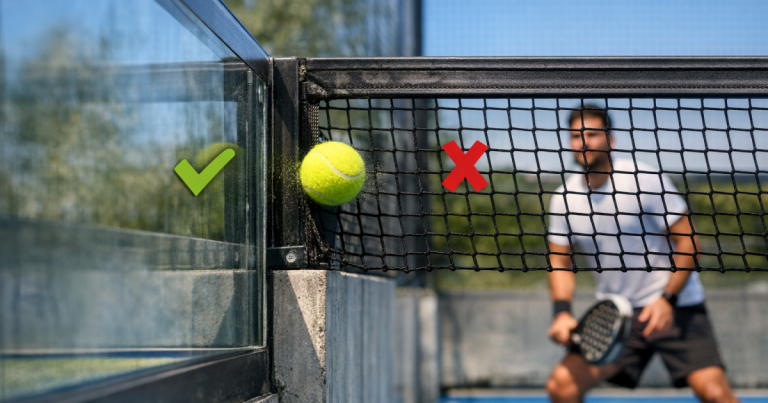
It also helps to understand which balls are in, out or playable off the glass and fence. Scoring is easier when the rally outcome is clear, so the guide to court lines and boundaries in padel pairs well with this topic.
What to confirm before a club match
Before the warm-up ends, take 30 seconds to agree the format. This is especially useful in social matches where players may have learnt at different clubs or from different coaches.
- Are you playing one set, best of 3 sets, or timed games?
- Is golden point being used at deuce?
- Does a set tie-break happen at 6-6?
- If the match reaches one set all, is there a full final set or a match tie-break?
- Who is serving first, and which player on each pair is receiving first?
- What happens if the booking time ends mid-game?
Clear agreement at the start makes the match more enjoyable. It also helps newer players focus on positioning, shot choice and communication instead of trying to work out the format under pressure.
FAQ
Is padel scoring exactly the same as tennis?
It is very similar: love, 15, 30, 40, games and sets. The main difference beginners notice is that golden point is commonly used in padel, while some tennis formats still use advantage scoring.
Do you always play golden point at 40-40?
No. Many clubs and competitions use golden point, but not all. Some matches use advantage scoring from deuce, so confirm the format before starting.
What score wins a padel tie-break?
A standard set tie-break is usually first to 7 points, with a 2-point lead. If it reaches 6-6, you keep playing until one pair leads by 2.
Can a padel set finish 6-5?
Normally, no. A standard set requires a 2-game lead, so 6-5 continues. The set may finish 7-5, or go to a tie-break at 6-6.
What is the difference between a tie-break and a match tie-break?
A set tie-break usually decides a set at 6-6 and is commonly played to 7. A match tie-break often replaces a final set and is commonly played to 10.
Final thoughts
Once you understand points, games, sets, tie-breaks and golden point, padel scoring becomes much less intimidating. The safest habit is simple: call the score before every serve, confirm the format before the first game, and pause at 40-40 or 6-6 if anyone is unsure. Good communication keeps beginner matches friendly, fair and flowing.
The padel match rules can look like a lot on paper, but they quickly become second nature once you have played a few sets. Start with the standard structure, learn how your club handles golden point, and you will feel far more confident in both social games and organised matches.