A racket can look simple from the outside, but the materials inside it make a big difference to how forgiving, firm or lively it feels on court. Understanding padel racket materials helps you read product descriptions without getting lost in jargon, so you can focus on comfort, control and clean contact rather than chasing advanced-player features too early.
The short answer
For most beginners, the most useful racket is not the hardest, stiffest or most powerful one. A forgiving face, a medium or soft-feeling core, and a manageable balance will usually help you learn faster because the racket gives you more margin when your timing is not perfect.
Carbon fibre tends to feel firmer and more direct. Fibreglass tends to feel softer and more forgiving. EVA cores are common and come in different firmness levels. Foam or polyethylene-style cores can feel softer and more elastic. None of these materials is automatically better; the right choice depends on how they are combined, where the sweet spot sits, and how the racket feels in your hand.
What the frame does
The frame is the outer structure of the racket. It helps the racket keep its shape, supports the hitting face, and affects how solid the racket feels when the ball hits away from the centre.
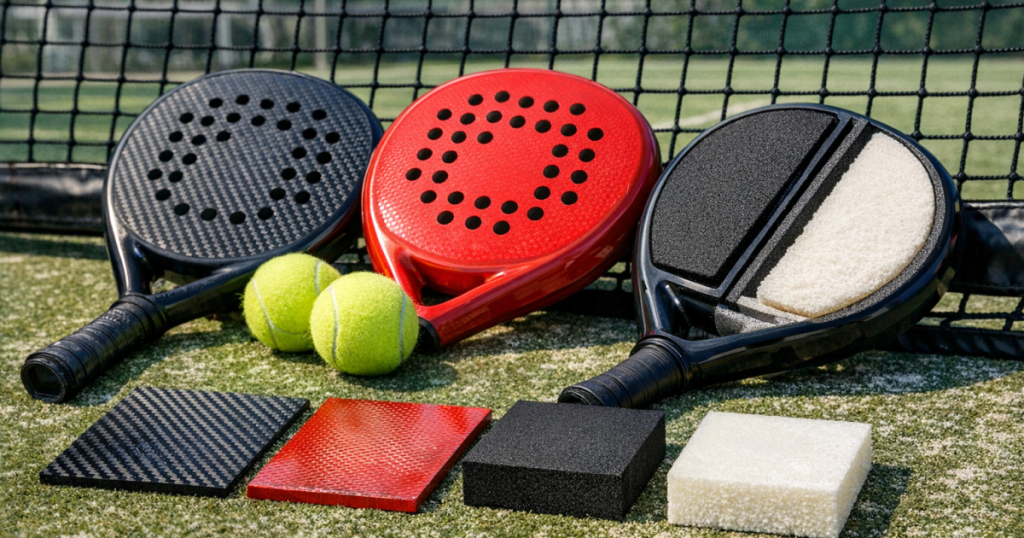
Most modern padel rackets use carbon fibre, fibreglass, or a composite mix in the frame. Carbon fibre is valued because it can provide stiffness and strength without making the racket excessively bulky. Fibreglass is usually more flexible, which can make a racket feel friendlier when you are still developing your swing.
A beginner does not need to obsess over the frame material alone. A carbon frame with a soft face and forgiving core can still feel approachable, while a very stiff overall build can feel harsh even if the marketing sounds premium. The full construction matters more than one material name on the specification list.
The hitting face: where feel really shows up
The face is the part of the racket that contacts the ball. It has a major influence on touch, rebound and how much feedback you feel through your hand.
Fibreglass faces
Fibreglass is common in beginner and intermediate rackets because it tends to flex more on impact. That flex can help the ball come off the face with less effort, which is useful when you are learning volleys, blocks and controlled lobs. It can also make slight off-centre hits feel less punishing.
The trade-off is that fibreglass may feel less crisp than a firmer carbon face when you start hitting harder. For a new club player, that is usually not a problem. Early progress comes from keeping the ball in play, learning the walls and building consistent contact.
Carbon faces
Carbon fibre faces are often associated with a firmer, more precise response. Many improving players like that direct feel because it rewards clean timing and compact technique. Carbon can also appear in different weaves and layups, but the label on its own does not tell the whole story.
A carbon-faced racket can be excellent, but it is not automatically the best beginner choice. If the face and core feel too stiff, you may need more exact timing to get comfortable depth and control. If you are still working out the difference between a block, a punch volley and a full swing, a softer construction can be more forgiving.
Hybrid faces
Many rackets use a mix of fibres or layers to balance comfort and response. A hybrid build may aim to give some of the softness of fibreglass with some of the stability of carbon. For beginners moving into regular matches, this middle ground can make sense, provided the racket still feels easy to use.
Racket cores: EVA, foam and why firmness matters
The core sits inside the racket and is usually the part beginners notice most once they hit a few balls. It affects rebound, comfort, control and how much help the racket gives you when you are not swinging aggressively.
Soft EVA
Soft EVA generally feels more forgiving and can help the ball rebound with less effort. This is useful for beginners because many early shots are compact: blocks at the net, controlled returns, simple volleys and defensive shots after the glass. A softer core can make these shots feel less demanding.
The possible downside is that a very soft core may feel less stable when you swing hard. As you improve, you may prefer a slightly firmer feel for more predictable response on faster shots.
Medium EVA
Medium EVA is a common all-round choice. It can offer a useful balance of comfort, control and firmness without feeling too specialised. Many early-stage club players settle well with a medium-feel racket because it supports steady improvement rather than pushing them into one playing style too soon.
Hard EVA
Hard EVA can feel precise and solid, but it normally asks more from the player. You may need cleaner contact and better timing to get the most from it. For a beginner, that can mean more mishits, less depth on defensive shots, and a less relaxed swing.
Foam or polyethylene-style cores
Foam-style cores often feel soft, elastic and comfortable. They can be friendly for slower swings and touch shots. Some players enjoy the extra rebound; others find it harder to judge pace when they start hitting faster. As with EVA, the exact feel depends on the racket design, not just the core label.
How materials affect common beginner shots
Materials become easier to understand when you connect them to real shots rather than spec sheets.
- Serve: a forgiving face can help you place the ball consistently while you learn spin, depth and legal contact height.
- Return of serve: a softer or medium core can make compact blocks feel easier when the ball comes in quickly.
- Volley: a stable but not overly stiff face helps you guide the ball without swinging too much.
- Lob: a forgiving sweet spot helps when you contact the ball slightly low or late.
- Wall defence: softer-feeling rackets can help you absorb pace and lift the ball back into play.
- Smash: firmer carbon builds may reward advanced technique, but most beginners benefit more from control and placement first.
Once you understand padel racket materials in this practical way, the aim is not to find the most advanced construction. It is to find a racket that lets you repeat good contact under normal club-match pressure.
Material is only one part of the feel
Two rackets with similar materials can feel completely different. Shape, weight, balance, thickness, hole pattern, surface texture and sweet spot position all interact with the face and core. A soft core in a head-heavy diamond racket may still feel demanding, while a medium core in a round racket may feel much easier to control.
If you are new to those terms, it is worth reading our guide to racket shape, weight and balance alongside this one. Materials explain the feel of impact; shape and balance explain how easy the racket is to move and time.
Surface texture and spin
Some rackets have smooth faces, while others use a rough or textured finish. Texture can help the ball grip the face slightly, which may support spin when your technique is good. It is not a shortcut to heavy spin, and it should not be the main reason a beginner chooses a racket.
Spin in padel comes from footwork, racket path, contact point and decision-making. A textured surface can be a nice extra, but a comfortable shape and forgiving core will usually matter more during your first months of play.
Beginner-friendly combinations
You do not need to memorise every construction type. These broad combinations are a useful starting point:
- Most forgiving: fibreglass face, soft or medium core, round shape and even balance.
- Balanced progression: hybrid face, medium EVA core and round or teardrop shape.
- More demanding: firm carbon face, hard core and higher balance.
- Power-focused: stiff construction, smaller effective sweet spot and more weight towards the head.
For a first racket, the first two combinations are usually the safer lane. They support cleaner technique, better defensive play and more confidence in longer rallies.
If you are torn between a soft control feel and a more attacking setup, our guide on whether beginners should choose a control or power padel racket explains the trade-off in more detail.
What to check before trusting the spec sheet
Product descriptions can be helpful, but they are not perfect. Different brands use different names for similar ideas, and terms such as soft, medium and hard are not always measured in the same way.
- Check the full construction: look at face, core, shape and balance together, not as separate promises.
- Notice the sweet spot: beginners usually benefit from a larger, central sweet spot.
- Think about your swing speed: slower, compact swings often suit softer or medium-feel rackets.
- Be realistic about your level: a professional-style power racket can slow progress if it punishes small timing errors.
- Test if possible: a short hit at a club can tell you more than a long specification list.
- Watch for comfort: a racket that feels harsh or awkward is unlikely to help you relax and learn.
Reviews can also help when they describe feel, control and forgiveness in plain language. For example, our Wilson Blade Padel Racket review looks at how a real racket behaves for improving club players rather than only listing materials.
Care and durability basics
Racket materials are tough enough for normal play, but they are not indestructible. Avoid hitting the glass, fence, floor or your partner’s racket. Small chips around the frame are common, but cracks through the face or frame can change the feel and weaken the racket.
In the UK, many players move between indoor centres and outdoor courts. Try to keep your racket dry, avoid leaving it in a cold car boot for long periods, and do not dry it on a radiator. A simple racket cover or padel bag helps protect it from knocks and damp kit.
The big picture
For beginners, racket construction should make the game easier to learn, not more complicated. Fibreglass and softer cores usually favour comfort and forgiveness. Carbon and harder cores usually favour firmness and precision. Hybrid builds can sit neatly between the two.
The best early choice is normally a racket that feels easy to swing, has a generous sweet spot, and gives you confidence on serves, returns, volleys and wall shots. Start with control and comfort, then move towards firmer or more powerful constructions as your timing, footwork and match confidence improve.