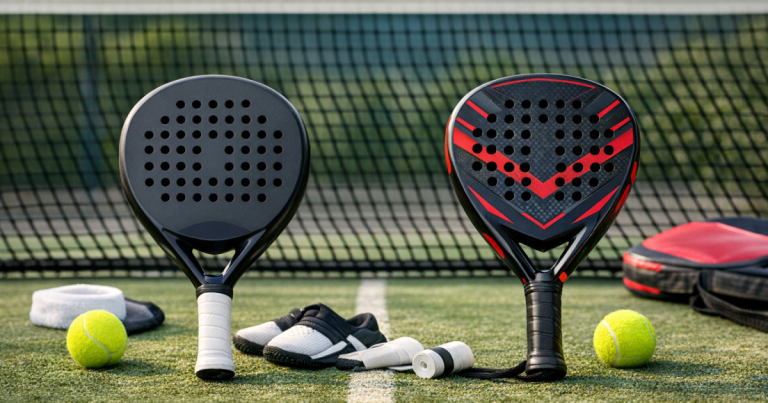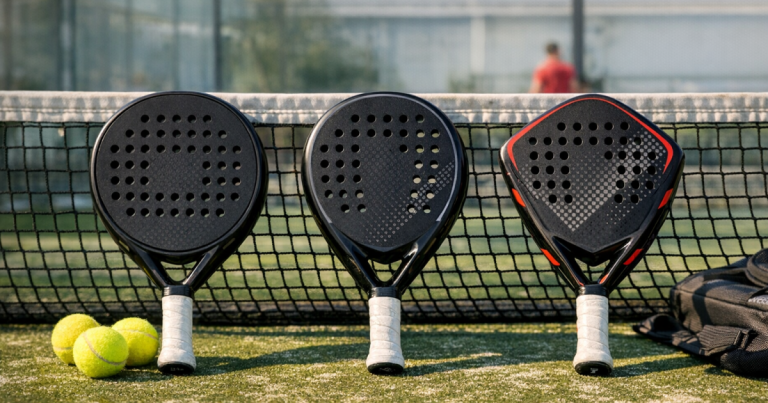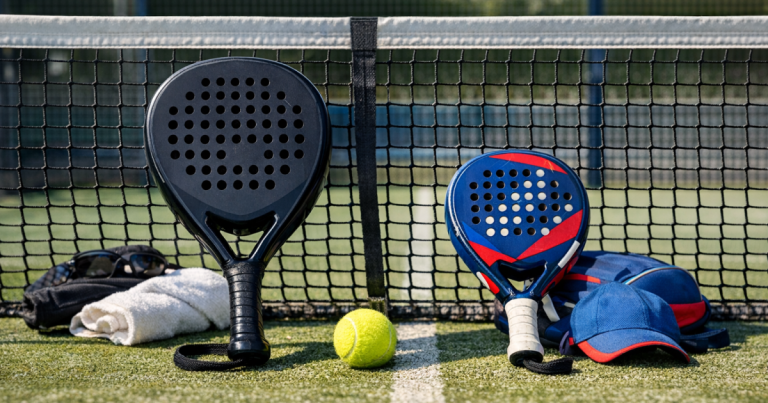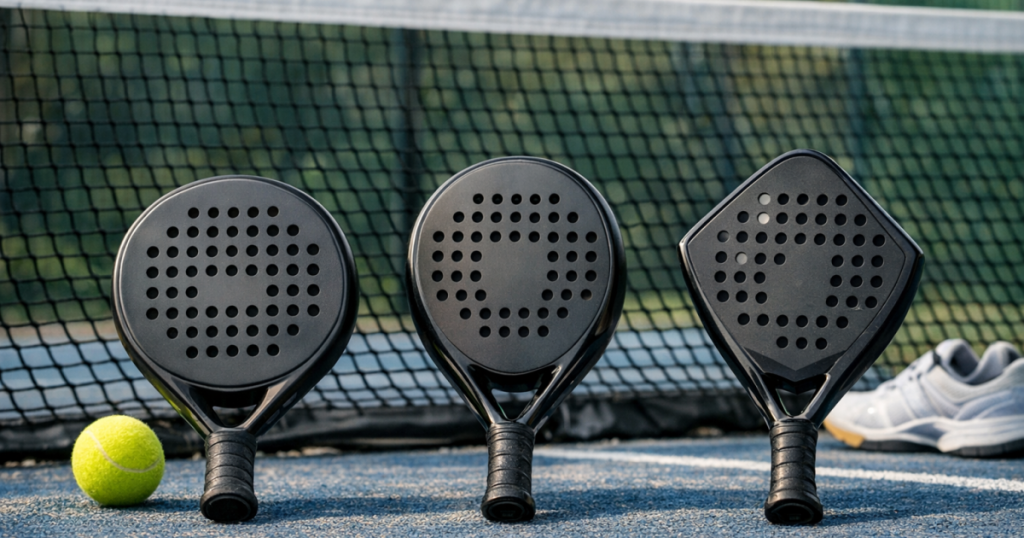
Choosing between padel racket shapes can feel oddly technical when you have only just started playing, but the idea is simple: the shape changes where the sweet spot sits, how the racket balances in your hand, and how forgiving it feels when you miss the middle.
For a new or early-stage player, that matters more than marketing language about power. Most points at club level are not won by smashing harder; they are won by getting one more ball back, defending the glass calmly, and making fewer rushed errors under pressure.
The shape is not the only thing that affects how a racket plays. Weight, balance, face material, core firmness and grip setup all matter too. But shape is one of the easiest clues to understand before you pick up a demo racket or read a product description online.
The short version
- Round rackets usually feel the most forgiving because the sweet spot tends to sit closer to the centre of the face.
- Teardrop rackets aim for a middle ground, giving a bit more attacking help without becoming too demanding.
- Diamond rackets tend to favour power, with a higher sweet spot and balance that can feel harder to manage for beginners.
- Beginners are usually better starting round or forgiving teardrop, then moving towards more aggressive shapes once timing and technique improve.
- Shape should be judged alongside feel, because a soft diamond may still feel easier than a stiff, heavy teardrop.
How padel racket shapes affect the way a racket feels
A padel racket has no strings, so the face, core and frame all influence the way the ball comes off the racket. Shape affects two big things: the sweet spot and the balance point.
The sweet spot is the area of the racket face where contact feels cleanest and most controlled. When you hit near it, the ball leaves the racket more predictably. When you miss it, you may feel twisting in the hand, loss of direction or a weak ball that sits up for the opponents.
Balance is where the racket’s weight feels concentrated. A lower balance can make the racket easier to manoeuvre in quick exchanges. A higher balance can help generate pace when you have time to swing, but it can also feel slower when defending fast balls at the net or reacting off the glass.
This is why two rackets with similar overall weight can feel very different. One may feel quick and comfortable in your hand, while another feels heavier at the head even if the listed weight is similar.
Round rackets: the friendliest starting point
Round rackets are usually the easiest shape for beginners to understand and enjoy. The sweet spot tends to be central and generous, which helps when your contact point is not yet consistent. That makes them useful for learning basic volleys, lobs, bandejas and defensive shots after the ball comes off the glass.
A round racket often feels easier to move because the balance is commonly lower or more neutral. That can make a real difference in early club play, where points are full of late reactions, awkward blocks and balls hit at your feet.
The main trade-off is that round rackets may not feel as naturally powerful as more attacking shapes. But for most newcomers, that is not a problem. Control gives you more time to develop good habits. If you are still learning where to stand, when to let the ball hit the glass, and how to keep the ball low, forgiveness is usually more valuable than extra punch.
A round racket is especially sensible if you are taking your first few lessons, joining open sessions, or coming from tennis and finding that padel rewards shorter, calmer swings. If the wider game still feels new, start with the shape that gives you the largest margin for error.
Teardrop rackets: the balanced middle ground
Teardrop rackets sit between round and diamond designs. They usually offer a slightly higher sweet spot than round rackets, with a balance that may feel more attack-minded without being extreme. For many improving players, this is where padel starts to feel more dynamic.
The appeal is clear: you can get a bit more help on overheads and aggressive volleys while still keeping reasonable control in defence. A teardrop shape can suit players who are past the very first stage, know how to prepare early, and want a racket that will not feel too basic as their game develops.
That does not mean every teardrop racket is beginner-friendly. Some are firm, head-heavy or designed for players who already hit cleanly. Others are much more forgiving. If you are unsure, pay attention to how the racket behaves when you miss the centre, not just how good it feels on one clean smash.
If you are also trying to understand how the face and core affect comfort, the separate guide to soft vs hard padel rackets is a useful next step. Shape gives you the outline; firmness changes the feel in your hand.
Diamond rackets: powerful, but less forgiving
Diamond rackets are normally aimed at players who want more power and are comfortable striking the ball higher on the face. The balance often feels higher, which can help create leverage on overheads, viboras and attacking shots when your timing is good.
The challenge is that diamond shapes tend to be less forgiving. The sweet spot is commonly higher and smaller, so mishits are more noticeable. In a match, that can show up as framed volleys, defensive blocks floating high, or rushed shots that pull wide when you are late.
For a beginner, the risk is not just making errors. A demanding racket can encourage bigger swings to compensate, which often makes timing worse. Padel is not a game where every ball should be attacked. If the racket makes you feel as if you need to force the point, it may slow your progress.
That said, diamond rackets are not “bad” for all developing players. A physically strong player with good racket-sport background may adapt quickly, especially with coaching. But if your priority is longer rallies, cleaner contact and confidence in regular club games, diamond is usually a shape to approach later rather than first.
Why shape alone does not tell the whole story
Racket labels can be helpful, but they are not a perfect prediction. Two round rackets can feel completely different if one is soft and light while the other is firm and head-heavy. A teardrop racket with a forgiving core may feel easier than a round racket that is too heavy for you.
For beginners, the most useful test is simple: can you defend comfortably and reset the point when you are under pressure? A racket that only feels good when you strike perfectly in the warm-up may not help once the game speeds up.
Try to notice these details when testing a racket:
- Off-centre hits: does the racket still send the ball roughly where you intended?
- Net reactions: can you move it quickly for blocks and short volleys?
- Glass defence: does it feel stable when you are late or stretched?
- Overheads: do you get useful control, not just extra speed?
- Comfort over a full session: does it still feel manageable after an hour of play?
If you are looking at real models and want to see how shape, feel and intended level can influence a decision, the comparison of the Babolat Viper Carbon and Head Graphene 360+ Alpha Elite shows why the headline shape is only part of the story.
Which shape makes most sense for beginners?
Most complete newcomers should start with a round racket or a forgiving teardrop racket. The aim is not to buy the most advanced shape you can handle for ten minutes; it is to use something that helps you learn repeatable shots over weeks of practice and match play.
Choose round if you want the safest route into the sport. It is the shape most likely to help with consistency, defensive confidence and relaxed technique. It is also a good choice if you are still borrowing rackets, playing once a week, or learning the rules and court positioning.
Choose teardrop if you already feel fairly comfortable in rallies and want a little more attacking support without jumping straight to a demanding racket. This can be a sensible second racket shape once you know your basic game style.
Be cautious with diamond if you are still struggling to control depth, defend the back corners or keep volleys low. The extra power can be tempting, but it will not fix timing, footwork or decision-making. In many beginner matches, a calmer racket wins more points than a more explosive one.
Common myths about racket shape
“Diamond is only for advanced players”
Not always, but it is usually less forgiving. A player with good timing from another racket sport might manage one earlier than expected. For most beginners, though, it adds difficulty before the fundamentals are secure.
“Round rackets are only for defensive players”
No. A round racket can still attack well if your technique is sound. It simply gives more margin when you are learning. Many club points are won through placement, patience and low error count rather than raw power.
“Teardrop is automatically the best compromise”
Teardrop is a useful middle ground, but not automatically the right answer. A firm, high-balance teardrop can still feel too demanding, while a softer one may be ideal for an improving player.
“A powerful racket will improve my smash”
Only up to a point. Smash quality comes from positioning, timing, contact point and shot choice. A racket can support those things, but it cannot replace them.
Helpful questions
Should my first padel racket be round?
For most beginners, yes. A round racket usually gives the easiest blend of control, forgiveness and manoeuvrability, which helps while you are still building technique.
When should I move from round to teardrop?
Consider teardrop when you can rally consistently, defend the glass with some confidence, and want more help on attacking shots without losing too much control.
Is a diamond racket too hard for club nights?
It depends on your level. If you often miss the centre or feel rushed at the net, diamond will probably make club nights harder. If your timing is reliable, it may feel rewarding.
Does racket shape matter more than weight?
No. Shape, weight, balance and firmness work together. A shape that looks suitable on paper can still feel wrong if the racket is too heavy or too firm for you.
Can I learn with a borrowed racket first?
Yes, and it is a good idea. Borrowing or hiring for a few sessions helps you notice whether you prefer a forgiving round feel or a slightly more attacking teardrop shape.
Key takeaways
Round, teardrop and diamond rackets are best understood as different levels of forgiveness and attacking help. Round shapes usually support control and confidence. Teardrop shapes offer a useful bridge as your game improves. Diamond shapes can add power, but they ask more from your timing and technique.
If you are still early in your padel journey, do not rush towards the most powerful option. Pick the shape that helps you keep the ball in play, learn the court and enjoy longer rallies. For a broader starting point beyond rackets, the guide on how to start playing padel as a complete newcomer covers the next steps into lessons, sessions and regular club play.