Resistance bands are worth considering for padel warm-up drills if you use them for activation, not as a workout. For beginners, the main value is getting the shoulders, hips and legs ready for short bursts, quick changes of direction and controlled racket swings before you step fully into points.
They are not magic, and they should not replace gentle movement, court awareness or hitting practice. A band can help you feel prepared, but a good warm-up still needs to look like padel: small steps, split steps, turns, reaches and relaxed swings.
Pain-related rehabilitation, injury diagnosis and return-to-play decisions should be handled by a qualified physiotherapist or healthcare professional in line with UK clinical standards and relevant safeguarding requirements.
What to know first
- Use a light or medium band, not the strongest one you can find.
- Keep the band section short: usually 3 to 6 minutes is plenty before a casual match or coaching session.
- Focus on smooth control, not fatigue. You should feel more ready afterwards, not tired.
- Prioritise shoulders, upper back, hips, glutes and ankles because these areas help with turning, reaching and recovering.
- Finish with padel movements without the band so your body is ready for the court rather than just the exercise.
Why bands can help before padel
Padel looks gentle at first because the court is smaller than a tennis court, but beginner rallies can still be awkward on the body. You might lunge late for a low ball, twist towards the glass, reach high for a lob, or stop suddenly after chasing a rebound. Bands can wake up the muscles that support those actions.
The biggest benefit is activation. A light band gives your shoulders and hips a small amount of resistance, which encourages the supporting muscles to switch on before you ask them to work at match speed. This can be useful if you have spent the day sitting at a desk, driving to the club, or standing around in cool weather before your booking starts.
Bands also make warm-ups more deliberate. Instead of doing a few random arm circles and hoping for the best, you can follow a short routine that prepares the movements you are about to use. If you are still learning the layout of the court, it also helps to understand the basics of court lines, walls and player positions, because your warm-up should reflect where you will actually move during rallies.
A simple 8-minute band routine before play
This routine is designed for beginners warming up before a club game, lesson or social match. Keep the tension light enough that you can move smoothly and breathe normally throughout.
Step 1: Check the band and your space
Before you start, look for splits, thinning, tacky patches or small tears in the band. If it looks damaged, do not use it. Stand at least 1 to 2 metres away from other players, bags, benches and fencing so the band cannot flick into anyone if it slips.
Hold the band with a relaxed grip. Avoid wrapping it tightly around your hand, as that can make it harder to release if it catches or pulls unexpectedly.
Step 2: Wake up the shoulders and upper back
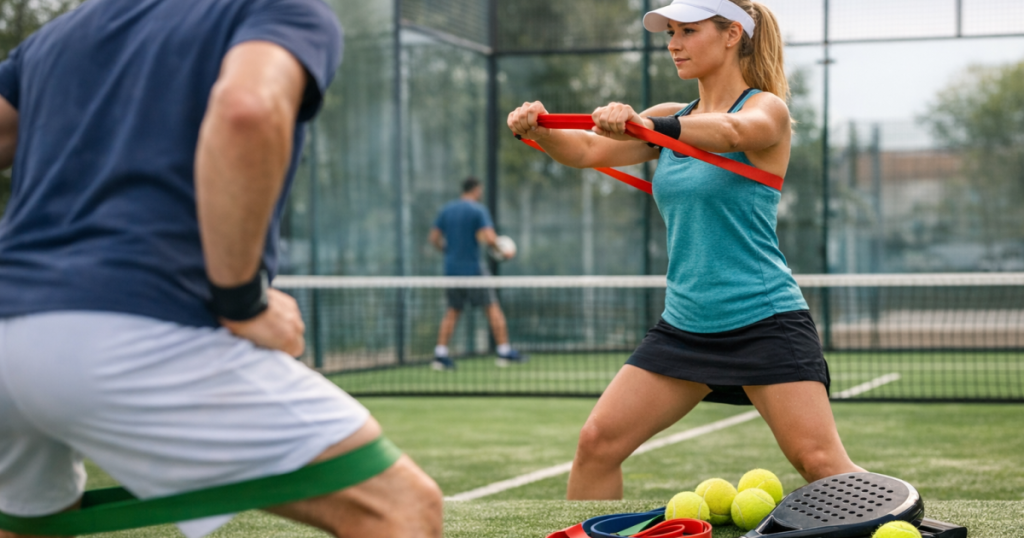
Stand tall and hold the band in front of your chest with both hands. Pull it gently apart until your shoulder blades move towards each other, then return with control. Do 8 to 12 slow repetitions.
Next, keep your elbows close to your sides and rotate your forearms outwards against the band. This is a small movement, not a big stretch. Do 8 to 10 repetitions. You are preparing the shoulder for volleys, overheads and controlled forehands, not trying to build strength five minutes before a match.
Step 3: Switch on hips and glutes
Place a small loop band above the knees or use a longer band carefully tied only if it sits securely. Take small sideways steps in one direction, then back the other way. Keep your knees soft and your feet facing forwards. Aim for 6 to 8 steps each way.
This helps with the low, balanced positions beginners need for volleys, returns and balls near the side glass. If your knees collapse inwards or your lower back starts working harder than your hips, reduce the resistance or remove the band.
Step 4: Add gentle split-step rhythm
With the band removed, bounce lightly on the balls of your feet and practise a small split step. Land softly, take two short adjustment steps, then reset. Repeat for about 30 seconds.
This matters because padel is full of tiny repositioning movements. Beginners often take one large step and then reach, but better balance usually comes from several smaller steps. The band prepares the muscles; this step turns that preparation into padel movement.
Step 5: Practise shadow turns for glass and corner balls
Without hitting a ball, turn your shoulders as if you are preparing for a forehand, then recover to a neutral ready position. Repeat on the backhand side. Keep the movement easy and controlled.
If you are learning rebounds, your warm-up should include turning rather than just swinging. The ball can come off the back or side glass, and your first job is often to move your feet and rotate calmly. For that skill, read more on using the glass walls in early matches.
Step 6: Finish with easy rallies or feeds
Once the band work is done, spend a few minutes hitting gently. Start with soft groundstrokes, then volleys, then a few lobs or overhead preparations if you have space and a partner. Keep the first balls slow enough that you can find timing without forcing the swing.
This final step is important. If you only use the band and then go straight into competitive points, your muscles may be warmer but your timing will still be cold.
When bands are genuinely useful
- Before early morning or evening bookings: cooler conditions can make players feel stiff, especially on outdoor courts in Britain.
- After sitting for long periods: a short hip and shoulder routine can help you feel less sluggish before the first game.
- Before coaching drills: if your session involves volleys, movement patterns or repeated feeds, a band can prepare the same areas you will use repeatedly.
- When you feel rushed: a simple routine gives structure when you only have a few minutes before stepping on court.
- For doubles positioning practice: activated hips and legs make it easier to stay low, move together and recover after each shot.
When to leave the band in your bag
Resistance bands are not always needed. If you are already warm from walking, cycling or a previous session, you may only need a short movement-based warm-up. They can also be unhelpful if you use too much resistance and tire your shoulders before serving or volleying.
Leave the band out if the court area is crowded, the band is damaged, or you feel discomfort during the movement. A warm-up should reduce stiffness and improve control. It should not create sharp pain, pinching, numbness or fatigue.
Also avoid copying intense gym-style band circuits before a match. Padel rewards quick reactions and relaxed hands. If your arms feel heavy before the first service game, the warm-up has become too much.
Common beginner mistakes
- Using the band like a strength session: save hard resistance work for separate training, not the minutes before a match.
- Skipping footwork: shoulder activation helps, but padel warm-ups must include steps, turns and recovery positions.
- Holding the breath: if you cannot breathe normally, the movement is probably too hard for a warm-up.
- Doing too many reps: one controlled set is often enough. More is not automatically better.
- Ignoring footwear: bands can prepare your muscles, but grip and support still matter on court. If you are unsure what a starter pair should feel like, our review of starter padel shoes explains the basics.
How to tell if your routine is working
A good band warm-up should make your first few points feel calmer. You should notice that your feet move earlier, your shoulders feel freer, and your first volleys are easier to control. You should not feel pumped, shaky or short of breath.
Use this quick check before starting a match:
- Can you turn both ways comfortably?
- Can you drop into a low ready position without feeling stiff?
- Can you take three short steps and stop under control?
- Can you swing gently without tightness in the shoulder or elbow?
- Do you feel alert rather than tired?
If the answer is yes, your warm-up has probably done its job. If not, simplify it. Walk, jog lightly, do some gentle mobility work, then build back towards hitting.
What people usually ask
Should beginners use resistance bands before every padel session?
Not necessarily. They are useful when you feel stiff, cold or underprepared, but they are optional. Many beginners do well with a short routine that combines light movement, a few band exercises and easy hitting.
How strong should the band be?
Use the lightest resistance that lets you feel the target muscles working without strain. If the band changes your posture, makes you grimace, or slows the movement too much, it is too strong for a pre-match routine.
Can resistance bands replace stretching?
They can replace some static stretching before play, but not all mobility work. Before padel, dynamic movement is usually more useful than long held stretches. Save deeper flexibility work for after play or separate sessions if it suits your body.
How long should padel warm-up drills take with bands?
For most beginners, 8 to 12 minutes in total is enough: a few minutes of general movement, 3 to 6 minutes with the band, then gentle hitting. The aim is readiness, not exhaustion.
What to remember
Resistance bands are worth using for padel warm-ups when they stay light, short and connected to the way you actually move on court. Think of them as a preparation tool: wake up the shoulders, hips and legs, then move without the band and finish with easy rallies.
If you are new to club play, the best routine is the one you can repeat confidently before each session. Keep it simple, listen to how your body feels, and make sure your final few minutes look and feel like padel rather than a gym circuit.