
Trying to organise a friendly padel club night through scattered messages can turn a simple evening into a queue of maybes, drop-outs and last-minute confusion. This Spond App review looks at whether it genuinely helps beginner and mixed-level padel groups keep sessions tidy, fair and easy to join.
Quick verdict: Spond is useful when a club night has a regular organiser, clear session rules and enough players to make attendance tracking worthwhile. It is less impressive if your group only plays casually with the same four people every week, or if nobody wants to keep the event details up to date.
Product overview
Spond is a group organisation app used by sports teams, clubs and community groups to manage events, availability and communication. For padel, its main appeal is simple: it can give a club night one place for session invites, responses, updates and organiser messages, instead of relying entirely on a fast-moving WhatsApp chat.
That matters because padel club nights are often more complicated than they look. You may have 12 players across three courts, a mix of beginners and improving players, reserves waiting for a space, and people arriving after work. A good organiser needs to know who is coming, who is likely to drop out, and whether the standard will feel welcoming rather than chaotic.
Spond does not magically create a well-run club night. It gives organisers a cleaner structure. The quality still depends on how clearly the club explains sign-up deadlines, cancellation etiquette, court allocation and level expectations. If you are still choosing where to play regularly, our guide to choosing your first padel club is a helpful next read alongside any app setup.
For early-stage players, the biggest benefit is confidence. You can see the event, respond clearly, receive updates and avoid feeling like you have missed a key message buried in a group chat. For organisers, it can reduce repeated admin questions and make attendance easier to scan before the session starts.
Key specs
- Product reviewed: Spond App
- Product type: Group and sports club organisation app
- Best padel use case: Club nights, coaching groups, socials, ladders and recurring beginner sessions
- Core functions to verify: Event invitations, attendance responses, group messaging, notifications, member management and any payment-related options your club plans to use
- Access: Check current availability on your device’s app store and through Spond’s own website
- Cost: Verify current pricing, payment handling and organiser features directly with Spond before relying on it for a club or paid session
- Important setup point: The organiser still needs to define session rules, player levels, cancellation cut-offs and reserve-list handling
Pros and cons
Pros
- Clearer attendance: Players can respond to an event rather than posting vague messages in a busy chat.
- Good for recurring sessions: Regular club nights are easier to manage when each date has its own invite and update trail.
- Helps newer players know what is happening: Beginners can see details in one place instead of asking the same questions repeatedly.
- Less message clutter: Organiser updates are easier to separate from general social chat.
- Useful for reserves: A structured attendance list makes it easier to see when spaces open up, provided the organiser manages this fairly.
Cons
- Only as good as the organiser: If events are not updated, players will still end up chasing information elsewhere.
- Another app to check: Some players may ignore notifications or prefer existing messaging habits.
- Needs clear etiquette: Spond can show who has replied, but it cannot make players cancel responsibly or arrive on time.
- May feel unnecessary for small groups: A regular group of four or six friends may not need a dedicated platform.
- Feature details can change: Clubs should verify current limits, payment tools, privacy settings and admin permissions before committing.
Performance in real use
For padel club nights, Spond’s strongest real-world use is attendance visibility. A typical beginner-friendly session often depends on numbers being right: too few players and courts are wasted; too many and people sit around for long stretches. A structured event page makes it easier for organisers to spot gaps before the evening, rather than discovering them at the club.
It also helps when players are new to club culture. Beginners are often unsure whether “interested” counts as attending, whether they can bring a friend, or how late is too late to cancel. With Spond, the organiser can write these expectations into the event notes, then point everyone to the same place. That makes the session feel more organised without making it formal or unfriendly.
Where it works best is in a club night with light but firm rules. For example, the event description might state the standard, start time, court rotation format, cancellation cut-off and whether reserves will be invited in order. That is not Spond doing the etiquette work; it is Spond giving the etiquette somewhere visible to live. If you are preparing for your first organised game, the padel rules cheat sheet for a first club match can help you arrive with fewer basic uncertainties.
The messaging side is useful, but it needs discipline. If every player uses the event comments for jokes, side conversations and unrelated questions, the practical updates get lost again. The best setup is to keep essential session details in the event information and use comments only for relevant changes, such as running late, giving up a place or confirming a reserve spot.
For mixed-level padel groups, Spond can support better matching, but only indirectly. It will not judge someone’s level for you. Organisers still need to describe the session honestly: beginner social, improver matchplay, mixed-level rotation or competitive club night. That small wording choice makes a big difference. A beginner who turns up to an intense matchplay session by accident is unlikely to enjoy it, and stronger players may feel equally frustrated if the night has been mislabelled.
Drop-outs are the biggest test. A useful club-night tool should make it easy for players to say they can no longer attend and for organisers to fill the place. Spond can make this cleaner than a group chat, but only if the club has a habit of checking responses before the session. If nobody monitors attendance after the invite goes out, the benefit drops quickly.
For privacy and admin, clubs should take a careful look before rolling it out widely. Check what contact details members can see, who can send group messages, how younger players are handled if relevant, and what happens when someone leaves the club. These are not reasons to avoid Spond, but they are sensible checks for any organised sports group in the UK.
Who it’s best for / who should skip it
Spond is best for padel clubs, coaches and regular organisers who run repeat sessions with changing attendance. It suits beginner club nights particularly well because it reduces uncertainty: players know where to respond, where to look for updates and what the session is meant to be.
It is also useful for groups that have grown beyond a single chat. Once you have multiple courts, a reserve list or different levels attending different evenings, a dedicated event structure starts to feel worthwhile. The app gives the organiser a clearer picture before making court, pairing or rotation decisions.
You should probably skip it if your padel is very informal. If the same four friends book one court every Thursday and already communicate smoothly, Spond may be more admin than benefit. It may also be a poor fit if your group refuses to use a separate app consistently. Half-adoption is frustrating: some players reply in Spond, others reply by text, and the organiser still has to reconcile everything manually.
For clubs, the question is not simply “Is Spond good?” It is “Will our players actually use it, and will our organiser maintain it?” If the answer to both is yes, it can make club nights feel calmer and more reliable.
Alternatives
The obvious alternative is WhatsApp, which many UK padel groups already use. It is familiar, quick and excellent for informal conversation. Its weakness is structure: attendance, reserves and key updates can easily disappear among unrelated messages. WhatsApp works best for small groups or as a companion chat, not as the only system for a busy club night.
TeamUp is another name some sports and fitness organisers consider, particularly where booking, classes or paid sessions are part of the setup. It may be more than a casual padel group needs, so clubs should compare the current features, pricing and admin workload carefully before switching.
ClubSpark may also appear in the conversation for racket sports venues and clubs. Whether it is suitable depends heavily on how the venue already manages bookings, memberships and communications. For a simple beginner social night, Spond may feel lighter; for a venue-wide operation, the right choice depends on existing systems.
Questions people ask
Is Spond better than WhatsApp for padel club nights?
For attendance and event details, usually yes. For casual chat, WhatsApp is often easier. Many groups may find the best setup is Spond for session organisation and a separate chat for social messages.
Can beginners use Spond without feeling overwhelmed?
Yes, if the organiser keeps the event notes simple. Beginners mainly need the time, venue, level, cost if relevant, cancellation expectations and what to bring.
Does Spond decide player pairings or court rotations?
Do not assume it will handle that for your group. Treat Spond as an organisation tool, then use a clear rotation plan at the club night itself.
Should a padel coach use Spond for lesson groups?
It can help with recurring group lessons, attendance and updates. Coaches should verify current payment, privacy and admin features before using it as part of a paid coaching setup.
What should organisers write in a padel event invite?
Include start time, finish time, venue, player level, number of spaces, cancellation cut-off, reserve process and any etiquette points such as arriving warmed up and ready to rotate.
Verdict + score
Spond is a sensible, practical tool for padel club nights that have outgrown loose group chats. It is strongest for RSVPs, recurring events and organiser clarity, and it can make beginner-friendly sessions feel more welcoming because expectations are easier to find. It will not fix poor etiquette, unclear levels or passive organising, so the club still needs firm habits around cancellations, reserves and session descriptions. For regular UK padel groups with changing numbers, it earns a confident 8.1/10.
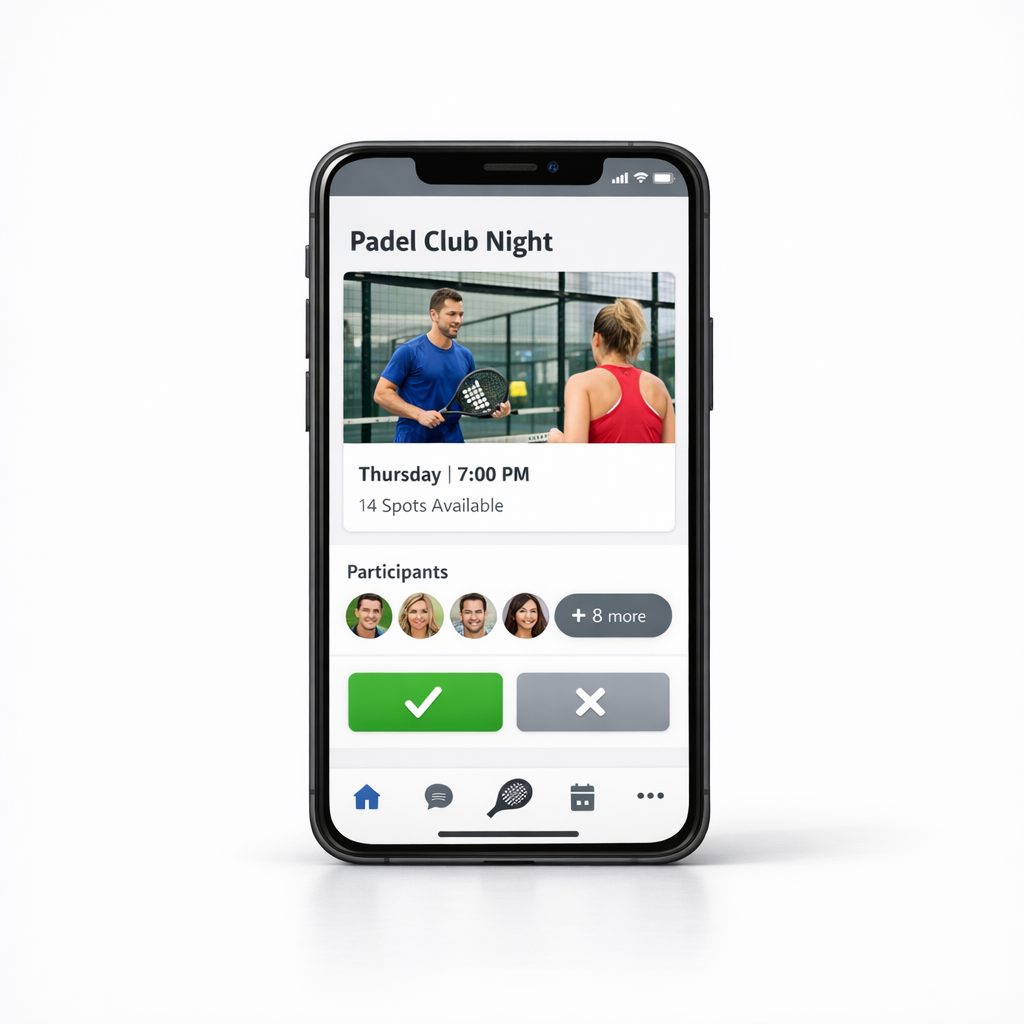
Spond App
Trusted resour cesHelpful external resources related to this topic.British Padel — associationPadel Magazine — mediaSport England — government agency You might also like: Padel Equipment Costs: What to Spend and What to Skip.
You might also like: Padel Equipment Costs: What to Spend and What to Skip.