Your padel racket grip controls how securely the racket sits in your hand, how relaxed your swing feels, and how easily you can adjust between forehands, backhands, volleys and bandejas. For beginners, it is one of the cheapest and simplest setup details to get right, but it is also one of the easiest to ignore until the handle feels slippery, bulky or awkward.
The good news is that padel handles are not complicated. You usually start with the factory handle and then adjust the feel with overgrips. A sensible setup should let you hold the racket firmly without squeezing, change grip positions quickly, and finish a match without feeling as if the handle is fighting you.
Main points
- Most padel rackets come with a fairly standard handle size, so players usually fine-tune thickness with one or more overgrips.
- A grip that is too thin can make you squeeze harder and lose stability on off-centre hits.
- A grip that is too thick can make wrist movement, quick reactions and grip changes feel clumsy.
- Overgrips add feel, absorb sweat, improve tackiness and allow small handle-size adjustments.
- Beginners should aim for comfort and control before chasing a specialist feel used by advanced players.
Why the handle matters more than beginners expect
When people first choose a racket, they tend to focus on shape, weight and power. Those things matter, but the handle is where all of that design meets your hand. If the handle feels wrong, even a forgiving racket can feel unstable.
A poor grip setup often shows up in simple ways: the racket twists when you block a volley, your hand slides during a smash, or you feel as if you need to squeeze tightly to keep control. That extra tension can make your swing shorter and less relaxed. In padel, where touch, angle and quick preparation matter, a calm hand is a real advantage.
If you are still working out whether to borrow, hire or buy your first racket, it is worth reading renting vs buying padel gear for your first matches. Rental rackets can be perfectly fine for early sessions, but the handle may feel worn, shiny or too thin, so do not judge the whole sport by one tired grip.
Padel handle size is usually adjusted, not selected
In tennis, players often talk about choosing a specific grip size. Padel is different. Many rackets are sold with a relatively slim, standard-feeling handle, and players build up the thickness with overgrips. That is why two people can use the same racket model and have very different handle feels.
This also explains why beginner racket advice can feel confusing. You may see experienced players using two or three overgrips, while another player uses only one very thin wrap. Neither approach is automatically correct. The right setup depends on hand size, sweat level, playing style, and how much wrist freedom you like.
A good padel racket grip should feel secure without becoming a clenched fist. As a rough comfort check, hold the racket in your normal forehand position and gently move it through a few shadow swings. The handle should not wobble around in your hand, but your fingers should not feel stretched open either. If your forearm tenses immediately, the setup probably needs adjusting.
What an overgrip actually does
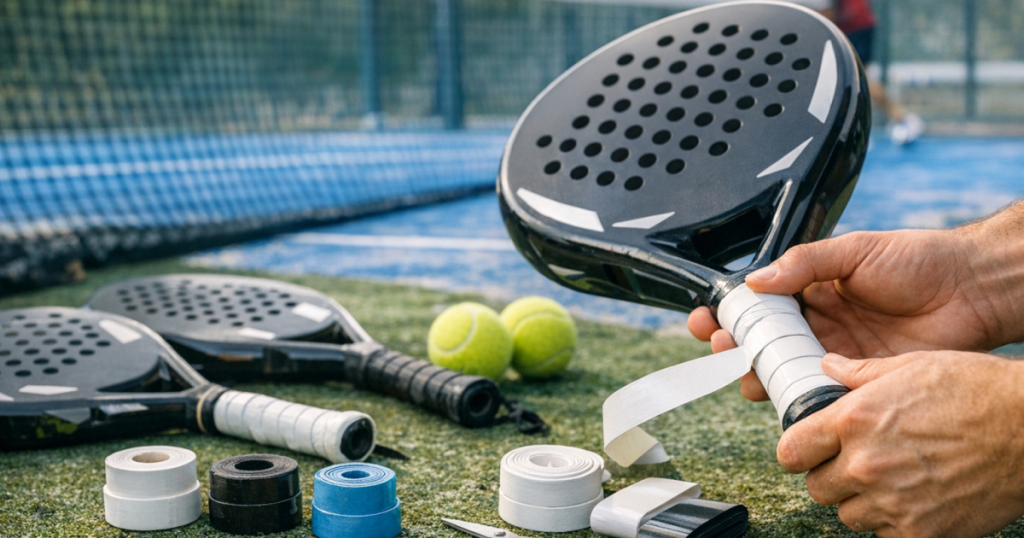
An overgrip is a thin wrap placed over the existing grip on the handle. It is not there just for looks. It changes the way the handle feels in four practical ways.
- Thickness: each wrap slightly increases the handle size, which can help if the racket feels too narrow or twisty.
- Texture: some overgrips feel tacky and sticky, while others feel drier and softer.
- Sweat control: an absorbent wrap can help the handle stay usable during longer games or warm indoor sessions.
- Freshness: a new overgrip can make an older racket feel cleaner and more predictable without changing the racket itself.
The overgrip sits above the base grip. If the original grip underneath is damaged, uneven or moving around, adding another layer may only hide the problem for a short time. In that case, replacing the base grip or asking a club shop to rewrap it neatly can make more sense.
Thin, medium or thick: what each feel changes
A thinner handle
A thinner handle can make the racket feel lively in the hand. Some players like it because it allows quick wrist movement and fast changes at the net. For a beginner, though, too thin can mean the racket twists when you meet the ball late or away from the sweet spot.
You may prefer a thinner setup if you have smaller hands, like a loose feel, and do not struggle with slipping. But if you keep tightening your grip during rallies, it may be a sign that the handle needs slightly more build-up.
A medium-feeling handle
Most newer players should start here. A medium-feeling handle means you can hold the racket securely while still moving your wrist and fingers freely. Usually this means the factory grip plus one fresh overgrip, though the exact feel depends on the racket and the wrap used.
This setup keeps things simple while you learn timing, court positioning and control. It also gives you a fair baseline: if the racket still feels unstable, you can add another wrap later rather than making a big change straight away.
A thicker handle
A thicker handle can feel solid and reduce twisting, especially for players with larger hands. It may also suit someone who dislikes a very wristy swing and wants a steadier contact feel. The trade-off is that too much thickness can make it harder to adjust quickly during fast exchanges.
If you add a second or third overgrip, check how the racket feels in volleys, lobs and low defensive shots, not just in warm-up swings. A handle can feel comfortable in your hand but still be too bulky when the ball comes quickly.
How to spot a grip setup that is not working
Grip issues are usually easy to feel once you know the signs. They are not always caused by the racket itself; sometimes the handle wrap is simply worn out or badly fitted.
- The racket twists on contact: the handle may be too thin, too slippery or held with too much tension at the wrong moment.
- Your hand slides towards the end cap: the overgrip may be worn, damp, too smooth or not wrapped securely.
- Your wrist feels restricted: the handle may be too thick, or the overgrip may be bunched up unevenly.
- You keep changing your hold mid-rally: the handle may not be giving enough feedback, or you may not yet have a consistent basic grip.
- The wrap peels at the top: the finishing tape may be loose, or the overgrip may have been stretched and secured poorly.
If you are also trying to understand how handle feel interacts with the rest of the racket, the guide to racket shape, weight, balance and foam is a useful next step. A head-heavy racket with a slippery handle can feel much harder to control than the same racket with a secure grip.
A simple beginner setup process
Start with one fresh overgrip. Wrap it smoothly from the bottom of the handle upwards, overlapping each turn evenly. Keep enough tension to avoid wrinkles, but do not stretch it so hard that it becomes thin, shiny or uncomfortable.
Once fitted, test it in a real session rather than deciding in your living room. Warm-up swings are useful, but padel exposes grip problems when you block a fast volley, scoop a low ball off the glass, or change from defence to attack quickly.
After one or two matches, ask yourself three questions:
- Did I have to squeeze harder than I wanted?
- Did the racket twist or slide during normal shots?
- Could I change between forehand, backhand and volley positions without feeling blocked?
If the handle feels too narrow or unstable, add one more overgrip and test again. If it feels bulky or slow, remove a layer or try a thinner-feeling wrap. Make one change at a time so you can actually tell what helped.
Different preferences you will hear around the club
Padel players often have strong opinions about grip feel. Some like a tacky overgrip because it gives immediate stickiness in the hand. Others prefer a dry, absorbent feel because it copes better with sweat and does not feel gluey. Neither is universally better.
Indoor courts can feel warm and humid during busy sessions, so players who sweat a lot may value absorption more than tackiness. In cooler conditions, a tackier wrap may feel reassuring because the hand is less likely to slide. If you play at several venues, do not be surprised if the same setup feels slightly different from one court to another.
You may also hear about hesacore-style undergrips, ridged handles or replacement grips with more cushioning. These can be useful for some players, but they are not essential for learning the game. Beginners usually get more value from a clean, evenly wrapped overgrip and a relaxed hold than from adding specialist handle modifications too early.
When to replace an overgrip
There is no perfect replacement schedule because players sweat differently and play different amounts. Instead, judge the grip by feel. Replace it when it becomes shiny, loses tackiness, feels damp even at the start of a session, starts peeling, or no longer gives you confidence on contact.
Keeping a spare overgrip in your bag is a simple habit. It avoids the classic club-night problem of realising during warm-up that your handle feels slick and unreliable. If you play regularly, treat overgrips as normal maintenance rather than a one-off accessory.
For broader care habits, including when racket damage is cosmetic and when it may affect play, see the beginner guide to padel racket care, damage and replacement. A fresh grip will not fix a cracked frame or loose handle, but it can make a sound racket feel much better.
Common beginner mistakes
- Using the factory grip for too long: the original grip may be fine at first, but once it becomes smooth or dirty, control usually drops.
- Adding too many layers at once: a big change can make the racket feel unfamiliar and harder to manoeuvre.
- Ignoring uneven wrapping: lumps and gaps change how the handle sits in your hand, especially near the bottom.
- Choosing only by colour: colour is personal, but feel, absorption and durability matter more on court.
- Copying an advanced player exactly: their setup may suit their hand, technique and match level, not yours.
Questions people ask
How many overgrips should a beginner use?
One overgrip over the factory handle is a sensible starting point for most beginners. Add another only if the handle feels too thin, unstable or twisty during real play.
Can an overgrip make my racket feel heavier?
It can change the feel slightly because you are adding material to the handle. The bigger difference is usually balance and comfort rather than a dramatic weight change.
Should I remove the plastic wrap from a new racket handle?
Yes. The clear plastic film is packaging, not a playing surface. Remove it before fitting an overgrip or using the racket properly.
Is a tacky or dry overgrip better for padel?
Tacky grips feel secure straight away, while dry grips often suit players with sweatier hands. Try both styles if your current setup slips or feels uncomfortable.
Do left-handed players wrap the handle differently?
Some left-handed players prefer wrapping in the opposite direction so the overlap sits more naturally under the fingers. The main aim is a smooth, secure finish.
What to remember
Grip setup is not about copying a professional or making your racket look neat. It is about giving your hand a stable, comfortable connection to the racket so you can learn the game with less tension and more control.
Start simple: a clean base grip, one well-fitted overgrip, and a few matches of honest feedback. If the handle slips, twists or feels too small, build it up gradually. If it feels bulky or slow, reduce the layers. Small adjustments can make a big difference, and they are easy to reverse while you work out what suits your hand and your game.