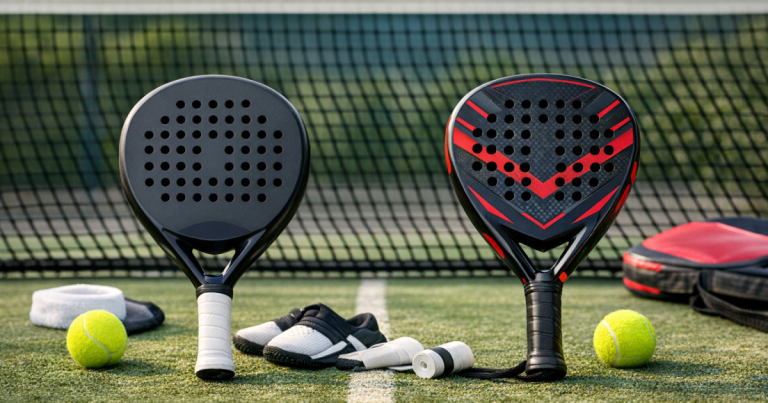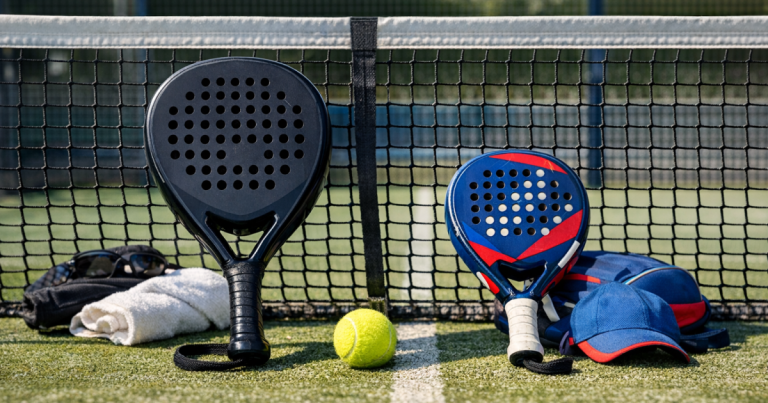
A padel racket can feel confusing at first because it has no strings, a thick face and a short handle, so understanding padel racket anatomy helps you connect what you feel in your hand with what happens to the ball. Once the parts make sense, terms like balance, sweet spot, core and frame stop sounding like marketing and start becoming useful.
The main idea is simple: the racket’s shape, weight, balance, face, core and grip all affect how easy it is to control the ball, generate power and defend under pressure. Beginners usually benefit from comfort, forgiveness and control before chasing extra speed.
At a glance
- The frame gives the racket its structure and affects stability when you hit off-centre.
- The face is the flat hitting surface, usually with holes through it to manage weight and aerodynamics.
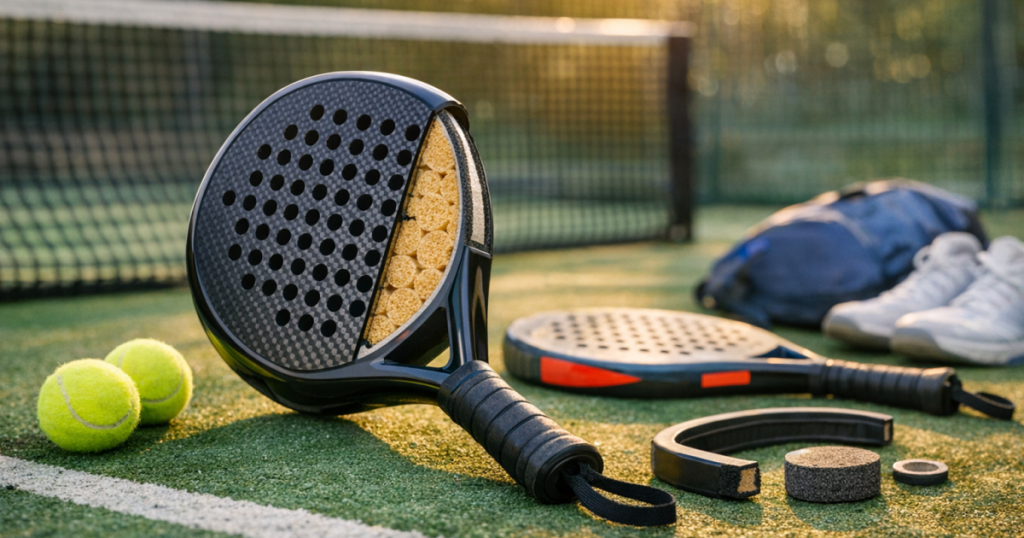
- The core sits inside the racket and has a big influence on feel, comfort and rebound.
- The sweet spot is the most forgiving hitting zone, not a physical part you can see.
- Balance describes where the weight feels concentrated: towards the handle, centre or head.
- The grip and wrist strap affect comfort, security and how confidently you can swing.
The frame: the racket’s skeleton
The frame is the outer structure around the racket. It helps the racket hold its shape and gives support to the hitting face. A stiffer-feeling frame can make a racket feel more direct, while a more forgiving feel can be kinder when your timing is still developing.
For new players, frame behaviour matters most on imperfect contact. If you often catch the ball near the edge, a very demanding racket can feel harsh or unstable. A more forgiving design gives you a better chance of keeping the ball in play, which is usually more helpful than extra power in your first few months.
The outer edge may include a protector or bumper area. This helps reduce wear from light scrapes against the glass, court surface or side fence, but it is not a licence to be careless. Padel courts are compact, and beginners often misjudge spacing when learning to defend near the walls.
The face: where contact happens
The face is the broad hitting surface. Unlike a tennis racket, it does not use strings. The ball compresses against the face and core, then rebounds. That is why padel rackets can feel so different even when they look similar from a distance.
The face normally has a pattern of holes. These reduce weight and influence how the racket moves through the air. Hole size, number and placement vary by model, but beginners do not need to obsess over the pattern. It is more useful to ask whether the racket feels stable, comfortable and easy to manoeuvre.
Surface texture is another visible feature. Some rackets have a smoother face, while others have a rougher finish intended to help with spin. Technique still matters far more than texture. If your swing path, timing and contact point are inconsistent, a rough face will not magically create reliable spin.
The core: why two rackets can feel completely different
The core is the material inside the racket, between the two faces. It plays a major role in how firm, soft, lively or muted the racket feels. You cannot assess it properly just by looking at the racket on a shop wall.
A softer-feeling core can make low-speed shots feel more comfortable and forgiving. That can suit beginners who are still building confidence with volleys, blocks and defensive lobs. A firmer-feeling core can offer a more direct response, but it may feel less friendly if you are late to the ball or hit outside the centre.
This is one reason borrowing a racket for a session can be so useful. Five minutes of gentle hitting tells you very little. Try serves, volleys, lobs, bandejas if you use them, and defensive shots after the ball comes off the glass. That gives you a more realistic sense of how the core behaves in normal play.
The sweet spot: forgiveness in real match situations
The sweet spot is the area of the face where contact feels cleanest and most controlled. It is not marked on the racket, and it is not always exactly in the visual centre. Racket shape and balance both affect where it feels.
For beginners, a generous sweet spot is valuable because padel is full of awkward contact: reaching for volleys, blocking fast balls, defending after the side wall, or trying to lob when under pressure. A forgiving racket helps you keep more rallies alive while your footwork and positioning improve.
If you regularly feel the racket twisting in your hand, or the ball drops short when you miss the centre, the sweet spot may be too demanding for your current level. That does not mean the racket is poor. It may simply be aimed at a player who already makes cleaner contact more often.
Shape: round, teardrop and diamond
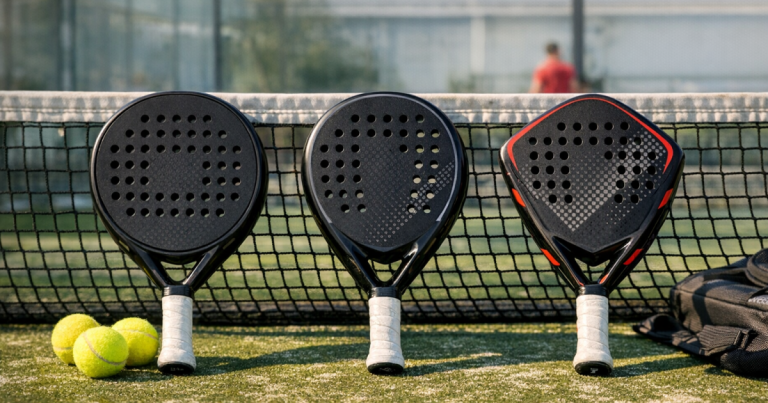
Racket shape is one of the easiest features to spot. It also gives a rough clue about how the racket may play, although every model should still be judged on feel rather than shape alone.
- Round rackets: Usually associated with control, lower balance and a more forgiving sweet spot. They are often the easiest starting point for beginners.
- Teardrop rackets: A middle-ground shape that can offer a blend of control and power. Some early-stage players move into this style once their timing improves.
- Diamond rackets: Commonly linked with higher balance and more attacking power. They can feel less forgiving if you are still learning to contact the ball cleanly.
Shape is useful, but it should not be your only filter. A comfortable teardrop racket may feel easier than a stiff round one, depending on its weight, balance and core. If you are buying your first racket, it is worth reading about common padel racket buying mistakes before assuming the most powerful-looking option will help you improve faster.
Weight and balance: why manoeuvrability matters
Weight is the number you can measure, usually shown in grams. Balance is how that weight feels when you hold and swing the racket. Two rackets with similar listed weights can feel very different if one carries more mass towards the head.
A head-light or evenly balanced racket is often easier to move quickly at the net and on defensive blocks. A head-heavy racket can feel more powerful on overheads, but it may also feel slower when you are reacting to fast shots. For beginners, manoeuvrability is not a luxury. It helps you prepare earlier, adjust the racket face and avoid rushed swings.
If your wrist, forearm or shoulder feels tired unusually quickly, the racket may be too heavy, too head-heavy, or simply not right for your swing. Do not ignore that feedback. Comfort is part of performance, because a racket you can control for a full session is more useful than one that only feels impressive for a few smashes.
The grip, handle and wrist strap
The handle on a padel racket is shorter than many beginners expect. That compact handle helps with quick reactions and close control, but it also means grip setup matters. A grip that is too thin can make you squeeze harder. A grip that is too thick can reduce feel and make quick changes harder.
Overgrips are commonly used to fine-tune thickness and absorb sweat. They are inexpensive compared with rackets, so replacing them regularly is one of the simplest ways to keep your racket feeling secure. If the grip feels slippery, flattened or uncomfortable, your shots may suffer even if the racket itself is perfectly suitable.
The wrist strap is a safety and control feature. Put it on before you start hitting, especially in club games where players are close to the net and glass. It should feel secure without distracting you.
How the parts change the way a racket plays
Racket feel is the result of several parts working together. That is why single features can be misleading. A round shape suggests control, but a stiff face and high balance may still feel demanding. A softer core may feel comfortable, but if the racket is too heavy for you, it will still be hard to use well.
Here are a few real-world examples of how the anatomy translates on court:
- Blocking fast volleys: A stable frame and forgiving sweet spot help the ball rebound cleanly without needing a big swing.
- Defending off the glass: A manoeuvrable racket helps you adjust late when the ball comes off the back or side wall differently than expected.
- Lobbing under pressure: A comfortable face and core make it easier to guide the ball high without snatching at it.
- Attacking overheads: Higher balance and a firmer response can add punch, but only if you are set up early and striking cleanly.
- Long club sessions: Sensible weight, grip comfort and vibration feel become more important as fatigue builds.
Your playing level also changes what matters. A first-time player may need forgiveness above all else, while a regular improver may start wanting more precision or extra help in attack. If you are unsure what standard of game you should be joining, the guide to padel player levels can help you match your racket expectations to the games you are actually playing.
Simple checks before changing racket
Before blaming your racket, check whether the issue appears across different shots and sessions. One bad match does not prove your equipment is wrong. Patterns are more useful.
- Control problem: If balls fly long even on gentle swings, the racket may feel too lively for your current touch.
- Depth problem: If defensive shots regularly drop short, you may need better technique, a more forgiving sweet spot, or both.
- Timing problem: If you are late at the net, the racket may be too slow to manoeuvre, or your ready position may need work.
- Comfort problem: If the racket feels harsh or tiring, look at weight, balance, grip thickness and how firmly you are holding it.
- Confidence problem: If you are afraid to swing through the ball, a simpler, more forgiving setup may suit you better.
Cost is another sensible check. You do not need to pay for advanced features before you can use them. A modest, comfortable starter racket plus decent balls and proper shoes is often a better use of money than spending most of your budget on one impressive-looking racket. For a broader view, see the breakdown of padel equipment costs.
Things readers ask
Does a beginner need a round racket?
Not always, but a round racket is often a sensible place to start because it usually feels forgiving and easy to control. A comfortable teardrop racket can also work if it is not too heavy or head-heavy.
Is a heavier racket more powerful?
It can be, but only if you can swing it on time and control the face. For many beginners, a slightly easier-to-move racket produces better shots because preparation is quicker and contact is cleaner.
Can the sweet spot make a big difference?
Yes. A larger, more forgiving sweet spot helps when contact is imperfect, which happens often while learning. It can make volleys, blocks and defensive shots feel less punishing.
Should I choose a rough face for more spin?
Only if the racket also feels comfortable and controllable. Spin mainly comes from technique, timing and swing path, so surface texture should be a secondary detail for early-stage players.
How do I know when to upgrade?
Upgrade when your current racket is clearly limiting you across several sessions, not just after one frustrating game. Look for repeated issues with comfort, manoeuvrability, control or the type of shots you now play more often.
Main lessons
Once padel racket anatomy is clear, racket choice becomes much less mysterious. The frame gives stability, the face and core shape the feel, the sweet spot affects forgiveness, and weight plus balance decide how easy the racket is to move in real rallies.
For most beginners, the best-performing racket is not the most powerful one. It is the one that helps you prepare early, contact the ball cleanly, defend calmly and enjoy longer rallies while your game develops. Start with comfort and control, then let your future playing style guide any upgrades.