Buying your first racket can feel oddly harder than learning the glass rebound. There are different shapes, weights, surfaces and price points, and plenty of confident opinions from players who already know what they like. Most padel racket buying mistakes happen when beginners copy advanced players instead of choosing something that makes the first few months easier.
A good starter racket should help you get the ball back, protect your confidence, and let you develop clean technique. It does not need to be the most powerful, the stiffest, or the most expensive option on the shelf.
The short version
- Choose control and comfort before power.
- Do not buy a racket just because a strong player uses it.
- Be cautious with very heavy, hard or head-heavy rackets while you are still building technique.
- Check the grip, balance and feel in your hand, not only the brand name.
- Spend enough for a reliable beginner racket, but keep budget back for lessons, court time and balls.
- Try a club loan racket or demo racket before committing if you can.
Mistake 1: choosing power before control
Beginners often assume a more powerful racket will make padel easier. In reality, power is not very useful if you cannot consistently find the middle of the racket or control the ball after it hits the glass. A racket that launches the ball too easily can make lobs sail long, volleys pop up, and returns feel rushed.
Control-friendly rackets usually feel easier at low and medium swing speeds. They help you guide the ball, keep rallies going and learn the difference between blocking, pushing and attacking. That matters more than hitting one spectacular smash every few games.
As a rule, your first racket should make simple shots feel calmer. If you test a racket and your timing immediately feels late, your wrist feels busy, or your defensive shots keep flying, it may be too demanding for your current level.
Mistake 2: copying professional or advanced players
It is tempting to buy the racket used by a favourite player or the strongest person at your club. The problem is that advanced players usually have faster preparation, stronger wrists, better footwork and a clearer idea of how they want the racket to respond.
Many performance rackets are built around a specific trade-off: more power but less forgiveness, a firmer strike but less comfort, or a higher balance that rewards a committed swing. Those things can be useful later, but they can punish a new player who is still learning positioning and shot selection.
Instead of asking, “What racket do good players use?”, ask, “What racket helps me hit ten steady balls in a row?” That question is far more useful during your first season of regular padel.
Mistake 3: ignoring racket shape
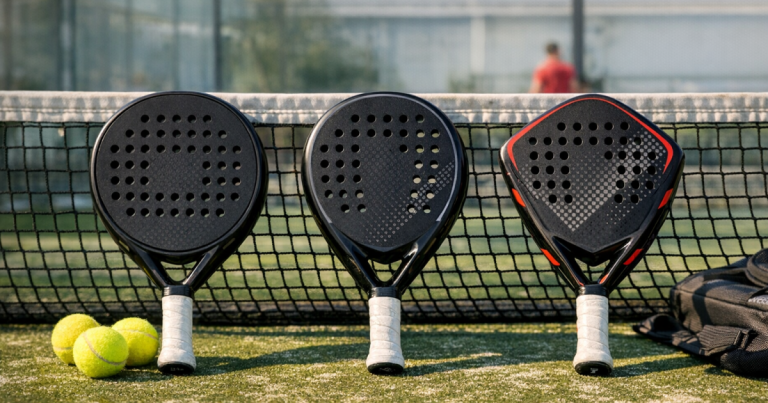
Padel rackets are commonly described as round, teardrop or diamond-shaped. The labels are not perfect because every model feels different, but they are still helpful for beginners.
- Round rackets usually place the sweet spot closer to the centre and are often the easiest shape for new players to control.
- Teardrop rackets can offer a middle ground, but some still feel quite attacking depending on their balance and construction.
- Diamond rackets are often associated with power and a higher sweet spot, which can be less forgiving if your contact point is inconsistent.
A beginner does not have to choose a round racket forever. But for first lessons, social matches and early club sessions, a forgiving shape can reduce frustration and make technical feedback easier to apply.
Mistake 4: treating weight as a minor detail
Weight affects more than power. It changes how quickly you can react at the net, how comfortable defensive blocks feel, and how tired your arm feels during longer sessions. Two rackets can look similar but feel very different once you start volleying repeatedly.
A heavier racket may feel stable when you hold it for thirty seconds in a shop, but padel involves quick reactions, awkward defensive positions and lots of small adjustments. If the racket feels slow during fast exchanges, your technique may start to compensate in unhelpful ways.
Do not judge weight in isolation, either. Balance matters. A racket with more weight towards the head can feel more demanding than its listed weight suggests. If you are unsure, prioritise a racket that feels easy to manoeuvre rather than one that feels impressive for a single hard hit.
Mistake 5: overlooking grip size and handle feel
Padel rackets usually have relatively slim handles, and many players customise the feel with one or more overgrips. Beginners sometimes ignore this and play with a grip that is too thin, slippery or uncomfortable.
A poor grip can make you squeeze too hard. That tension travels into your forearm, slows down your reactions, and makes soft shots harder. You should be able to hold the racket securely without feeling as though you are clamping it.
Before buying, check whether the handle feels stable in your hand. If the racket twists on off-centre contact, an overgrip may help, but do not use layers of grip to rescue a racket that otherwise feels wrong. Grip comfort is part of racket suitability, not an afterthought.
Mistake 6: spending the whole budget on the racket
A better racket will not replace court time, coaching or good footwear. For a new player, the smartest budget is often spread across the things that help you play more often and learn more cleanly.
If you are deciding between a very expensive racket and a sensible starter racket plus lessons, the second option is usually more productive. Coaching can help you understand positioning, glass use and shot choice, which will make any suitable racket perform better in your hands.
Used gear can also make sense, provided the racket is in good condition and has no obvious cracks, soft spots or major frame damage. For a deeper look at when second-hand equipment is worth considering, read our guide to new versus used padel gear.
Mistake 7: buying without trying anything first
Even a well-reviewed racket can feel wrong to you. Hand size, swing style, strength, confidence and playing frequency all affect what feels comfortable. That is why a short test can be more useful than a long list of specifications.
If your local club offers loan rackets, use them deliberately. Do not only ask whether you won the game. Notice whether volleys feel stable, whether lobs are easy to control, whether the racket feels quick when defending, and whether your arm feels relaxed afterwards.
If you are still choosing where to play regularly, racket access is one small but useful factor. Some clubs have better starter equipment, more beginner sessions and coaches who can explain what you are feeling. Our article on choosing your first padel club covers those practical details.
Mistake 8: reading specs without understanding feel
Specifications can help narrow things down, but they do not tell the whole story. Terms such as carbon, fibreglass, soft core, hard core, balance and sweet spot are useful only when connected to how the racket behaves on court.
For example, a new player browsing rackets such as Head Evo Speed, Nox X-One Evo or Bullpadel Indiga CTR should still check the current model details, listed weight range, return policy and whether the racket feels comfortable when hitting real balls. The name on the frame is less important than the response in your hand.
Be especially careful with vague claims such as “maximum power” or “professional feel”. They may be accurate for the intended player, but that player might not be a beginner building consistency from the back glass.
Mistake 9: forgetting how quickly your needs may change
Your first racket does not have to be your forever racket. During the first few months, your priorities are usually comfort, contact quality and confidence. As you improve, you may start wanting a different balance, firmer response or more help when attacking.
That does not mean you should buy the most advanced racket now to “grow into it”. Playing with a demanding racket too early can slow your progress because you spend more energy managing the equipment than learning the game.
A sensible starter racket gives you a clean baseline. Once your technique is steadier and you know whether you prefer defending, volleying, lobbing or attacking, your next racket choice becomes much easier.
What the evidence from real beginner play suggests
Across beginner sessions, the same pattern appears again and again: players improve faster when their racket lets them relax. They make better decisions when they are not fighting the frame, and they listen to coaching more effectively when every shot does not feel unpredictable.
The best early sign is not raw speed. It is repeatability. Can you return a controlled serve? Can you block a volley without panic? Can you lob without swinging wildly? Can you defend off the glass without feeling late every time? If a racket helps with those answers, it is doing its job.
Simple solo practice can also reveal whether your racket is too lively or too difficult to control. If you use rebound practice between club sessions, keep the space safe and the intensity sensible; our guide to safe wall-practice habits explains how to avoid turning useful repetition into bad habits.
Common questions
How much should a beginner spend on a padel racket in the UK?
Many beginners can find a suitable starter racket without going to the top of the price range. Set a budget that still leaves money for court time, coaching, balls and basic accessories. Check current UK prices and avoid buying purely because a large discount makes a demanding racket look like better value.
Is a round racket always best for a new player?
Not always, but it is often the safest starting point. A comfortable teardrop racket can work well for some beginners, especially if it still feels easy to control. Diamond-shaped rackets are usually worth approaching more carefully until your timing improves.
Should I buy a racket online or from a club shop?
Online buying can offer more choice, while a club shop may let you hold or test rackets before deciding. Whichever route you choose, check the return policy, exact model details and whether the racket suits beginner-level control rather than just looking good in photos.
How do I know if my racket is too advanced for me?
Common signs include late reactions, frequent off-centre hits, a tired arm, poor control on lobs, and feeling as though you need to swing hard to make the racket work. If your simple shots become harder, the racket may be working against you.
When should I upgrade from my first racket?
Upgrade when you understand what your current racket limits. If you can explain whether you want more stability, a firmer feel, a different balance or more attacking help, you are ready to choose more precisely.
What to remember
The most common padel racket buying mistakes come from rushing towards power, prestige or discounts before understanding feel. Your first racket should make padel easier to learn, not harder to survive.
Prioritise comfort, control, manageable weight and a forgiving response. Try before buying when possible, be honest about your current level, and treat the racket as one part of your development rather than the whole solution. The right first choice is not the flashiest frame; it is the one that helps you play more relaxed, more often and with better habits.